

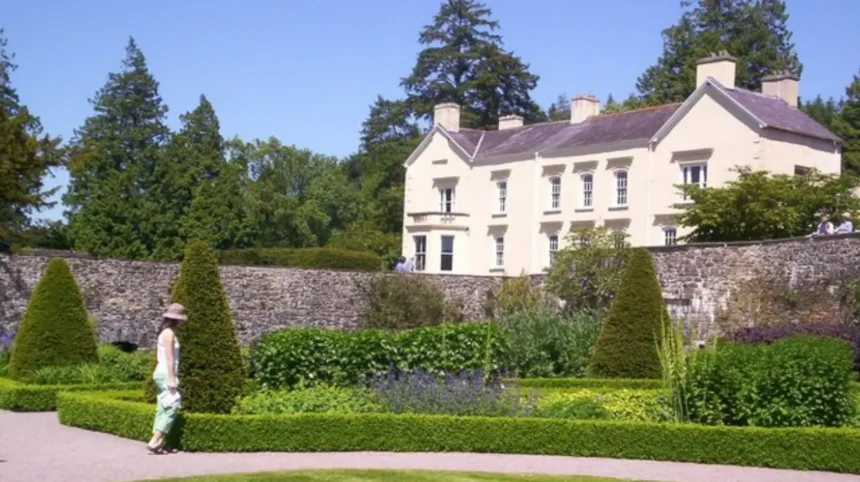
Aberglasney is a historic ten-acre heritage estate and botanical garden located in Llangathen within the Tywi Valley of Carmarthenshire, Wales. The property features a Grade II* listed medieval mansion alongside twenty distinct horticultural environments, including the only surviving Elizabethan cloister garden in the United Kingdom.
- What Is the Historical Significance of Aberglasney House and Gardens?
- Where Is Aberglasney Located within Carmarthenshire Wales?
- What Architectural Features Define the Aberglasney Estate?
- How Is the Subtropical Ninfarium Designed and Maintained?
- What Distinct Garden Zones Exist within Aberglasney?
- What Plant Collections and Botanical Species are Cultivated at Aberglasney?
- How Does the Aberglasney Restoration Trust Manage Conservation Efforts?
- What Role Does Aberglasney Play in Carmarthenshire Tourism and Economy?
- Frequently Asked Questions
- What are the opening hours and entry requirements for visiting Aberglasney Gardens?
- Are dogs allowed inside Aberglasney House and Gardens?
- How accessible are the pathways at Aberglasney for wheelchair users and strollers?
- How long does a typical visit to Aberglasney Gardens take?
- Is there dining available on site at Aberglasney Gardens?
Aberglasney functions as a living museum of landscape design spanning over five hundred years of British horticultural history. Managed by the Aberglasney Restoration Trust, the site serves as a center for botanical conservation, historical research, and regional tourism.
What Is the Historical Significance of Aberglasney House and Gardens?
Aberglasney represents one of the most complete physical records of continuous landscape design and architectural evolution in West Wales. The site provides documented physical evidence of land usage transitioning from a medieval gentry stronghold to an Elizabethan bishop’s residence, an eighteenth-century gentry estate, and a modern botanical restoration project.
Poetic references to the site date back to 1477, when the Welsh bard Lewis Glyn Cothi wrote of a grand residence encircled by nine green gardens, orchards, and ancient oaks in Llangathen. In the early sixteenth century, Sir William ap Thomas, High Sheriff of Carmarthenshire, expanded the original structural foundation before the estate transitioned to ecclesiastical ownership. Anthony Rudd, Bishop of uk/local/st-davids/">St Davids, purchased the property in 1594 and constructed the present mansion and formal garden layout, including the unique arcade structures that define the grounds.
During the eighteenth century, the estate belonged to the Dyer family. Landscape poet John Dyer celebrated the surrounding topography in his 1726 poem Grongar Hill, bringing national literary attention to the Tywi Valley.
The estate suffered severe decay during the mid-twentieth century after being requisitioned by the British Army for military housing during World War II. Following decades of abandonment and vandalism, the property was purchased in 1995 by the Aberglasney Restoration Trust. Archeological excavation and architectural stabilization began immediately, leading to the public opening of the restored grounds in 1999. The restoration project received national media coverage through the BBC documentary series A Garden Lost in Time, which cataloged the rescue of the lost Elizabethan features.
Where Is Aberglasney Located within Carmarthenshire Wales?
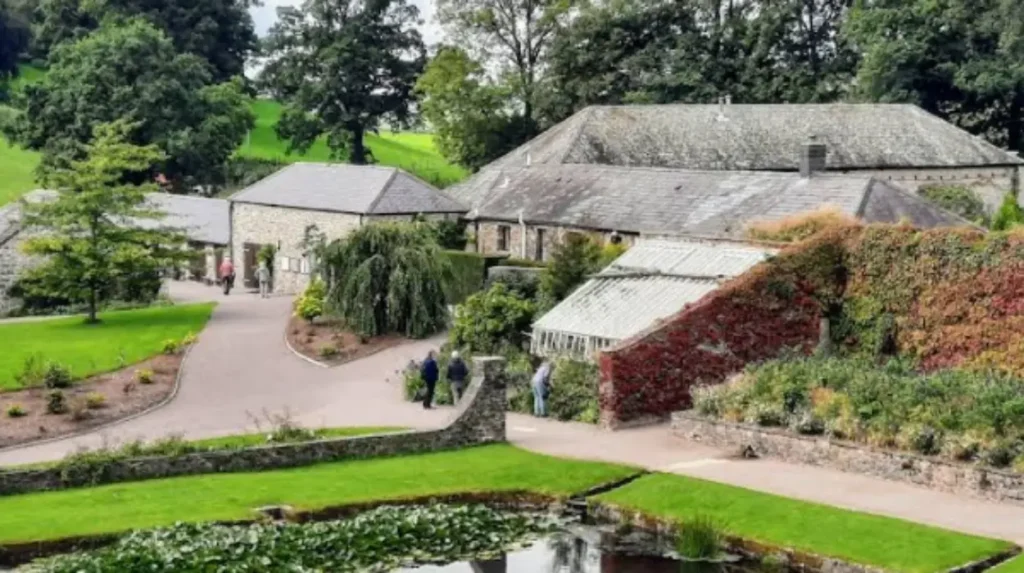
Aberglasney sits in the center of the Tywi Valley, positioned precisely between the market towns of Llandeilo and Carmarthen in southwest Wales. The geographic coordinates place the estate within the parish of Llangathen along the northern bank of the River Tywi.
The estate covers ten acres of formal grounds surrounded by agricultural floodplains and wooded hills. The site lies approximately three miles west of Llandeilo and twelve miles east of Carmarthen town. Route A40 provides the main vehicular access corridor linking the property to the regional road network.
The local topography features rich alluvial soils and a temperate maritime microclimate moderated by proximity to the Bristol Channel. High annual rainfall and mild winter temperatures in the valley create ideal growing conditions for both native European species and exotic subtropical flora. The elevation of the garden varies across its terraced hillside, sloping downward from the northern boundary toward the central courtyard and southern valley floor.
What Architectural Features Define the Aberglasney Estate?
The architectural identity of Aberglasney stems from the survival of structural stonework dating from the late sixteenth and early seventeenth centuries integrated into later Georgian and Victorian modifications.
The central structure is the Grade II* listed mansion house, which features a heavy masonry shell rebuilt in the Queen Anne style during the early 1700s over an earlier Elizabethan floor plan. The exterior walls consist of local Carmarthenshire limestone and sandstone rubble with cut stone dressings.
The most significant architectural element on the property is the Elizabethan Cloister Garden. This structure consists of a raised parapet walkway supported by arcaded stone walls enclosing a square central lawn. Archeological investigation confirmed that this double-tiered walkway was built around 1600 under the direction of Bishop Anthony Rudd. It remains the only fully intact example of a raised Elizabethan cloister garden in the United Kingdom.
Additional key structural components include:
- The Gatehouse and Forecourt Wall: A freestanding stone entry structure originally connected to early defensive outer walls.
- The Pool Garden: A formal rectangular water basin enclosed by high stone retainers, constructed in the seventeenth century.
- The Aviary and Pigeon House: Historic stone utility enclosures integrated into the northern perimeter masonry.
- The Glasshouse Infrastructure: Modern frame structures built over the central ruins to stabilize masonry while regulating ambient humidity.
How Is the Subtropical Ninfarium Designed and Maintained?
The Ninfarium is an indoor subtropical garden constructed within the roofless, ruined central court of the Aberglasney mansion house. Built in 2005, the structure uses a high-span glass roof that seals the internal stone walls of the ruined ruin while leaving the masonry visible.
This design creates a controlled thermal environment that mimics Mediterranean and warm-temperate microclimates. The glass canopy captures solar heat, protecting sensitive plant varieties from frost, excess wind, and torrential winter rain.
The interior layout integrates botanical plantings directly into the exposed internal brick and stone walls of the former domestic rooms. Vertical planting techniques allow climbing vines, ferns, and epiphytic orchids to anchor into historic wall crevices without damaging structural integrity. Automated environmental controls monitor internal temperatures, venting heat through roof louvers during summer months and activating supplementary heating grids during sub-zero winter conditions.
The collection inside the Ninfarium includes palms, tree ferns, orchids, bougainvillea, and rare tender perennials sourced from regions including South America, Asia, and Australasia. Moisture levels are maintained through automated overhead misting systems that supply soft water directly to root structures and foliage.
What Distinct Garden Zones Exist within Aberglasney?
Aberglasney contains twenty distinct horticultural zones distributed across its ten-acre footprint. Each zone reflects a distinct historical style, planting philosophy, or microclimate condition.
The arrangement transitions systematically from formal, structured enclosures near the main house to naturalistic woodland habitats along the outer boundaries.The Primary Garden Zones are organized into three primary structural groupings:
Formal Enclosures
- The Cloister Garden: Features formal box hedges, gravel paths, and the raised stone parapet walk.
- The Sunken Garden: Contains geometric flower beds surrounding a central stone fountain basin.
- The Pool Garden: Features static water surfaces framed by moisture-loving perennials and clipped topiary.
Productive and Display Gardens
- The Kitchen Garden: A fully operational walled garden producing heirlooms, vegetables, soft fruits, and cut flowers used in the estate tearooms.
- The Rose Garden: Cultivates traditional bush, climbing, and shrub rose cultivars.
- The Herbaceous Borders: Long parallel borders displaying high-density summer perennials arranged by color spectrum.
Naturalistic Landscapes
- The Yew Tunnel: An ancient canopy formed by intertwined yew trees originally planted as a formal hedge in the early eighteenth century.
- The Asiatic Woodland Garden: Houses acid-loving plant species including Rhododendrons, Magnolias, and Camellias shaded by native canopy trees.
- The Stream Garden and Upper Woodland: Focuses on damp-ground flora, ferns, and native spring bulbs along running water channels.
What Plant Collections and Botanical Species are Cultivated at Aberglasney?
Aberglasney holds diverse plant collections curated for botanical rarity, seasonal succession, and adaptability to West Wales soil profiles. The living collection comprises thousands of individual plant species spanning broad taxonomic families.
The garden soil consists predominantly of acidic, nutrient-rich loam, which supports ericaceous plants in the woodland sections while responding well to soil conditioning in the formal beds.
Key plant groups cultivated across the estate include:
- Magnoliaceae: Extensive spring-flowering collections of Magnolia species in the woodland zone.
- Orchidaceae: Specialized displays of hardy and tender orchid species housed in the Ninfarium and glasshouses.
- Primulaceae: Massed plantings of Primula varieties lining the woodland stream banks.
- Taxaceae: Ancient specimens of Taxus baccata forming the historic Yew Tunnel.
- Rosaceae: Traditional varieties of garden roses and fruit trees in the kitchen garden.
Horticultural staff maintain a continuous flowering succession throughout the calendar year. Early spring brings snowdrops, narcissi, and hellebores, followed by herbaceous perennials, woodland displays, autumn foliage changes, and evergreen winter structures.
How Does the Aberglasney Restoration Trust Manage Conservation Efforts?
The Aberglasney Restoration Trust operates as a registered educational and heritage charity dedicated to preserving the estate. The Trust acquired the property in 1995 to prevent structural loss and land subdivision. Funding models rely on visitor admissions, annual memberships, commercial events, private donations, and heritage grants.
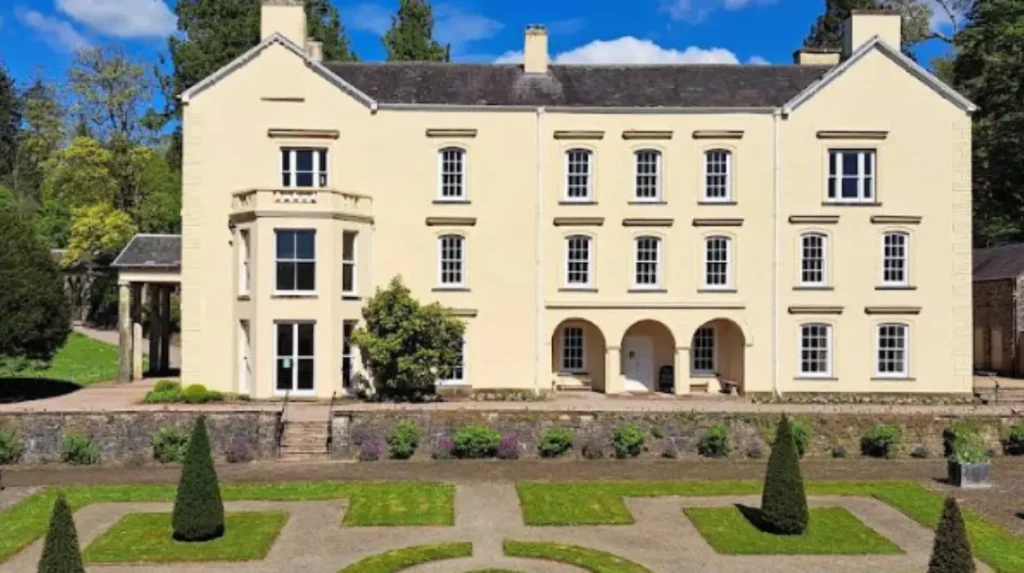
Conservation strategies focus on dual priorities: architectural preservation and ecological management. Masonry stabilization uses historic lime mortars to preserve original walls without trapping moisture. Horticultural teams prioritize organic soil enrichment, integrated pest management, and seed propagation from rare estate plants.
The Trust also participates in the Historic and Botanic Garden Training Programme. This initiative offers professional horticultural practical placements, training early-career gardeners in heritage restoration methods, propagation techniques, and historic garden management.
What Role Does Aberglasney Play in Carmarthenshire Tourism and Economy?
Aberglasney serves as an economic driver for the rural economy of Carmarthenshire and the broader West Wales region. The estate attracts tens of thousands of domestic and international visitors annually, contributing directly to regional hospitality, retail, and accommodation sectors.
The site provides direct employment for professional horticulturalists, administrative personnel, catering staff, and maintenance technicians. It also creates supply chain demand for regional food producers, building contractors, and transport services.
By offering year-round access across 364 days, Aberglasney mitigates seasonal swings in regional tourism. Cultural events, plant fairs, art exhibitions, and educational workshops held inside the restored mansion rooms ensure consistent visitor volume during autumn and winter months.
Frequently Asked Questions
What are the opening hours and entry requirements for visiting Aberglasney Gardens?
Aberglasney Gardens is open to the public 364 days a year, closing only on Christmas Day. Standard opening times begin at 10:00 AM daily, with seasonal closing hours varying between 4:30 PM in winter and 6:00 PM in summer. Admission tickets can be purchased at the gate upon arrival without requiring advance reservations.
Are dogs allowed inside Aberglasney House and Gardens?
Dogs are permitted entry into Aberglasney Gardens on designated dog-friendly days throughout the year and every Friday afternoon. Assistance dogs are allowed across the entire estate every day. Dogs must remain on short, non-extendable leads at all times to protect the plant collections.
How accessible are the pathways at Aberglasney for wheelchair users and strollers?
A significant portion of Aberglasney is fully accessible, featuring paved and smooth gravel pathways through the main gardens and lower grounds. Wheelchairs are available for visitor loan at the main entrance building upon request. Due to the historic architecture, certain terraced areas like the parapet walk involve steep stone steps.
How long does a typical visit to Aberglasney Gardens take?
A standard visitor tour of Aberglasney Gardens takes between two to three hours to walk through all twenty garden zones. Additional time is recommended for visitors wishing to explore art exhibitions in the mansion house or visit the tearooms.
Is there dining available on site at Aberglasney Gardens?
Aberglasney features an on-site tearoom overlooking the historic Pool Garden. The tearoom serves hot meals, drinks, cakes, and light lunches prepared with fresh ingredients grown in the estate kitchen garden. Visitors can access the dining facilities with standard garden admission.