
Key Points
- Swansea council is putting up 20 artificial intelligence roadside feedback signs at critical accident locations during 2026.
- SWARCO produces the signs that use digital as well as thermal vision sensors to detect the difference between motorcycles and other vehicles.
- The system will display speed information in green color if vehicles are travelling at legal speeds but if the vehicles are speeding then the sign turns red with flashing amber light and the bilingual warning “SLOW / ARAF”.
- These signs will not be used to enforce fines against speeding violations.
- Welsh government funding for road safety is enabling the installation of the devices after conducting a successful pilot program at Carmarthen Road, Cwmdu.
- Casualty statistics in the area show that motorcycles were responsible for around 16% of total collisions in Swansea in 2024, higher than the Welsh national average of 12%.
Swansea (Wales Times) August 28, 2026 — AI cameras are being introduced across twenty of the city’s most hazardous road corridors as uk/local/swansea/swansea-council/">Swansea Council deploys dedicated vehicle-recognition technology to reduce collisions. The roadside units are engineered to detect approaching motorbikes in mixed traffic flows and project real-time speed data directly into the rider’s forward view. Initial operational locations include Carmarthen Road at Waun Wen, Pontarddulais Road along the A483 in Fforestfach, the B4560 Swansea Road at Llewitha, and Gorseinon Road in Penllergaer.
- Key Points
- How Do Swansea’s AI Motorcycle Speed Feedback Signs Work?
- Will Motorcyclists Receive Fines or Speeding Tickets from the AI Cameras?
- Where Are the AI Road Safety Cameras Located in Swansea?
- What Does Casualty Data Reveal About Motorcycle Safety in Wales?
- Background of Swansea Motorcycle Safety Initiatives
- Predictions for Road Safety and Motorcyclists Across South West Wales
How Do Swansea’s AI Motorcycle Speed Feedback Signs Work?
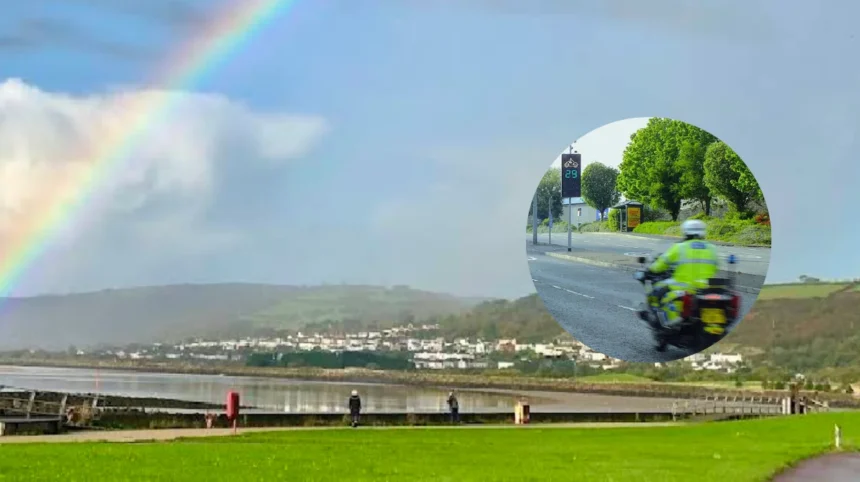
The roadside displays integrate thermal imaging with digital optical sensors and artificial intelligence algorithms to differentiate two-wheeled motor vehicles from standard cars, vans, and heavy goods vehicles. As an approaching motorcyclist enters the detection zone, the sensor assesses travelling speed and displays the reading in high-contrast digital numbering directly within the rider’s central gaze.
When a motorcycle travels at or below the posted legal speed limit, the digital indicator displays the numeric value in green. If the rider exceeds the legal threshold, the numeric visual immediately shifts to red, activating flashing amber warning beacons alongside bilingual road safety text reading “SLOW / ARAF”. The hardware has been positioned specifically to allow riders to register their current speed without diverting attention away from bends, side junctions, road surface hazards, or surrounding traffic.
Will Motorcyclists Receive Fines or Speeding Tickets from the AI Cameras?
The local authority has confirmed that the newly installed AI monitors are non-enforcement devices designed purely to assist rider self-regulation rather than issue fixed penalty notices. The technology does not record licence plate numbers for prosecution or transmit penalty data to South Wales Police.
As reported by the editorial staff of Swansea Bay News, Cllr Andrew Stevens, Swansea Council’s Cabinet Member for Environment and Infrastructure, stated:
“Motorcyclists are among the most vulnerable road users and we want to do all we can to reduce the risk of serious collisions on Swansea’s roads. This new technology gives riders a clear, real-time reminder of their speed at locations where our road safety data tells us extra support is needed. It is not about enforcement; it is about using innovation to help riders make safer decisions and reduce the chance of a collision.”
Where Are the AI Road Safety Cameras Located in Swansea?
The municipal deployment focuses on specific stretches identified through historical collision logs, elevated average speed readings, popular motorcycle transit routes, and road geometries characterized by open layouts or long straight sections that encourage throttle opening.
| Location Route | District Area | Selection Rationale |
|---|---|---|
| Carmarthen Road | Waun Wen | Historic collision data and high urban traffic density |
| A483 Pontarddulais Road | Fforestfach | High-volume arterial corridor with multiple junction conflict points |
| B4560 Swansea Road | Llewitha | Sub-arterial commuter corridor with open sightlines |
| Gorseinon Road | Penllergaer | Popular transit route linking residential and motorway networks |
| Carmarthen Road | Cwmdu | Former trial site where two rider fatalities occurred over 15 years |
What Does Casualty Data Reveal About Motorcycle Safety in Wales?
The infrastructure initiative follows analysis of official casualty records showing disproportionate incident rates for two-wheeled motor vehicles in the region. Swansea Council’s annual evaluation of police incident records revealed that motorcycles were involved in nearly 16% of all recorded road traffic collisions across Swansea in 2024, significantly higher than the broader Welsh national average of 12%. Across Wales as a whole, official statistics recorded 484 motorcycle casualties out of a total of 4,005 overall road casualties during the same twelve-month reporting period.
The roll-out follows live-environment prototype testing conducted on Carmarthen Road in Cwmdu, an area where two motorcyclists suffered fatal injuries over the preceding fifteen years. The testing framework involved collaboration between Swansea Council’s road safety specialists and the South Wales Police BikeSafe team to assess device accuracy and rider visual response in real traffic conditions. Financial backing for the equipment is provided through Welsh Government road safety grant allocations, with roadside hardware manufactured and supplied by traffic technology firm SWARCO. The municipal safety strategy also continues to fund and promote local BikeSafe rider training workshops alongside technological interventions.
Background of Swansea Motorcycle Safety Initiatives
Road safety authorities across South Wales have steadily expanded targeted intervention programmes over the past decade to address vulnerable road user vulnerability. Motorcyclists remain statistically over-represented in serious injury and fatality metrics across the United Kingdom relative to their total road traffic mileage.
In Wales, national and local transport directives have prioritised road layout modifications, advanced rider skill development courses such as BikeSafe and Dragon Rider, and public education campaigns to reduce casualty figures. The introduction of automated feedback hardware represents a transition toward intelligent transport systems that tailor active roadside notifications to specific vehicle types rather than relying exclusively on traditional static speed warning signs.
Predictions for Road Safety and Motorcyclists Across South West Wales
The deployment of targeted AI feedback technology is anticipated to alter local rider behaviour across major commuter and leisure arteries in Swansea. Because the signs provide immediate, high-visibility feedback tailored specifically to two-wheeled vehicles, compliance with posted speed limits is expected to improve along high-risk approaches, potentially reducing the frequency of severe braking incidents and loss-of-control collisions.
For local riders and commuters, the non-punitive nature of the infrastructure preserves positive engagement between road users and transport authorities while reinforcing hazard perception. If post-implementation data confirms a measurable decrease in casualty rates across the twenty designated corridors, similar intelligent recognition networks may be adopted by neighbouring local authorities across South West Wales and broader UK transport bodies seeking low-conflict road casualty reduction methods.