Key Points
- It looks like all the problems with fire defects and other construction flaws in Swansea’s 29-story Meridian Tower and the Meridian Quay buildings have been sorted out, claims Herald.Wales.
- The project consists of Meridian Tower, Meridian Bay and Meridian Wharf, and more than 200 leaseholders were informed that they will have to share the £5.1m bill for critical fire safety improvements.
- An improvement notice from Swansea Council demanded that remediation works be carried out, which included better internal compartmentalization and external fire breaks.
- The original developer Carillion went into liquidation, thus complicating the issue of who will have to carry the burden of the defects and repairs.
- Initially the leaseholders were offered to pay for the works via service charge, with demands reaching even £40,000; residents were advised not to pay by their lawyers until the liability insurance company was identified.
- However, according to a later agreement between Meridian Quay Management Company (MQMC) and East West Insurance Company (EWIC), funds for rectifying the fire proofing defects have been found without any costs for the leaseholders.
- The newest Herald.Wales article claims that the problem can now be sorted out.
Swansea Fire (Wales Times) October 13, 2026 – Fire defects and other long-standing problems at Meridian Tower and the surrounding Meridian Quay development in uk/local/swansea/">Swansea could finally be repaired, after years of legal disputes, insurance negotiations and financial pressure on leaseholders. As reported by Herald.Wales, the 29-storey residential tower and nearby blocks may now see the defects addressed following a prolonged battle over responsibility and funding.
The development, which includes Meridian Tower, Meridian Bay and Meridian Wharf, became the centre of a major building-safety dispute after fireproofing defects were identified. According to reporting by the Fire Protection Association, more than 200 leaseholders were told in September 2019 that they would collectively have to contribute towards a £5.1 million bill for urgent fire-safety works.
What Defects Were Found at Meridian Quay?
The issues included inadequate compartmentation between apartments and faulty firebreaks on the external structure. As reported by BBC News, Swansea Council’s improvement notice ordered internal compartmentation improvements to reduce the risk of fire spreading from one flat to another, as well as external firebreak improvements involving replacement brickwork.
WalesOnline later reported that the council notice set out defects including inadequate compartmentation between apartments and faulty external firebreaks. The reporting said the works were required to address the risk of fire spreading within and around the buildings.
The defects affected not only Meridian Tower, Wales’ tallest residential building, but also the neighbouring Meridian Bay and Meridian Wharf blocks. The Fire Protection Association reported that the initial £5.1 million bill related to urgent fireproofing work at Meridian Bay and Meridian Wharf, while a further bill for Meridian Tower was expected once its repair costs were established.
Why Did the Repairs Take Years?
The dispute became prolonged because the company that built the development, Carillion, had gone into liquidation. As reported by BBC News, Meridian Quay’s management companies said they had no choice but to seek money through leaseholders’ service charges while negotiating with insurers, because the original contractor was no longer available to carry out or fund the work.
The management company, Meridian Quay Management Company (MQMC), and its agent, Corporate Residential Management (CRM), said they were required to comply with improvement notices issued by Swansea Council. They said the notices required remedial work to begin in October 2019.
At the same time, the insurer East West Insurance Company said it was working closely with the managing agents to address the building defects. It said it could not comment on financial figures because the costs had not been finalised, but confirmed that all claims would be considered under the policy terms and conditions.
How Much Were Leaseholders Asked to Pay?
Leaseholders faced substantial demands. BBC News reported that flat owners were facing requests for up to £40,000 for fire-safety improvements, while some residents were asked for immediate payments of £17,000, with further costs expected the following year.
The Fire Protection Association reported that CRM initially said the bill needed to be paid by the end of September 2019, and that leaseholders were given only days to find thousands of pounds. It reported that CRM sought to recover at least part of the cost through service charges.
Legal representatives for some residents advised them not to pay. Martin Scott, of law firm Walker Morris, represented about 22 of the 265 leaseholders and told BBC News that the situation needed to be resolved by insurers carrying out what they had said they would do.
One resident, Christina Jehoratnam, told BBC Wales Live that she was losing sleep after being asked for £17,000 immediately, with more to follow. Her account was reported by BBC News as part of its coverage of the dispute.
Was an Agreement Reached With the Insurer?
Yes. Later reporting indicated that an agreement was reached between MQMC and East West Insurance Company to undertake the work. According to the Fire Protection Association, leaseholders were told at a meeting that the deal would “rectify” fireproofing issues.
The Fire Protection Association reported that leaseholders described the agreement as a “breakthrough” and praised MQMC for its “perseverance, resilience and tenacity”. Leaseholder Sian Thomas was reported as saying it was a “huge relief” that the insurance policy would respond in full to rectify the defects and that funding would now be in place to complete the necessary work at almost no cost to leaseholders.
The latest report by Herald.Wales says the fire defects and other issues could now finally be resolved after legal action and years of stress for leaseholders. The report does not provide a detailed construction timetable in the material available, but frames the development as a potential end point to the long-running dispute.
What Does This Mean for Residents Now?
For leaseholders, the reported progress may reduce the immediate prospect of further large personal bills for the fire-safety repairs. The earlier agreement reported by the Fire Protection Association indicated that insurance funding would cover the necessary work at almost no cost to leaseholders, although residents had previously faced years of uncertainty over service charges and liability.
The case also highlights how building defects can affect residents beyond immediate repair costs. Reporting by Swansea Bay News described leaseholders at Swansea waterfront developments as having faced difficulties selling flats, rising service charges and higher insurance premiums while safety issues remained unresolved.
Swansea Council has previously said it understood necessary works were being addressed and that it would not speculate on what action it might take if the improvement notice was not complied with.
Background of the Development
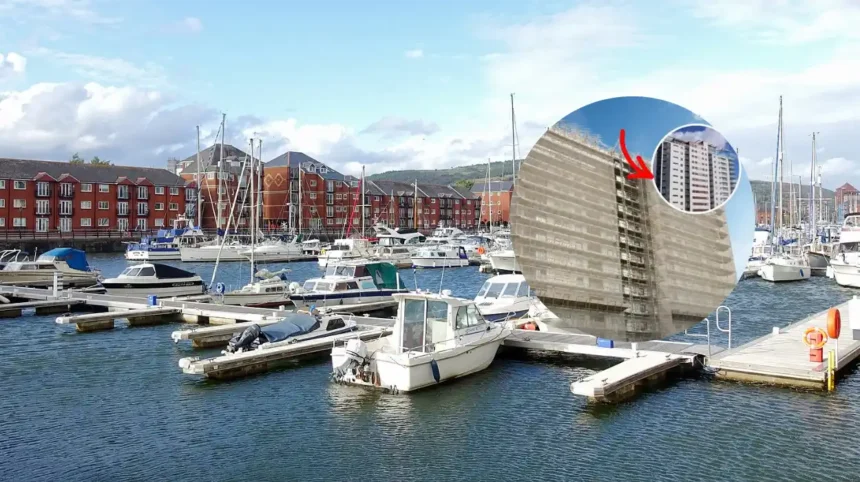
Meridian Tower is a 29-storey residential tower in Swansea and is described in reporting as Wales’ tallest residential building. It forms part of the wider Meridian Quay development, alongside Meridian Bay and Meridian Wharf.
The blocks were built by Carillion, which later entered liquidation. That collapse left residents, the management company and insurers to resolve who should pay for remediation after fire-safety defects were identified.
The dispute began to escalate publicly in 2019, when Swansea Council issued an improvement notice requiring more than £5 million of work at Meridian Quay. BBC News reported that the notice required internal compartmentation and external firebreak improvements, while the management companies said they needed to raise money through service charges to comply.
The case became one of several building-safety disputes in Swansea. Separate reporting by Nation.Cymru concerned the Aurora apartment block, where leaseholders pursued a High Court claim over alleged failures to identify defects and fire risks during construction; that case is distinct from Meridian Quay.
More recently, the Welsh Government has consulted on implementing the Building Safety (Wales) Act 2026. As reported by Swansea Bay News, the proposals include remediation orders, remediation contribution orders and measures intended to prevent leaseholders from paying for building-safety defects they did not cause.
Prediction: How Will This Affect Leaseholders?
If the reported resolution leads to completed repairs, Meridian Quay leaseholders could see greater certainty over both safety and finances. The most direct effect would be the remediation of compartmentation and firebreak defects, addressing the safety concerns identified in Swansea Council’s improvement notice.
The financial effect could also be significant. The earlier insurance agreement, as reported by the Fire Protection Association, suggested that funding would be in place to complete necessary work at almost no cost to leaseholders, which may ease concerns among residents who had faced demands running into tens of thousands of pounds.
For residents seeking to sell or remortgage, completed remediation may improve confidence in the buildings, although individual mortgage-lending decisions would depend on lenders’ own requirements and current building documentation. The broader Welsh policy direction, as reported by Swansea Bay News, is intended to reduce the burden on leaseholders for defects they did not cause, which could influence how similar disputes are handled in future.