


Bangor, the historic cathedral city nestled on the north Wales coast, captivates with its ancient roots and stunning natural surroundings along the Menai Strait. This evergreen gem in Gwynedd blends medieval heritage, academic vibrancy, and coastal charm, drawing visitors year-round for its timeless appeal.
Bangor’s Ancient Origins
uk/local/bangor/">Bangor’s story begins in the early 6th century when Saint Deiniol established a monastic community on the site now occupied by Bangor Cathedral, making it one of Britain’s oldest continuous Christian foundations. The name “Bangor” derives from an old Welsh word meaning a wattled enclosure, referring to the original structure that surrounded this sacred spot, granted by Maelgwn Gwynedd, king of the region. This monastery faced repeated devastation, sacked in 634 by Northumbrian forces and again in 1073, yet it endured as a beacon of faith amid turbulent times.
The site’s resilience underscores Bangor’s pivotal role in Welsh ecclesiastical history. By 973, the city entered royal records when Iago, ruler of Gwynedd, sought aid from England’s King Edgar, who mediated local power struggles while affirming the bishop’s endowments. Medieval bishops received charters granting fairs and manor lordship, fostering gradual settlement growth despite its modest scale until the 18th century. Viking threats likely influenced the low-lying, inconspicuous location of the early monastery, shielding it from sea raiders.
The Majestic Bangor Cathedral
Bangor Cathedral, dedicated to Saint Deiniol, stands as the city’s spiritual heart on a site of worship since around 530 AD. Though nothing of the original Celtic monastery survives, the present structure evolved through Norman rebuilding in the 12th century, aided by King Gruffudd ap Cynan, who funded expansions and was buried by the high altar in 1137. His son Owain Gwynedd and brother Cadwaladr also rest here, linking the cathedral to Gwynedd’s ruling dynasty.
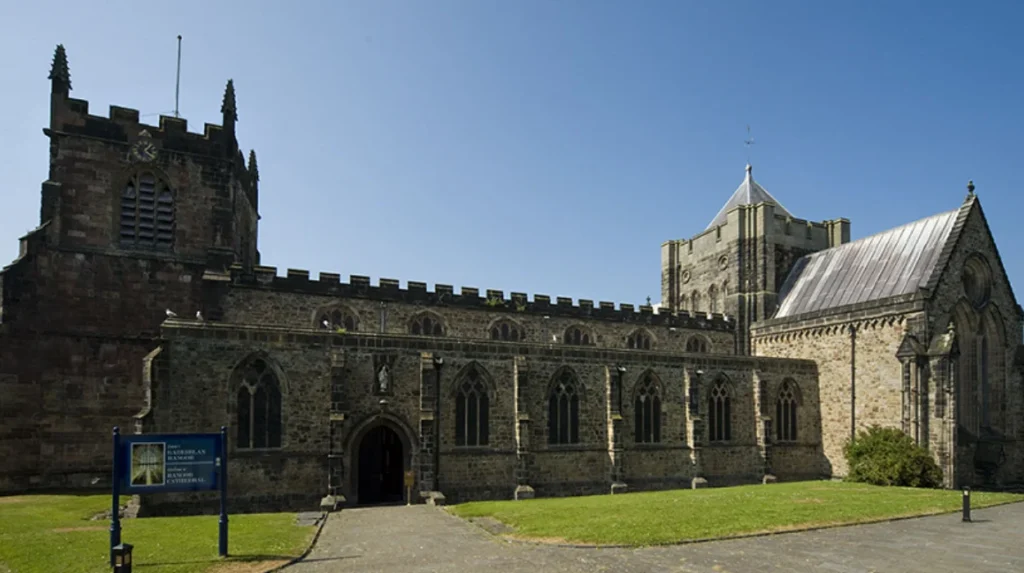
Extensive 19th-century restorations by Sir George Gilbert Scott from 1868 transformed its Gothic features, including soaring columns, stained glass, and a 15th-century oak “Mostyn Christ” carving depicting a pensive figure prior to the Crucifixion. The 1532 tower, built by Bishop Skevington, anchors the medieval-Victorian fabric, while Robert Thompson’s signature carved mice add whimsical detail. A Biblical Garden in the grounds features plants from scripture, enhancing its serene appeal.
The cathedral’s organ, rebuilt multiple times since the 14th century, supports a vibrant choral tradition, with bilingual services reflecting Bangor’s cultural duality. During the COVID-19 pandemic, it served as a vaccination centre, illustrating its ongoing civic role.
Geographical Splendor
Perched between Snowdonia’s mountains and the Menai Strait, Bangor enjoys a dramatic coastal setting separating mainland Gwynedd from Anglesey. Bangor Mountain rises 117 meters to the east, while suburbs like Maesgeirchen hug Port Penrhyn, a historic slate export hub. Rivers Adda and Cegin weave through, with the Adda largely culverted and Cegin feeding the port.
This locale offers sweeping strait views, bridged by Thomas Telford’s 1826 Menai Suspension Bridge and Robert Stephenson’s Britannia Bridge, vital links to Anglesey. Proximity to Snowdonia National Park, just miles away, provides easy access to hiking trails and peaks, blending urban life with wild landscapes. The area’s mild maritime climate supports year-round exploration, from strait sunsets to mountain vistas.
Population and Community
At the 2021 census, Bangor’s community numbered 15,060, with the built-up area reaching 16,990, marking it as one of Wales’ smaller cities by prescriptive right. Recent estimates suggest around 18,682 in the urban zone, reflecting steady growth driven by students and professionals. Ethnically diverse, 85% identify as White British, with 15% from Asian, mixed, Black, or other backgrounds, higher than many Welsh peers.
Gwynedd boasts Wales’ highest Welsh-speaking rate at 65.4%, but Bangor’s stands at about 44.1% for those over three, influenced by its student influx and anglicisation since the 1970s. Christianity dominates religiously, though a growing no-religion group exists alongside Muslim and other communities. Suburbs like Garth, Hirael, and Upper Bangor form a vibrant mosaic, with young mayor Owen Hurcum making history as Wales’ youngest and first non-binary leader in 2021.
Thriving Economy
Bangor’s economy pivots on education, tourism, and services, with retail, health, and public administration leading employment sectors. Over 2,500 residents aged 16+ work in wholesale/retail (515), accommodation/food (346), education (347), and health/social care (471), underscoring its student-city and visitor draw. Bangor University’s 10,000+ students across three colleges fuel innovation, with research grants comprising 19% of its £178 million income.
Historic slate from nearby Penrhyn Quarry shaped 19th-century prosperity via Port Penrhyn, while modern growth stems from M-SParc’s tech collaborations. Tourism thrives on piers, castles, and trails, complemented by retail along Wales’ longest High Street (1.265 km). Low deprivation ranks it among Gwynedd’s most resilient areas.
Academic Excellence at Bangor University
Founded in 1884 as University College of North Wales, Bangor University anchors the city’s intellectual life with campuses spanning Bangor and Menai Bridge. Its 11 schools and research institutes attract global talent, producing Royal Society fellows, Nobel winners, and state leaders among alumni. Environmental sciences, oceanography, and Welsh studies shine, leveraging Snowdonia and strait proximity.
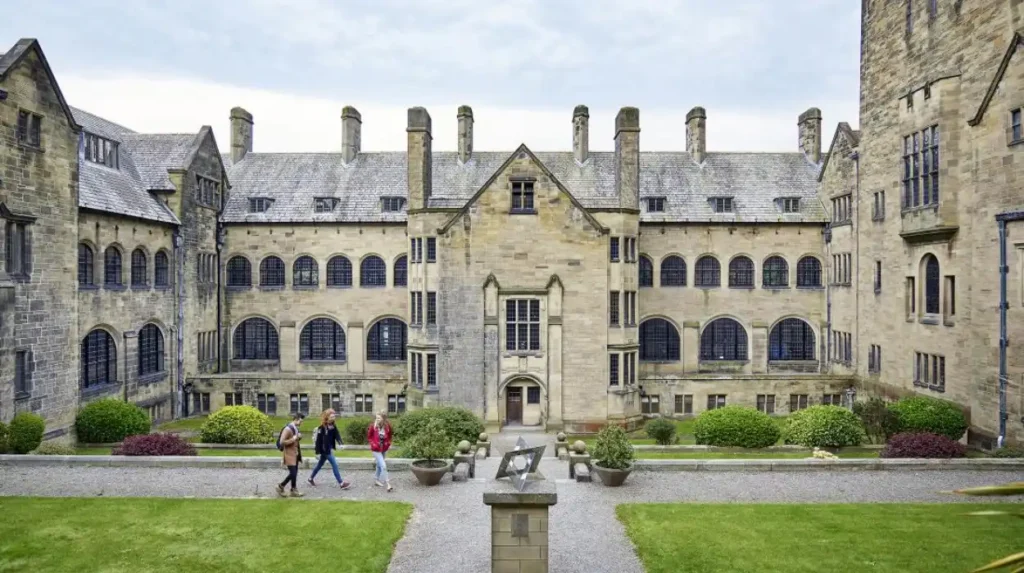
Pontio Arts Centre enhances cultural offerings with theatre and cinema, replacing Theatr Gwynedd. Friars School, established 1557, complements further education via Coleg Menai. This academic hub sustains the economy, drawing 49.3% born-outside-Wales residents.
Iconic Attractions
Garth Pier, Wales’ second-longest at 460 meters and Britain’s ninth, opened in 1893 as a Victorian promenade with kiosks offering crafts and views across the strait. Grade II-listed after 1980s restoration, it withstood ship collisions and near-demolition, symbolizing resilience.
Penrhyn Castle, a neo-Norman mansion built 1822-1837 by George Hay-Dawkins Pennant from Jamaican sugar wealth (including £14,700 slavery compensation), boasts opulent rooms and gardens. National Trust-owned, it overlooks the coast path. Storiel museum in Town Hall showcases Gwynedd heritage.
Outdoor Pursuits
Bangor’s trails invite endless adventure, from North Wales Path’s 97 km coastal route to National Cycle Network paths NCR 5, 8, and 85. Snowdonia gateways like Llanberis draw hikers to Yr Wyddfa (Snowdon), reachable in under an hour. Beach Road and Heol Dewi fields host recreation, while strait waters beckon kayakers and sailors.
Wildlife thrives at Eithinog and Nantporth reserves, managed by North Wales Wildlife Trust. Gwynedd Archaeological Trust on Garth Road unearths local history.
Cultural Vibrancy
Bangor pulses with arts, hosting National Eisteddfod multiple times, including 2005. BBC studios produce Radio Cymru output, with wartime evacuations birthing classics like It’s That Man Again. Music at Bangor series fills halls, while Storm FM student radio buzzes.
The 1967 Beatles visit for Maharishi Mahesh Yogi and Radio 1’s 2010 Big Weekend with Rihanna and Dizzee Rascal highlight its draw. Twin with Germany’s Soest fosters exchanges.
Transport Links
Bangor railway station on the North Wales Coast Line connects to Holyhead (32 minutes), Chester, and Crewe via Transport for Wales and Avanti West Coast. A5 (Telford’s road) and A55 bisect the city, linking London and Ireland ferries. Arriva buses serve Caernarfon and Llandudno; Liverpool Airport lies 134 km away.
Sports and Leisure
Bangor City F.C., now reformed as Bangor 1876, boasts Welsh Premier titles and European runs. Bangor RFC competes in WRU leagues, with university teams excelling alongside RGC. Wartski Fields offer community sports legacy.
Looking to Bangor’s Future
This compact city, among Britain’s smallest by area and population, thrives on heritage, education, and nature’s embrace. As research hubs like M-SParc propel innovation, Bangor remains an evergreen Welsh treasure, inviting exploration of its layered past and boundless outdoors.