

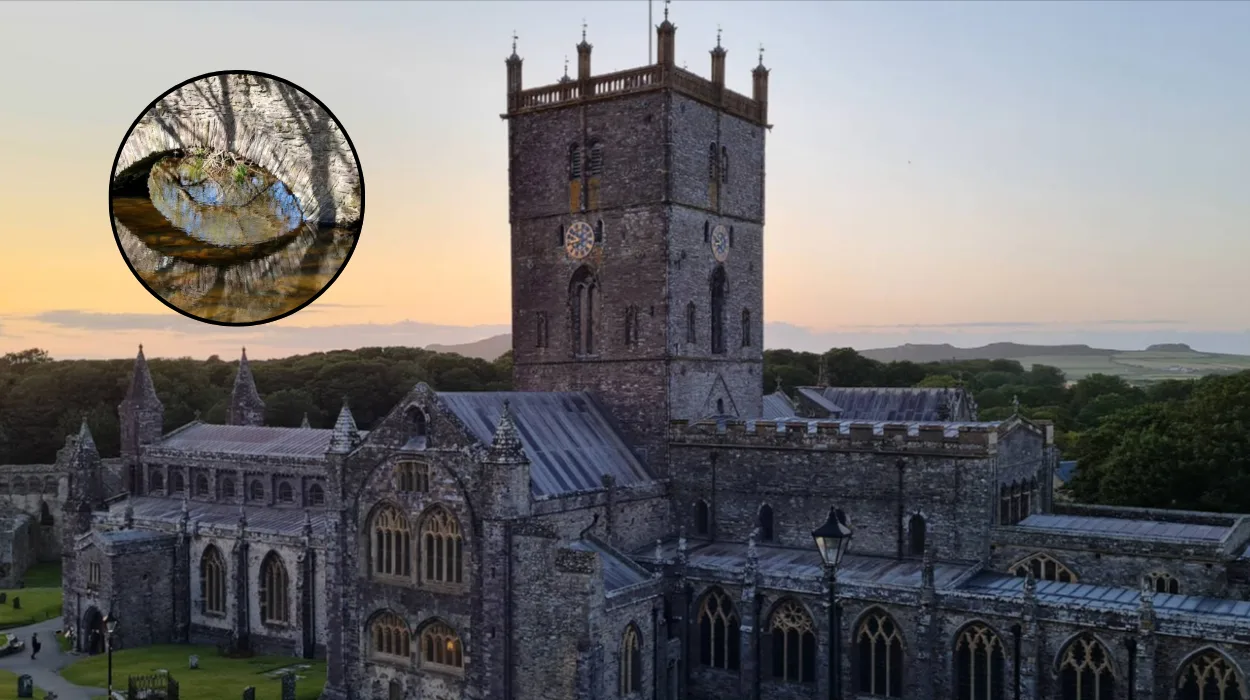
St Davids captivates as Wales’ smallest city, blending profound history, spiritual heritage, and stunning coastal beauty in Pembrokeshire. This timeless destination draws pilgrims, hikers, and culture seekers year-round, rooted in the legacy of its patron saint and dramatic National Park landscapes.
Origins of St Davids
St Davids emerged in the 6th century when Saint David, or Dewi Sant, founded a monastic settlement around 550 AD along the River Alun. Born circa 500 AD to Saint Non, David was baptized at nearby Porthclais Harbour and trained in ascetic Christianity, advocating simple living through manual labor, water fasting, and leek cultivation. Legends abound of his miracles, including raising the ground at Synod of Brefi to preach against heresy and taming a venomous adder, cementing his status as a pivotal Celtic church leader. By his death around 589 AD, the site had become a beacon of Welsh spirituality, later canonized in 1120 with papal decrees equating pilgrimages here to those in Rome or Jerusalem.
St Davids Cathedral: Architectural Marvel
Towering as the city’s heart, St Davids Cathedral was constructed from 1180 under Bishop Peter de Leia, fusing Norman solidity with Gothic elegance using local purple sandstone. Its history spans Viking raids that destroyed earlier wooden churches, a 1220 tower collapse, and a 1248 earthquake that tilted its floor dramatically upward toward the east end. Intricate features like the 16th-century nave roof in blue-and-gold Irish oak, medieval choir stalls, and Bishop Henry Gower’s 14th-century rood screen highlight its artistry, with George Gilbert Scott’s 19th-century restorations ensuring longevity. Today, it resonates with daily services, the pioneering Cathedral Choir featuring girl choristers, and events like the annual St Davids Cathedral Festival.
City’s Unique Status and Evolution
St Davids earned city status in the 12th century due to its cathedral, briefly lost it in 1886 amid reforms, and reclaimed it in 1994 through Queen Elizabeth II’s letters patent. Home to just 1,751 residents in 2021 across expansive terrain including Ramsey Island, it stands as Britain’s least populous city. Medieval pilgrim wealth faded post-Reformation when Bishop Barlow dismantled the palace, but Victorian tourism and 1952 National Park designation revived it into a heritage hub. Governed by St Davids City Council within Pembrokeshire, it balances eco-tourism with agriculture in a community boasting low unemployment around 3.5%.
Surrounding Natural Treasures
Nestled in Pembrokeshire Coast National Park, St Davids boasts world-renowned cliffs, golden beaches, and wildlife havens like Whitesands Bay for surfing and Ramsey Island for seals and puffins via boat trips. The Bishop’s Palace ruins, a 14th-century Cadw site by Henry Gower, offer sweeping vistas, while ancient spots like Iron Age Clegyr Boia and Saint Non’s Well evoke mystical origins tied to David’s life. Trails such as the Pembrokeshire Coast Path and St David’s Way weave through Celtic crosses, hidden coves, and holy wells, ideal for immersive 12km daily hikes amid dramatic seascapes.

Patron Saint David’s Legacy
Dewi Sant, formally declared Wales’ patron in the 12th century, symbolizes national resilience through his Vita by Rhigyfarch, detailing journeys to Jerusalem and church foundations across Wales and beyond. Celebrated on March 1 with leeks and daffodils, his teachings—”Do the little things”—stem from tales like a dove alighting on his shoulder during sermons. His influence endures in Welsh identity, from Eisteddfodau to global twinnings with Naas in Ireland and Orléat in France.
Practical Visitor Guide
Access St Davids easily via A487 roads or frequent T11 buses from Fishguard and Haverfordwest, with ample parking for day trips. Accommodation spans boutique stays like St Davids Cross Hotel, cozy B&Bs, and campsites with sea views, supported by a local economy where average incomes hover at £30,000. Savor fresh seafood, Welsh lamb, and craft ales at harborside pubs or the Cathedral Refectory; visit year-round, peaking in summer for festivals. Over 300,000 visitors annually explore its 210 listed buildings, rugby at St Davids RFC, and lifeboat station heroics at St Justinian.
Cultural Vibrancy Today
St Davids thrives artistically with galleries, poetry at Cathedral Hall, and modern talents like filmmaker Kieran Evans. Sustainability drives its appeal, preserving Iron Age forts and coastal paths while fostering twins like Matsieng in Lesotho. This Pembrokeshire jewel remains an eternal spiritual and natural retreat, perfect for soul-stirring escapes.
