
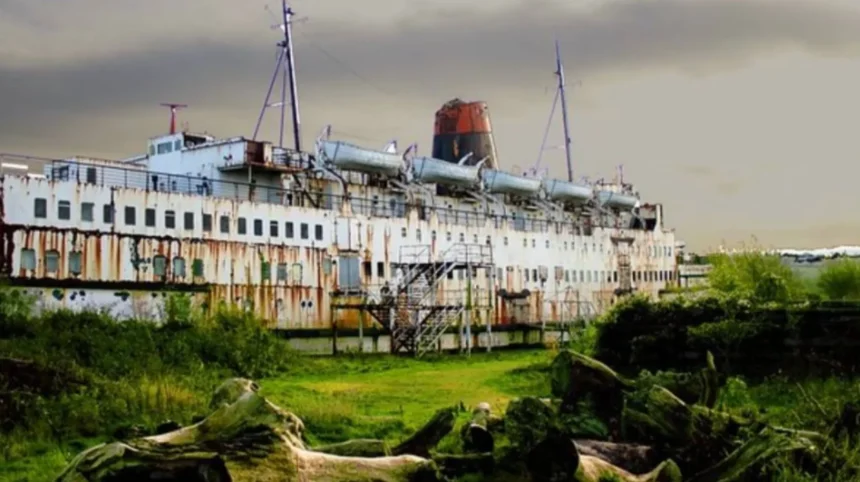
The TSS Duke of Lancaster is a retired 4450 gross register ton passenger ferry and cruise ship built in 1956 by Harland and Wolff in Belfast. It operated for British Railways until 1979 before being beached at Llanerch-y-Môr in Flintshire, North Wales.
Harland and Wolff constructed the vessel as a passenger-only turbine steamship designed to replace earlier pre-war railway steamers on the Irish Sea routes. The ship measured 354 feet in length and featured twin steam turbines capable of driving the hull at operational speeds up to 21 knots. During its early operational years, the vessel served the Heysham to Belfast passenger crossing while double-acting as a luxury cruise liner during seasonal off-peak periods. Passengers on these European cruises traveled to destinations across Norway, Spain, Denmark, and the Netherlands.
The operational landscape of maritime transport shifted rapidly during the late 1960s due to the rise of roll-on roll-off vehicular ferries. British Rail converted the ship at the Cammell Laird shipyard in 1970 to accommodate 105 motor vehicles and 1200 passengers simultaneously. Following this major structural overhaul, the vessel resumed cross-channel duty along routes connecting Fishguard to Rosslare as well as Holyhead to Dún Laoghaire. Decreasing profitability and the modernization of the Sealink fleet resulted in the permanent withdrawal of the vessel from active maritime service in November 1978.
Why Was the Duke of Lancaster Beached at Llanerch-y-Môr?
The Duke of Lancaster was permanently beached at Llanerch-y-Môr in August 1979 to operate as a static floating market, leisure center, and tourist attraction known as The Fun Ship. Private investors selected the tidal dock berth to bypass restrictive Sunday trading legislation.
Empire Trawlers Limited purchased the decommissioned vessel from British Rail in 1979 with the explicit intention of creating a large-scale commercial retail hub. British Sunday trading laws during that era restricted high-street shops from operating on Sundays, but maritime loopholes provided exemptions for active or berthed sea vessels. The buyers navigated the ship into a specially constructed concrete berth along the River Dee estuary near Mostyn Docks. The engine room was sealed, and the hull was permanently embedded within the coastal mud and surrounding concrete foundation.
The Fun Ship complex opened to the public in late 1979 and initially attracted thousands of visitors every weekend. The vessel contained multiple retail stalls, amusement arcades, bars, restaurants, and a cinema spread across its interior decks. Visitors could tour the original engine rooms and navigate the preserved captain’s bridge while shopping from local merchants. Commercial operations continued successfully for several years as the location became one of the most visited tourist destinations in Flintshire.
What Caused the Closure and Abandonment of The Fun Ship?
Long-running legal disputes between the ship owners and local planning authorities regarding emergency road access, fire safety compliance, and parking infrastructure caused the complex to shut down permanently in the mid-1980s.
The rapid commercial growth of The Fun Ship created severe logistical challenges for the rural infrastructure surrounding Llanerch-y-Môr. Delyn Borough Council raised continuous safety objections regarding the narrow railway bridge that served as the sole vehicular access route to the berth. Emergency services, including modern fire engines and ambulances, could not pass under the low bridge height to access the vessel safely during peak operational hours. These infrastructure limitations prompted council authorities to issue enforcement notices that restricted visitor capacities and commercial trading hours.
Legal battles between the vessel owners and local government bodies escalated throughout the early 1980s, resulting in protracted court battles. Planning permission applications to convert upper passenger decks into a 300-room hotel facility were repeatedly denied by planning committees. The financial burden of ongoing legal action combined with operational restrictions rendered the commercial venture unsustainable for the operating company. Operators ultimately locked the access doors in 1984, leaving the fully equipped interior abandoned and exposed to coastal atmospheric decay.
How Did the Street Art Transformation Project Impact the Ship?
In 2012, a street art collective known as DuDug transformed the rusted exterior hull of the ship into an open-air art gallery featuring large-scale murals painted by international graffiti artists.
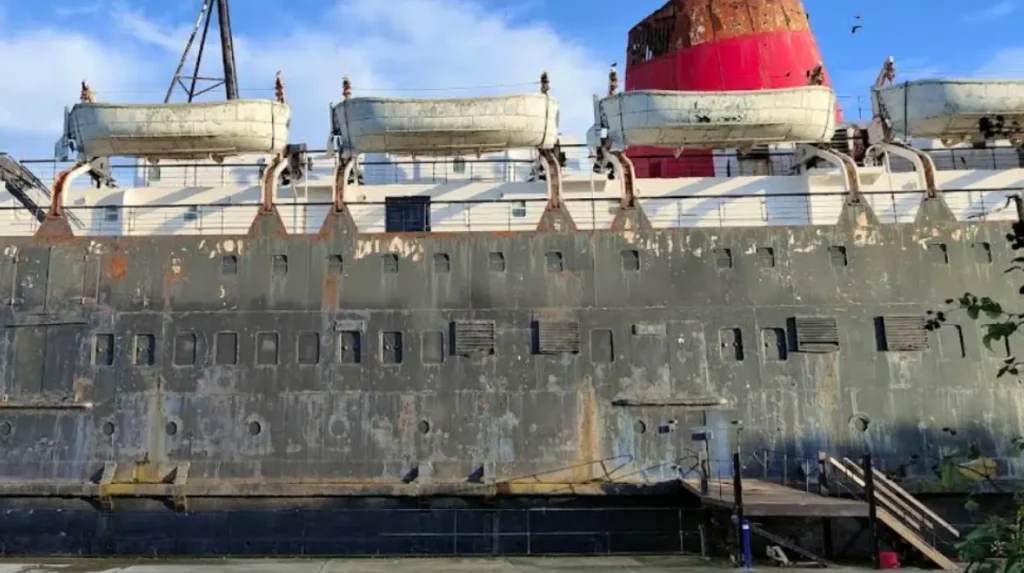
The black and white steel hull of the vessel had suffered decades of severe weathering and surface corrosion from the saltwater environment. Project organizers coordinated with the private owners to invite recognized street artists from across Europe to execute legal artwork directly on the exterior structure. Prominent artists including Snub23, Run, Dan Kitchener, and Lora Zombie created expansive murals across the superstructure. These dynamic artworks incorporated portraits, surrealist imagery, and pop art themes designed to cover the extensive surface rust.
The street art initiative renewed public interest in the forgotten maritime vessel and brought international media coverage to the Flintshire coastline. Photographers and tourists traveled to the Dee Estuary to document the stark visual contrast between 1950s naval architecture and modern urban art. The project ultimately ceased after further disputes regarding site access and safety concerns along the surrounding private land boundaries. Coastal weather conditions eventually weathered these painted murals, leaving faded artistic remnants on the corroded steel plates today.
What Is the Current Structural Status and Ownership of the Vessel?
The Duke of Lancaster remains privately owned by the Rowley family and sits permanently aground at Llanerch-y-Môr Wharf. The interior functions as a sealed, preserved time capsule containing original 1970s fixtures and arcade machinery.
The ship is listed on the National Historic Ships register as a vessel of significant maritime importance. Despite standing inactive for four decades, the underlying steel structure and hull remain physically sound due to the protective concrete dock casing. Corrosion is primarily confined to outer deck plating, external railings, and unmaintained paintwork exposed to sea air. Trespassing on the vessel or entering the surrounding private dockland is strictly prohibited, with security fencing and monitoring systems protecting the perimeter.
The interior of the ship remains largely undisturbed since its sudden closure in the mid-1980s. Dozens of rare 1970s coin-operated arcade games were salvaged from the interior deck lounges by collectors during a specialized extraction operation in 2011. Original wood paneling, velvet seating, decorative carpets, bar fittings, and engine room machinery remain preserved inside the sealed compartments. Periodic proposals to restore the vessel for tourism or hospitality continue to emerge, though official redevelopment activities remain constrained by local access infrastructure.
Frequently Asked Questions
Can you go inside the Duke of Lancaster ship in North Wales?
No, public access inside the Duke of Lancaster is strictly prohibited due to safety hazards and private property restrictions. The ship sits on private land secured by perimeter fencing and security monitoring systems.
Where is the Duke of Lancaster ship located?
The ship is permanently embedded at Llanerch-y-Môr Wharf, located near Mostyn in Flintshire, North Wales along the River Dee estuary. It is clearly visible from the nearby North Wales Coast Line railway tracks and the A548 coastal road.
Who built the Duke of Lancaster ship?
Harland and Wolff built the vessel in Belfast, Northern Ireland, launching her in 1956 for service with British Railways. The shipyard is famous for constructing the RMS Titanic and numerous iconic mid-century ocean liners.
Is the Duke of Lancaster going to be scrapped?
There are no official plans to scrap the historic vessel, as it remains protected under private ownership and recorded on the register of National Historic Ships. The owners continue to explore restoration ideas for future static reuses.