

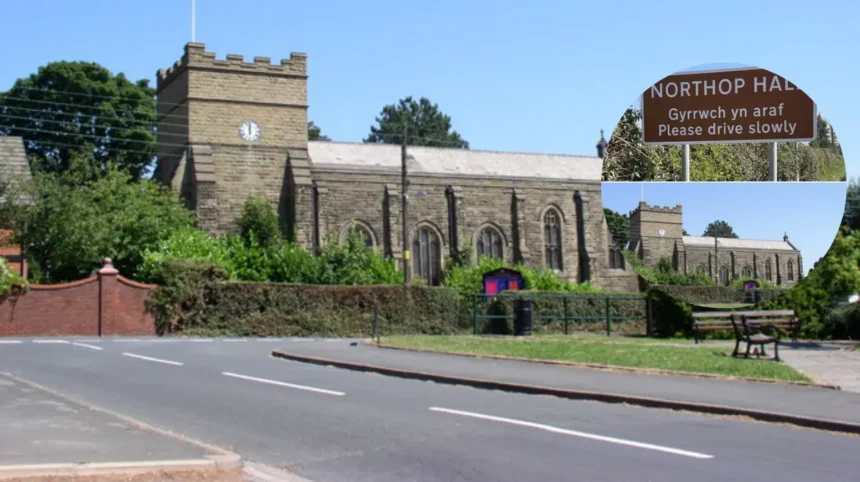
Recently, a bizarre incident came to light when Flintshire Council in North Wales approved the renaming of the village of Northop Hall to ‘Pentre Moch’ (Welsh name), meaning ‘Pigs Village’ or ‘Pigs Holding’. The decision was met with immense opposition, as residents claimed the village would become a ‘laughing stock’ among the public.
According to the BBC, Jeff Sampson, a resident of Northop Hall for 46 years, was quick to register his disapproval – “Ludicrous!” “I personally am not happy about it. I really don’t think it’s necessary.”
However, Flintshire Council decided to proceed with the Welsh name ‘Pentre Moch’ citing heritage conservation to be the reason behind it. According to the BBC, the chairman of the Flintshire Council, John Gollege, stated –
“We’re trying to display and encourage the Welsh heritage of the village,” he said.
“It is not a name change. The name will remain Northop Hall,” said Gollege.
“Other towns and villages like Mochdre, Swindon and Swinton all have references to pigs in their names.”
Some residents however supported the re-introduction of the Welsh name. It did not bother them. In fact, they thought it was an opportunity to use the Welsh language, which, according to them, “isn’t heard enough!”
The Story of ‘Pentre Moch’: Roots and Meaning!
Northop Hall village is a large village located in Flintshire, North East Wales. It dates back to the 13th century, when a Pig farm called ‘Pentre Moch’ became the pinnacle of its existence. By the 17th century, as the village developed, people began to address it as ‘Pentre Moch’ in Welsh. In the 19th century, however, the British Government strictly restricted the use of the Welsh Language. It reasoned that people would stay ignorant and uneducated. It was a setback for the villagers as the word ‘Pentre Moch’ was erased from the map.
By the late 20th century, however, people realized the significance of culture and heritage conservation. Hence, the government assigned a literal Welsh translation to the name Northop Hall, pronounced as “Neuadd Llaneurgain”.
Neuadd: The Welsh word for “Hall”.
Llaneurgain: This is the historical Welsh name for the neighboring, parent village of Northop. It translates to “the holy enclosure of Eurgain,” referencing Saint Eurgain, a 6th-century Welsh saint who founded the parish church there.
On 10th April 2025, the Northop Community Council picked up the matter and presented a proposal. It highlighted the significance of the Welsh name “Pentre-Moch” and specified that villagers had used it for years. It also stressed that the Welsh name ‘Neuadd Llaneurgain’ had no historical value.
According to Flintshire, Councilor, Mared Eastwood, Cabinet Member for Education, Welsh Language, Culture and Leisure, said: “Place names are an important part of our heritage and identity, and it is important that they reflect both local usage and historical evidence.
In late April 2025, they launched a public consultation campaign to find public opinion and assess the legitimacy of their decision. Many people protested against it. However, many others supported the decision.
“I just feel that’s what it has always been known as; people who have lived here a long time are very aware of it,” said Gaynor Hughes, who has lived there for 50 years.
Another resident, Scott Bagley said:
“It’s a lovely language; they should have Northop and the Welsh variation. It’s a lovely place,”
According to the BBC, the council clerk, Sharon Swift, said that a rigorous review process was used. “This has included extensive checking of resident details against the electoral roll and also the elimination of multiple voting in person and via e-mail.” The consultation proved “clear village support for the name change”.
In a report, the Welsh Language Commissioner pointed out several efforts to find an alternative to Pentre Moch, but none “gained currency in the same way as the original and historical name of Pentre Moch”.
It added that the name was “descriptive, not derogatory”, and many other settlements in Wales refer to Moch. “They reflect their key status in the agricultural economy of the Middle Ages,” the report said.
The Decision is Final: On 23rd September 2026, the council definitively voted to pass the motion, meaning the internal community argument over whether the name would make the village a “laughing stock” has legally concluded.
Dual Naming Confirmed: The village formally retains Northop Hall for English use. The historic name Pentre Moch thus replaces the modern, artificial translation ‘Neuadd Llaneurgain’ in all Welsh contexts.
Administrative Implementation Initiated: Government authorities have already initiated the practical steps to update the new name across the Ordnance Survey maps, the Royal Mail registry, and the official Land and Property Gazetteer.
So it’s official now! The village of Northop Hall has a twin-name, or should we say, a long-lost twin, Pentre Moch. True, Pentre Moch is a heritage symbol of the Flintshire village. It reminds us of the agricultural economy of the 17th century. Undoubtedly, heritage conservation is essential in this material world. However, we must not ignore the life and times we live in! The various governments all over the world, are changing place names, but we must consider, whether it is justified!
“Place names are an important part of our heritage and identity, and it is important that they reflect both local usage and historical evidence”. However, at the same time, they symbolize our pride and prestige. We must feel proud of it and realize our duties towards it.
We must also remember that children are leaders of the future. We need to involve them in these decisions. They must feel a sense of respect and connection to the name, and this can only happen when the society refers it respectfully. Here’s wishing ‘Pentre Moch’ another 400 years of a glorious life!