

Key Points
- The people of Tal-y-bont, Wales have reported losing hope for their relative, Jit Bahadur Chaudhary, who is missing in the Trishuli 3B hydropower plant.
- According to official reports, there are 933 missing workers employed at hydropower stations out of 4,247 missing individuals and at least 903 people dead.
- The emergency services have employed controlled mountain blasting to reach the highly buried tunnels at Trishuli 3A and 3B power stations.
- The incident was due to glacial breakdown and caused a 5.2-magnitude earthquake and the movement of debris for 62 miles along the river.
- There has been considerable damage to infrastructure including broken bridges, solar panels, and multiple hydropower plants.
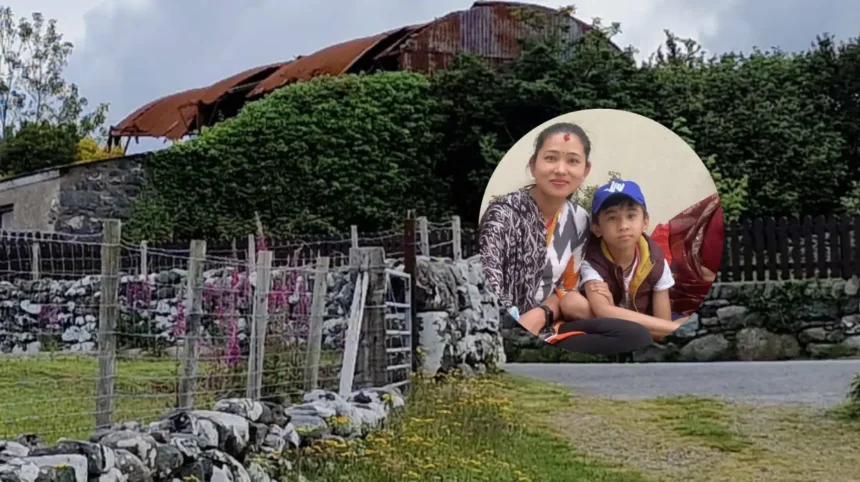
Wales (Wales Times) September 01, 2026 – A woman residing in mid-Wales has expressed profound distress as the search continues for a missing relative following catastrophic flooding across central Nepal. Jyoti Upadhyay, a native of Nepal who has lived in Tal-y-bont for five years, confirmed that she and her husband have been unable to obtain information regarding Jit Bahadur Chaudhary. Chaudhary, who has lived with Upadhyay’s mother-in-law for 25 years and is regarded as immediate family, was on duty as a driver at the Trishuli 3B hydropower installation in Bagmati Province when the disaster occurred.
As reported by BBC Radio Wales Breakfast, Jyoti Upadhyay stated that: “To be honest, since Saturday we have lost hope”. She further explained to the broadcaster: “Since Wednesday, life has been upended. For the first few days, we were waiting very hopefully for some information. There was some hope that he would somehow have walked up to higher ground and would have made the long trek, sort of the 60-mile trek home. But as the days passed, that hope has definitely faded”.
What Is The Current Scale Of The Nepal Flood Casualties?
The scale of the devastation extends across multiple provinces, leaving emergency services overwhelmed by the volume of casualties. Figures released on Monday morning indicate that 933 hydropower workers remain unaccounted for across various project locations in the country. In total, 4,247 individuals are recorded as missing, while at least 903 people have been confirmed dead.
Approximately 300 bodies have been recovered from waterways and debris deposits downstream, though Chaudhary has not been identified among them. In addition to local labourers and plant personnel, international and domestic tourists are feared trapped or swept away, as the river valley serves as a prominent pilgrimage route for several religious faiths.
How Are Emergency Teams Attempting Rescue At Trishuli?
Rescue operations remain heavily concentrated on the Trishuli 3A and 3B hydroelectric sites, where extensive tunnel networks are suspected to hold trapped personnel. Nepali military and emergency personnel executed a controlled blast into the hillside in the early hours of Monday morning in an attempt to breach blocked subterranean entryways.
As reported during BBC Radio Cymru’s Bwrw Golwg programme, Jyoti Upadhyay stated that:
“It has been extremely difficult to reach the site. What we understand is that all the buildings are under meters of mud and it has been impossible to search for anyone there”.
She elaborated on the operational constraints, noting:
“Within 20 minutes the connections were all down. The phone signals have not been working and that is why it has been so difficult to hear anything. It took about three days for us to get any information. We have been looking at the news, trying local contacts and trying to see what the army and the police have been doing”.
Access to the valley floor remains restricted exclusively to air transport due to severed road networks. Upadhyay added: “We know that the only way to reach the site is by helicopter. You need special skills to be able to drive a helicopter in that area. It is an extremely difficult place. We have been waiting for special machines to be able to work through the mud. There is some good news from other stations along the river as some people were able to hide in tunnels within the hydropower stations. There’s not a lot of hope for that particular site – but we don’t know until someone can get in. At the moment everything is under mud”. Because Chaudhary was employed as a driver, relatives consider it unlikely he was deep inside the protective tunnel network when the surge arrived.
Why Did The Glacial Collapse Cause Such Severe Destruction?
The surge was initiated by a catastrophic glacial collapse in the upper mountain ranges, defined by the US Geological Survey (USGS) as the structural disintegration of a glacier or large section of ice. The impact of the descending mass striking the valley floor generated sufficient force to register a magnitude 5.2 seismic tremor on USGS monitoring instruments.
This sudden displacement released high-velocity torrents of water and dense silt that travelled roughly 62 miles (100 kilometres) down the river system. The force of the flow flattened surface buildings, inundated energy stations, and tore away essential transport links.
What Cultural Significance Do Recovery Efforts Hold For Families?
The inability to retrieve victims poses acute emotional and spiritual distress for local families due to traditional regional customs. Upadhyay outlined the central importance of funeral rites in Nepalese heritage, observing that physical remains are required to facilitate traditional passages in the afterlife.
As reported by the BBC, Jyoti Upadhyay stated that:
“In Nepal, their death rituals are extremely important. With the beliefs around the afterlife and trying to ensure the best passage through to the afterlife… for that the body is essential. If people have been washed away, then how can people move on and how do they complete these rituals?”.
Background
The Himalayan river basins host extensive hydroelectric generation facilities designed to provide baseload electricity to Nepal and export surplus energy across South Asia. The Trishuli corridor contains approximately 14 individual hydropower plants located along narrow valley floors. While the mountainous region possesses a long history of seismic vulnerability, the frequency and severity of glacial destabilisation have intensified due to rising atmospheric and regional temperatures. As frozen glacial structures melt and destabilise at higher elevations, valley settlements and infrastructure situated directly below face increasing exposure to high-volume flash flooding and landslips.
Predictions
The widespread destruction along the Trishuli corridor is expected to create severe long-term economic, infrastructural, and humanitarian challenges for communities and industry stakeholders. The severance of river bridges has isolated numerous towns and villages, which will require prolonged logistical operations to maintain basic food, medical, and utility supplies. Furthermore, the loss of substantial hydropower capacity and large-scale solar arrays will disrupt domestic energy supply across urban and industrial sectors. International civil engineering bodies and disaster management authorities will face intensified pressure to revise structural design standards and early-warning monitoring protocols for mountainous infrastructure projects in response to heightened climate volatility.