Key Points
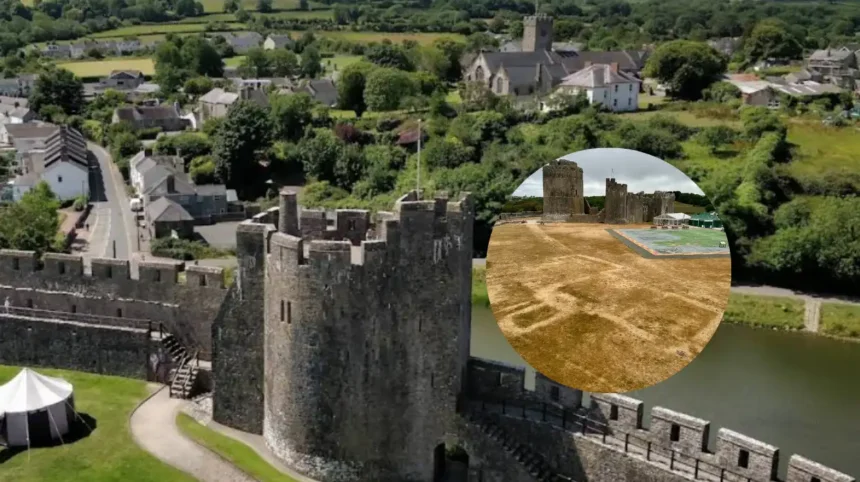
- Excessive drought and 2026 heatwaves have resulted in parch marks on the grass in Pembroke Castle, South Wales that show the position of a manor house beneath the surface.
- The marks are thought to indicate the location of a prestigious house where Henry Tudor, the future King Henry VII, was born in 1457.
- According to John Donoghue, who is the castle guide and writer, the heatwave has made the marks visible “better than ever.”
- A historian named Nathen Amin referred to the marks as “totally fascinating,” noting that they might spark archaeological research at this place.
- Archaeological works conducted in 2018 and 2023 by the Dyfed Archaeological Trust discovered traces of a late 15th-century double-winged hall house built on the site; the parch marks provide more information about the building’s plan.
- While in the past it was supposed that Henry was born in the 13th-century guards’ room, now many modern historians suppose that Lady Margaret Beaufort gave birth in more comfortable quarters within the castle grounds.
Castle (Wales Times ) August 22, 2026 — The outline of a manor house where Henry Tudor is believed to have been born has become visible because of exceptionally dry weather, emerging on grass at Pembroke uk/local/swansea/castle/">Castle in South Wales after this summer’s heatwaves created parch marks — contrasting lines that form above long-buried walls and foundations. Although a faint outline of some of the walls has shown up before, in exceptionally dry summers, this year’s is the clearest it has been, with experts hoping it may offer insights to archaeologists.
What do the parch marks at Pembroke Castle show?
The parch marks have revealed the shape of a building within the walled ward, a fortified area of the castle, according to photographs taken by John Donoghue, who works at the castle in Pembrokeshire as a guide. Mr Donoghue, who is the author of Castles, Crime and Cake: A Policeman’s Accidental Guide to History, said:
“It was known that there was a manor house there – and it’s believed that the future King Henry VII was born there.”
“It has shown up before, but this prolonged heatwave has seemed to have shown it off better than ever. I was just opening up the castle when I thought it looked fantastic,”
he added.
Nathen Amin, a historian and author of Son of Prophecy: The Rise of Henry Tudor, said:
“These parch marks at Pembroke have been utterly fascinating to observe, to be able to quite literally trace some lost heritage.” “If, as now seems likely, these marks reveal the location of a high-status residence, then this would indicate that somewhere within the extent of these parch marks the first Tudor king of England was born. I’m curious to see if [they] can be the trigger for further archaeological exploration,” Mr Amin said, as reported by The Telegraph.
Where was Henry VII actually born at Pembroke Castle?
Henry Tudor was born at the castle on January 28, 1457, the son of Lady Margaret Beaufort, the Countess of Richmond, who was 13 at the time, and Edmund Tudor, the first Earl of Richmond. He became Henry VII after winning the Battle of Bosworth Field on August 22, 1485 — 541 years ago on Saturday — taking the crown from Richard III and ushering in Tudor England.
While some historians believe he was born in a tower in the castle walls, many think it happened in a more comfortable manor house in the grounds. John Leland, a 16th-century antiquarian who visited the castle during the reign of Henry VIII, recounted a story of the earlier Henry being born in a 13th-century guards’ chamber, and said the birthplace was marked by a coat of arms on the chimney. However, modern historians believe Lady Margaret is much more likely to have chosen the comfort of the nearby manor house to give birth, rather than an inhospitable tower.
According to an account from her personal confessor, John Fisher, the Bishop of Rochester, the birth was difficult because of her slight stature. It had been deemed so unlikely that she would carry a child to term that Henry’s birth was considered a miracle. Mr Amin said: “The traditional story is that Henry Tudor was born to his 13-year-old mother Margaret Beaufort in a 13th-century guards’ chamber – one that still exists, in fact. The story, however, seems fanciful, although enduring.” “In consideration of her ancestry, station and, most of all, her physical condition, then, Margaret likely gave birth in the more comfortable domestic quarters reserved for the use of the lord, her brother-in-law Jasper Tudor, who was Earl of Pembroke and in residence during the 1450s,” he added. “A private dwelling of high status fitted with the latest amenities, including a mural stair, cellar, fireplace – such a noble suite would have been a far more appropriate environment for Margaret’s labour than a guard’s chamber near the gatehouse,” Mr Amin told The Telegraph.
How do heatwaves expose buried archaeology?
Parch marks appear when sub-surface features such as walls, foundations or ditches affect how grass grows during dry spells. Areas above stone or compacted foundations tend to retain less moisture, causing grass to dry and pale more quickly, while filled ditches or deeper soil can keep grass greener for longer, creating visible contrasts. This summer’s repeated heatwaves and drought conditions across parts of Britain have produced similar effects at other historic sites, including outlines of former gardens and structures revealed on lawns.
At Pembroke, the marks have clarified the outline and layout of rooms associated with the late 15th-century residence. Excavations in 2018 and 2023 by the Dyfed Archaeological Trust uncovered some evidence of a late 15th-century double-winged hall house that stood on the site. The parch marks revealed further details about the outline and layout of rooms, complementing earlier fieldwork.
Why does Henry Tudor’s birthplace matter?
Henry’s blood claim to the throne was fairly weak, relying on his mother being the great-granddaughter of John of Gaunt, the son of King Edward III, so Lady Margaret invoked an ancient Welsh prophecy that heralded a “messiah” who would rise to claim sovereignty. His claim was legitimised at the Battle of Bosworth Field in Leicestershire, which ended 331 years of Plantagenet rule and decades of civil war between the houses of York and Lancaster. It placed England on a path that would eventually lead to the Reformation.
Henry VII was England’s only Welsh king and fought under the red dragon banner of Wales. Pembroke Castle, where he was born, remains a focal point for interpretations of early Tudor history and Welsh identity. Clarifying the precise location and nature of his birthplace helps historians and heritage professionals refine narratives around the dynasty’s origins and the social conditions of mid-15th-century Wales.
Background to the development at Pembroke Castle
The emergence of the manor outline follows a sequence of heatwaves that have left large parts of Britain in drought status, with restrictions on water use affecting millions. Similar parch-mark phenomena have been reported at other historic properties, including Blenheim Palace and Portchester Castle, where dry lawns have exposed former garden layouts and installations. At Pembroke, the site has long been associated with Henry Tudor’s birth, but physical evidence of the domestic buildings within the ward has been limited.
Archaeological investigations by the Dyfed Archaeological Trust in 2018 and 2023 identified structural remains consistent with a high-status, double-winged hall house dating to the late 15th century. The 2026 parch marks have added definition to these findings, allowing researchers and castle staff to visualise the building’s footprint without excavation. John Donoghue’s photographs and observations, together with commentary from historians such as Nathen Amin, have drawn wider attention to the site and raised the possibility of future targeted work to investigate the residence further.
Predictions for heritage, tourism and research audiences
For heritage professionals and archaeologists, the clearer outline increases the likelihood of targeted, non-intrusive surveys such as geophysical mapping or limited test trenching to confirm room divisions and construction phases. If future work substantiates the manor as the birthplace, interpretation at Pembroke Castle could be updated to reflect a shift from the traditional guards’ chamber narrative to a domestic-quarters model, aligning with current scholarly views on Lady Margaret Beaufort’s circumstances.
For tourism and local audiences in Pembrokeshire and wider Wales, the story offers a timely hook for visitor engagement, particularly around anniversaries linked to Henry VII and the Battle of Bosworth. Clear, visible archaeology on the ground can strengthen on-site storytelling, support educational programmes, and potentially boost footfall during periods when weather conditions make the marks visible. For researchers of Tudor origins and Welsh history, the development provides a concrete reference point for debates about birthplace location, elite domestic architecture in 15th-century Wales, and the interplay between prophecy, legitimacy and dynastic foundation myths.