Key Points
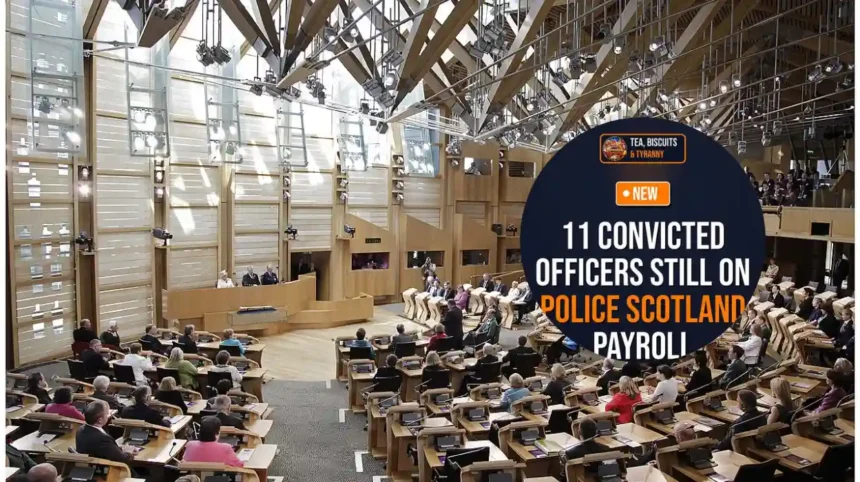
- Eleven Police Scotland personnel, who have been found guilty of committing crimes, are still being paid by the agency.
- Of the eleven, eight were convicted for offenses involving violence against women and girls.
- Chief Constable Jo Farrell described the issue as “intolerable” and attributed it to poor duty arrangements, which have delayed the removal of convicted police personnel.
- The 11 convicted personnel form part of around 80 suspended Police Scotland personnel.
- Police Scotland estimates that the 80 suspended personnel cost the agency about £4.5 million annually.
- Ms Farrell said that some of the suspended personnel have not been on duty for many years now, which affects the welfare, public expenditure, and utilization of resources.
- She informed the Criminal Justice Committee of the Scottish Parliament that some cases have “incontrovertible evidence” against the officers involved, but under the present process, they cannot be swiftly dismissed from service.
- This was in response to Ms Farrell’s letter, dated 13 November 2026 to Criminal Justice Committee convener David Linden before the committee meets on 18 November.
- The Justice Secretary Neil Gray stated that proposed regulations, which will be presented to the Scottish Parliament, would give Police Scotland more time if there are any criminal convictions of police personnel.
- Mr Gray stated that the proposal is meant to clarify issues, improve victim and witness support and maintain proper safeguards.
- The Scottish Police Federation’s David Kennedy contradicted the chief constable’s views stating that convicted officers can undergo a misconduct process in 35 days and that the process “is fit for purpose but simply is not being enforced.”
- In separate correspondence, the Justice Secretary informed that about 80 officers are suspended and another 140 officers are on restricted duty.
- Recently, Police Scotland announced that 45 serving officers are suspended on charges of violence against women and girls.
Wales Police (Wales Times) November 15, 2026 — Eleven Police Scotland officers who have been convicted of crimes, including eight convicted of violence against women and girls, remain employed by the force and are still being paid, Chief Constable Jo Farrell has confirmed. The disclosure was made in a letter to the Scottish Parliament’s Criminal Justice Committee as MSPs consider proposals intended to speed up misconduct proceedings.
- Key Points
- What did Jo Farrell say about convicted officers?
- How much are suspended officers costing?
- What changes are being considered?
- What did the chief constable ask for?
- What has the Scottish Police Federation said?
- What other suspension figures have emerged?
- Have some convicted officers left the force?
- What happens next?
- Background of the development
- Prediction: How this can affect Scottish policing
As reported by the Morning Star, Ms Farrell said the convicted officers were among approximately 80 Police Scotland officers currently suspended, at an estimated annual cost of £4.5 million. She described the situation as “intolerable” and said the existing conduct framework could leave people who have “no place in policing” within the organisation for longer than they should be.
The chief constable’s letter, dated 13 November 2026, was addressed to Criminal Justice Committee convener David Linden ahead of the committee’s consideration of proposed police conduct regulations on Wednesday, 18 November. In the letter, Ms Farrell said criminal proceedings and “sluggish conduct arrangements” had left officers suspended, at times for years, creating a welfare impact, a cost to the public purse and a reduction in Police Scotland’s deployable resources.
As reported by BBC News, Ms Farrell said: “There are cases of proven criminality where the existing process has taken too long because of sub-optimal regulations.” She added: “This can leave individuals who ultimately have no place in policing within the organisation for longer than they should be.”
What did Jo Farrell say about convicted officers?
Ms Farrell said that, in addition to the 11 convicted officers still employed, there were other cases involving “incontrovertible evidence” against officers that could not be fast-tracked for dismissal under the current arrangements. She said the situation was “intolerable” both to her as chief constable and, she argued, to the public.
The letter stated that 11 officers convicted of offences remained employed by Police Scotland, including eight convicted of violence against women and girls offences. The official parliamentary correspondence did not identify the individual officers, the specific offences in every case, or the stage reached in each disciplinary process.
Ms Farrell wrote that criminal proceedings and delayed conduct arrangements had consequences beyond the cost of suspension. She said they affected officers’ welfare, reduced the number of officers available for operational policing and imposed a cost on the public purse.
How much are suspended officers costing?
Police Scotland assessed the annual cost of the approximately 80 suspended officers at about £4.5 million. The figure was included in Ms Farrell’s letter to the Criminal Justice Committee and was repeated in the Justice Secretary’s related correspondence to the committee.
The chief constable said the cost arose because officers could remain suspended while criminal cases progressed through the courts and while misconduct processes continued. She said that, in some cases, suspension had lasted for years.
The Justice Secretary’s letter to the committee said the majority of the suspension cases concerned alleged off-duty criminality, with a large proportion involving allegations of violence against women and girls. It also stated that, in addition to the approximately 80 suspended officers, 140 officers were on restricted duties.
What changes are being considered?
The Criminal Justice Committee is considering Justice Secretary Neil Gray’s proposals to modernise police conduct arrangements in Scotland. The committee is due to discuss options that would allow Police Scotland to act more quickly in cases where an officer has been convicted.
Mr Gray said Ms Farrell was right that cases involving officers convicted of serious offences should be dealt with more quickly. He said regulations had been introduced to the Scottish Parliament to enable Police Scotland to act faster in conviction cases.
“These are aimed at improving transparency and strengthening support for victims and witnesses, while retaining appropriate safeguards,” the Justice Secretary said.
Official correspondence from Mr Gray said the proposed regulations would provide a more effective mechanism for dealing with conduct matters, including accelerated misconduct procedures in appropriate cases. The correspondence said this would allow disciplinary consequences to be determined more quickly where circumstances justify it, including after criminal proceedings have concluded.
What did the chief constable ask for?
Ms Farrell said the proposals under consideration would “modernise the police conduct regime, to accelerate hearings for the most serious cases and enhance transparency of outcomes”. She also said she strongly supported a focus on treating witnesses and complainers in a trauma-informed way.
Her position was that the current system was too slow in cases where criminal convictions had already been secured or where evidence was described as incontrovertible. She argued that the delay kept unsuitable officers within Police Scotland for longer than necessary.
The chief constable did not say in the published letter how quickly she believed convicted officers should be removed from the payroll, nor did she identify the legal or procedural barriers preventing immediate dismissal in every case.
What has the Scottish Police Federation said?
The Scottish Police Federation’s David Kennedy challenged the suggestion that the regulations themselves were inadequate. As reported by The Scottish Sun, Mr Kennedy said:
“If convicted you can be taken to a misconduct hearing within 35 days.”
He added: “The regulations are fit for purpose but they’re not being used properly.” His comments represented a direct disagreement with the chief constable’s claim that “sub-optimal regulations” were contributing to delays.
The Scottish Police Federation is the representative body for rank-and-file police officers in Scotland. Its response indicates that the debate over delayed dismissals is not solely about the length of criminal proceedings, but also about how existing misconduct procedures are applied.
What other suspension figures have emerged?
The disclosure about 11 convicted officers follows earlier reporting that 45 serving Police Scotland officers were suspended over allegations of violence against women and girls. That figure was reported last month and concerned allegations, not convictions.
Ms Farrell also said last month that between 300 and 400 officers had been re-vetted under new rules introduced following the murder of Sarah Everard by Metropolitan Police officer Wayne Couzens. The re-vetting programme was cited in the context of wider scrutiny of police conduct and officer vetting.
The latest letter does not state whether the 11 convicted officers are included within the 45 officers previously reported as suspended over allegations of violence against women and girls.
Have some convicted officers left the force?
BBC News reported that Derek McNee, Campbell Petrie, Carmichael John Williamson and Cameron Ross had all been convicted and were no longer on the Police Scotland payroll. Their cases were reported separately from the 11 convicted officers who remain employed.
The Scottish Sun reported that former sergeant Campbell Petrie, 50, of Muirend, Glasgow, was jailed for 12 years at Glasgow High Court for raping and sexually assaulting two women, and received full pay during a two-year suspension. The same report said Constable Carmichael John Williamson, 32, of Shetland, was convicted at Edinburgh High Court of two rapes, had been suspended in January 2024 on a £50,000-a-year salary, and was due to be sentenced the following month.
These details were reported by The Scottish Sun and should be understood as separate from the chief constable’s latest parliamentary correspondence, which did not name the 11 officers still employed.
What happens next?
The Criminal Justice Committee is scheduled to consider the proposed police conduct regulations on Wednesday, 18 November. Ms Farrell is expected to give evidence to the committee as part of that consideration.
The Scottish Government has introduced regulations to Parliament that it says would allow Police Scotland to act more quickly where officers have convictions. The committee’s scrutiny will determine whether the proposals receive support and whether further changes are made before they proceed.
Background of the development
The development comes amid continuing political and public scrutiny of police conduct, vetting and the handling of allegations of violence against women and girls. Ms Farrell’s letter was submitted as the Scottish Parliament examined proposed reforms to the police conduct regime, with the stated aim of accelerating serious misconduct hearings and improving transparency.
The Justice Secretary’s correspondence said the proposed amendments would create a more effective mechanism for conduct matters, including accelerated procedures in appropriate cases after criminal proceedings conclude. The related regulations are set out in legislation published by the Scottish Government, with commencement provisions dated 26 November 2026.
The wider context includes Police Scotland’s earlier disclosure that 45 serving officers were suspended over allegations of violence against women and girls, and the force’s re-vetting of between 300 and 400 officers under rules introduced after the murder of Sarah Everard. Those figures concern allegations and vetting activity respectively, and are separate from the 11 convictions disclosed in Ms Farrell’s latest letter.
Prediction: How this can affect Scottish policing
For Police Scotland officers and staff, the proposed reforms could lead to faster misconduct hearings in serious cases, particularly where a criminal conviction has already been recorded. If implemented as described, the changes may reduce the time convicted officers remain suspended and employed, potentially lowering the £4.5 million annual cost associated with around 80 suspensions.
For victims, witnesses and complainers, the stated aim of improving transparency and providing trauma-informed treatment may affect how cases are communicated and handled. However, the practical effect will depend on how the regulations are applied, how quickly hearings take place, and whether safeguards continue to protect due process.
For the public in Scotland, the immediate effect is likely to be greater parliamentary attention on police misconduct procedures and the use of public money during suspensions. The disagreement between Police Scotland’s chief constable and the Scottish Police Federation suggests that implementation, rather than legislation alone, may determine whether convicted officers are removed from the payroll more quickly.