Key Points
- Plaid Cymru member of Parliament Liz Saville Roberts asked about wildfires in the House of Commons after a large wildfire hit the Rhinogydd mountain range.
- The fire that occurred in July lasted for more than two weeks, and it caused “immeasurable damage” to the peatland and wildlife in Eryri National Park.
- North Wales Fire and Rescue Service could not get immediate access to specialized aerial support and resources from all over the United Kingdom during this disaster.
- Liz Saville Roberts urged for quicker access to military support, better aerial firefighting capacity and increased investment because of global warming and wildfires.
- Stephen Kinnock, the Welsh Secretary, said that it took just one hour to approve the application for Military Aid to the Civil Authorities (MACA) but admitted that there were difficulties with helicopter capacity.
- Rhun ap Iorwerth, First Minister, plans to hold a Wildfire and Resilience summit next month.
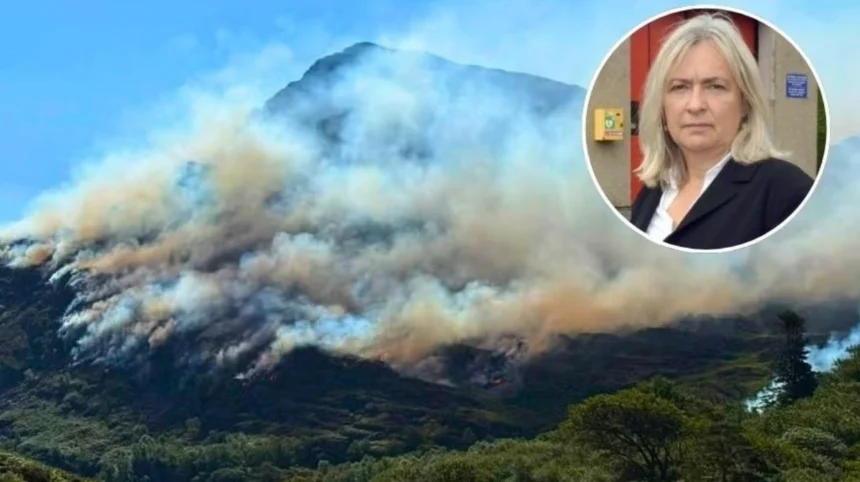
Wales (Wales Times) September 04, 2026 – A major wildfire in the Rhinogydd mountains near Cwm Bychan has prompted fresh calls for UK Government action to improve wildfire response in Wales. The blaze, which broke out in July, burned for more than two weeks across remote and environmentally sensitive terrain within Eryri National Park, causing what Plaid Cymru MP Liz Saville Roberts described as “immeasurable damage” to peatland and wildlife.
- Key Points
- What did Liz Saville Roberts say in Parliament?
- How did the UK Government respond to wildfire resource concerns?
- What wider wildfire pressures have emerged across Wales?
- What is the background to this development?
- What predictions can be made about how this affects communities and emergency services?
As reported by staff at Nation.Cymru, Roberts raised the issue with the new Secretary of State for Wales during Wales Questions in the House of Commons on Wednesday, highlighting gaps in the current system for supporting Welsh crews during large-scale incidents. The North Wales Fire and Rescue Service spent days tackling the blaze, with the remote location making the operation particularly challenging.
According to Plaid Cymru, aerial support was not immediately available because of demand for specialist aircraft elsewhere in the UK, although it was deployed later to help crews tackle remote hotspots and prevent the fire spreading.
What did Liz Saville Roberts say in Parliament?
In the House of Commons, Ms Saville Roberts said:
“The Rhinogydd mountains of Eryri National Park are the last true upland wilderness in Wales. They burned for over two weeks in July causing immeasurable damage to peatlands and wildlife. Despite heroic work by local firefighters, there were no UK wide resources available, including the military, to tackle this ecological disaster. What steps is he taking to ensure Welsh Government have sufficient resources in the face of overwhelming climate change?”
She said the fire highlighted gaps in the current system for supporting Welsh crews during large-scale incidents. Ms Saville Roberts said:
“The wildfire in the Rhinogydd mountains demonstrated both the scale of the threat we face and the remarkable commitment of crews on the ground. They worked tirelessly in demanding conditions to bring the fire under control. However, these incidents also exposed shortcomings in the support available to Wales.”
She argued that aerial firefighting capacity and faster access to UK-wide resources are urgently needed as climate change increases wildfire risk. Ms Saville Roberts said:
“Firefighters were too often left tackling major wildfires without the aerial assistance that can be crucial in containing blazes and supporting crews in difficult terrain. As climate change increases the frequency and severity of wildfires, we must ensure that our emergency services have the resources, equipment, and operational support they need.”
She welcomed plans for a Wildfire and Resilience summit to be held by the First Minister next month but said UK ministers also need to act. Ms Saville Roberts said:
“If Wales is to meet the growing threat posed by wildfires, the UK Government must also play its part by ensuring that Welsh fire and rescue services have access to the investment and support necessary to keep our communities safe.”
How did the UK Government respond to wildfire resource concerns?
Welsh Secretary Stephen Kinnock told the Commons:
“My understanding is that there were challenges around the helicopter capability. I think decisions were taken by Natural Resources Wales some time ago in changing the way that the tendering worked for helicopter capability. We certainly need to look at that, but I also would hope that she would welcome the fact that when the Welsh Government and the fire services did put in a request for MACA, the MACA request was turned around by myself within an hour. And so that shows, I think, Team Wales partnership between the Ministry of Defence and the Welsh authorities to get on top of these deeply troubling situations.”
MACA – Military Aid to the Civil Authorities – is the formal process through which civilian authorities can request Ministry of Defence support during an emergency. Calls for military assistance were made during the Rhinogydd wildfires after specialist aerial firefighting helicopters were initially unavailable because of high demand elsewhere in the UK.
In related statements captured during Prime Minister’s Questions, the UK Government confirmed that South Wales Fire and Rescue Service submitted a military aid to the civilian authorities request for consideration, which was endorsed by both the Welsh Government and the Wales Office and authorised by the Ministry of Defence. While matters related to agriculture and the fire and rescue services are devolved in Wales, ministers said they are committed to working with the Welsh Government to strengthen resilience against wildfires and provide assistance to those affected.
What wider wildfire pressures have emerged across Wales?
The Rhinogydd incident occurred amid a broader period of intense wildfire activity across Wales. As reported by WalesOnline, from July 19 to September 1, the joint fire control centre managed a total of 8,466 calls, reaching a peak on August 13 with 1,006 incoming calls in a single day.
South Wales Fire and Rescue Service declared a major incident in response to multiple prolonged and concurrent wildfires. At the height of activity last month, the service was responding to 14 concurrent wildfires across the region and using every available resource to keep communities safe, including specialist mutual aid through National Resilience and British Army support through Military Aid to Civil Authorities.
The major incident has now been stood down, but emergency services continue to warn that the risk has not disappeared and are urging the public to remain vigilant and avoid activities that could increase wildfire risk.
What is the background to this development?
The push for improved wildfire response in Wales follows a summer of repeated large-scale blazes across upland and rural areas, exposing strain on fire service capacity and specialist resources. Senedd members have urged the Welsh Government to review emergency response, with Cabinet Minister for Local Government, Housing and Planning Siân Gwenllian saying its upcoming summit would include the Fire Brigades Union and other recognised representative bodies.
Peredur Owen Griffiths MS, commenting on the impact of Gwent wildfires, said it had been devastating to see the impact of fires across the country over the summer holidays and asked the government to consider whether enhanced preventative measures such as improved land management practices, enhanced firebreaks or other resilience interventions are needed in residential areas vulnerable to mountain blazes.
Plaid Cymru has also linked wildfire resilience to wider devolution debates. The party’s Westminster leader has written to Prime Minister Andy Burnham calling for a constructive relationship to advance devolution to Wales, including powers over policing, the Crown Estate and rail infrastructure. Roberts said:
“We have reached out to the Prime Minister because we want a constructive relationship that allows us to work together to deliver for Wales and improve people’s lives.”
What predictions can be made about how this affects communities and emergency services?
If the UK Government and Welsh authorities do not expand aerial firefighting capacity and streamline access to UK-wide resources, future wildfire seasons are likely to place even greater pressure on local crews, particularly in remote upland areas such as Eryri. For communities living near wildfire-prone landscapes, this could mean longer incident durations, higher disruption to homes and livelihoods, and increased risk to natural assets such as peatlands and wildlife habitats.
For emergency services, the trajectory points toward more frequent major incidents requiring mutual aid, military support and cross-border coordination. Without additional investment in equipment, training and preventative land management, fire and rescue services may face repeated capacity constraints during peak periods, as seen during the August surge when more than 1,000 emergency calls were handled in a single day.
For policymakers, the Rhinogydd case is likely to sharpen scrutiny of how devolved and reserved responsibilities intersect during environmental emergencies. If the Wildfire and Resilience summit leads to concrete changes in helicopter tendering, MACA procedures and preventative measures, it could reduce response times and ecological damage in future seasons. If not, pressure is likely to grow for clearer UK-wide frameworks to support Welsh fire and rescue services as climate-driven wildfire risk intensifies.