

Key Points
- Questions have been raised over the effect of proposals for a data centre in Cardiff on local air quality.
- Curtis Hall Ltd made proposals in January 2026 to construct a data centre on the Cardiff East Park & Ride site in Llanrumney.
- An initial assessment on air quality noted the emissions from running emergency backup generators for over 30 minutes would exceed short-term NO2 limits and recommended local people remain indoors with windows shut.
- However, a second, more detailed April 2026 air quality assessment deemed the emissions safe for human health, thanks to using newer, less polluting generators and weekly individual testing.
- Two Senedd members, Nick Carter and Zaynub Akbar, dispute the modelling results and claim the revised assessment still predicts up to three annual NO2 breaches near residential properties and Glan‑yr‑Afon Primary School.
- The Welsh Government has imposed a holding direction that stops Cardiff Council from approving the application until ministers decide whether to call it in.
- Cardiff councillor Joe Carter is calling on ministers to call in the application due to energy, water, transport and environmental implications.
- Curtis Hall Ltd disputes any health dangers in their present proposal, claiming the recommendation to stay indoors concerns an outdated December
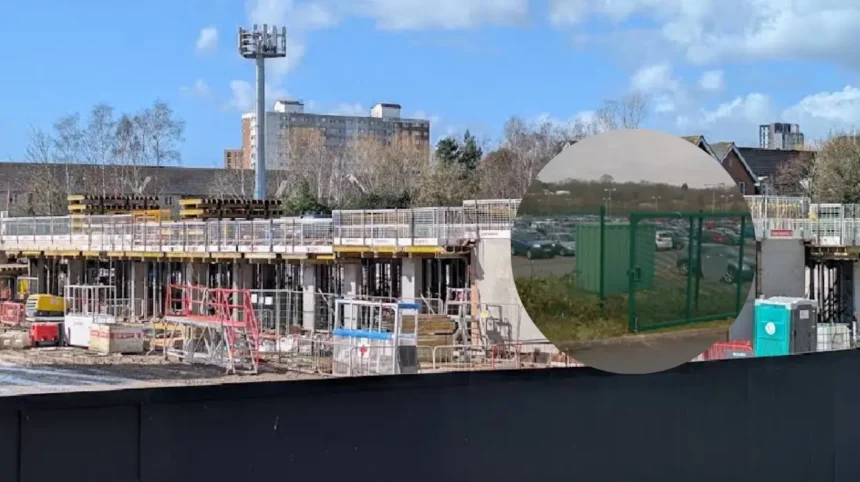
Cardiff (Wales Times) September 10, 2026 – Concerns have been raised about the impact controversial plans for a data centre will have on the air quality for local residents. In January 2026 Curtis Hall Ltd submitted plans to uk/local/cardiff/cardiff-council/">Cardiff Council to build a data centre on the site of the Cardiff East Park and Ride in Llanrumney. In the application’s air quality assessment, under a section labelled “Use of the emergency backup generators for more than 30 minutes”, the application reads: “It is likely that the short-term impact of NO2 (nitrogen dioxide) emissions from the backup emergency generators, when operated more than 30 minutes, would result in the exceedance of the short-term NO2 air quality objective for the protection of human health.” It continues: “Therefore, in case of the emergency use of the backup generators at the data centre, it is recommended that the operators take the additional precautions to limit exposure such as informing the neighbouring residents to stay inside and keep windows closed.”
- Key Points
- What did councillors and campaigners say about health risks?
- Why have Welsh ministers intervened in the planning process?
- How does the Cardiff case fit wider UK data centre debates?
- Background to the Cardiff data centre development
- Prediction: how could this development affect local residents and patients?
In a further assessment from April 2026 guidance on the backup generators changed to say that each of the backup generators would be tested individually each week and the nitrogen dioxide levels emitted were “considered acceptable for the protection of human health”. Despite this two members of the Senedd are still concerned about the impact the fumes could have on residents if the development went ahead. In a joint statement to the Local Democracy Reporting Service (LDRS) MSs Nick Carter and Zaynub Akbar said: “People in Llanrumney should never be told that breaching air quality standards next to their children’s school is acceptable.” “But that is exactly what nearby homes and Glan-yr-Afon Primary School are facing even under the developer’s own revised modelling, which still predicts up to three breaches of safe nitrogen dioxide levels a year.”
“The applicant’s original air quality assessment found that running backup generators for more than half an hour would likely breach safe nitrogen dioxide limits and their advice would have been that nearby residents should stay indoors with their windows shut.” “After questions from Cardiff council the applicant narrowed the testing conditions, testing generators one at a time instead of together, and revised the modelling to show the impact as ‘acceptable’.” “The developer says that is fine because it falls under an annual limit. We do not agree.”
Recently the Welsh Government issued a holding directive against the plans, which prevents Cardiff council from approving the application while the Welsh Government considered whether they should be the final decision-makers – a move welcomed by the two MSs. The directive does not stop the council from debating or refusing the application. The directive came after public outrage from the local community in which multiple campaigns against the data centre have been launched.
What did councillors and campaigners say about health risks?
One campaign was led by Cllr Joe Carter who represents the ward the centre is planned in. Regarding the original assessment the councillor for Pentwyn told the LDRS: “The proposed data centre is not only taking away a much-used hospital park and ride, removing open space, and creating water issues, it risks poisoning the air we breathe as well.” “The fact that the developers admit in their own documents that to use the diesel generators for more than 30 minutes would create a health risk is very worrying.” “This development brings no benefit to Pentwyn and surrounding communities and only brings potential harm to our health and our environment. It must be stopped.”
Curtis Hall Ltd has denied claims the data centre’s backup generators would pose a risk to the health of local residents. A spokesman for the developer told the LDRS: “The suggestion that the current proposals acknowledge a health risk from operating the backup generators for more than 30 minutes is based on an outdated assessment from December 2025 and does not reflect the scheme currently before the planning authority.” “During the planning process the proposals were updated to use newer, lower-emission generators, supported by a further air quality assessment submitted in April 2026.” “That modelling assessed impacts at sensitive locations, including nearby homes, schools, and care homes, and concluded that the proposed scheme is acceptable in terms of protecting public health.”
They went on to say that it is “incorrect” to suggest the assessment was made acceptable by narrowing the testing conditions and the testing requirements have not changed with “routine testing” always having involved running one generator at a time for 30 minutes. The spokesman added: “The key change was the use of newer, lower-emission generators. The national air quality standards have not changed either and the updated assessment demonstrates that the scheme meets those standards.” “These generators are for emergency backup only and would be used in the unlikely event of a grid failure. The updated assessment considered an extreme 72-hour outage, which National Grid data indicates might occur only once in 10 years.” “Even in that scenario the combined risk of exceeding the one-hour limit is around one in a thousand, which regulators regard as not significant.” “References to residents staying indoors with windows closed therefore relate to the earlier December 2025 assessment and should not be presented as advice applying to the updated scheme.”
Why have Welsh ministers intervened in the planning process?
Welsh Government ministers have been urged to take control of a controversial planning application for a huge data centre proposed on the site of a hospital park-and-ride facility. Cardiff councillor Joe Carter has asked the Welsh Government to “call in” plans for the development at the Cardiff East Park and Ride in Pentwyn, meaning the final decision would be made by ministers rather than Cardiff Council. Curtis Hall Ltd submitted plans in January to build the data centre on the site, which is currently used to provide a free park-and-ride service for the University Hospital of Wales. The proposal has attracted significant opposition, including protests at County Hall and a petition calling for the Welsh Government to intervene.
Cllr Carter, a Liberal Democrat who represents Pentwyn, has now written to Planning Minister Siân Gwenllian asking her to use her powers to call in the application. Such interventions are rare. According to the Welsh Government, only around five to 10 of approximately 25,000 planning applications each year are called in for determination by ministers. Cllr Carter told the Local Democracy Reporting Service (LDRS): “We’ve been fighting the controversial plans to demolish a popular hospital park and ride and replace it with an energy intensive data centre since the end of last year.” “It’s the equivalent of 10 football fields. It will use the electricity of 100,000 homes and potentially 0.6m litres of water a day.” “These proposals undermine the One Planet Cardiff strategy and any other green aspirations this city and country have.” “We are calling on the planning minister, Siân Gwenllian MS, to use her powers to call in this application, take independent evidence, and make a decision.” “Her predecessor did this with the Cardiff Parkway Railway and that was much better aligned with Welsh Government transport and climate change policies.”
The call-in request, signed by Cllr Carter and fellow councillor Dan Naughton, also raises concerns about the potential impact on roads, the loss of a public amenity and access to the hospital. It argues the proposed data centre would be “extremely energy intensive” and could have a “severe impact” on the ability of patients to travel to the hospital. A petition carrying 2,995 signatures was submitted with the letter. The application has also attracted more than 1,300 comments on Cardiff Council’s planning portal, with 1,296 objections and two comments in support.
A spokesman for the developer told the LDRS: “Our planning application sets out how we have designed the scheme in line with local planning policy, to minimise environmental impacts, whilst supporting South Wales’ economic and investment ambitions as an AI growth zone.” “The site ceased operating as a park and ride due to significant operating costs and underuse by visitors.” “Cardiff council granted temporary use of the site to University Hospital of Wales for use as a car park in 2023 pending the site’s longer-term redevelopment.” “We understand that Cardiff Council continues to support the hospital in securing a more sustainable alternative parking site.” “Our plans would improve sustainable transport for local communities living closest to the site through the provision of a new bridge and link road between Pentwyn and Llanrumney, connecting these communities and relieving the congestion on surrounding roads.”
No decision has yet been made on the planning application. The Welsh Government’s Planning Directorate has been contacted for comment.
How does the Cardiff case fit wider UK data centre debates?
In Cardiff, campaigners are concerned about proposals for a data centre campus in Llanrumney, on the site of the Cardiff East Park & Ride that takes passengers to the University Hospital of Wales. “The park-and-ride is so important,” said Sue Elias, who uses the service and has been campaigning against the proposal with the residents’ union Acorn. Elias said she understood the need to build data centres but said “there should be a pause” to consider the most responsible sites. “They shouldn’t just be put up and then worry about the consequences afterwards.”
Cardiff and Vale University Health Board (CVUHB) said the park and ride was an “essential transport link”, adding that it was “committed to identifying a suitable and convenient alternative location”. The campaigners are also concerned about the potential impact on the environment. “The data centre planned would be an environmental nightmare both for the wildlife and the local residents,” said Lizzie Bailey, who lives locally. “This will be a temporary disruption with the construction but then a permanent disruption because of the diesel generators, the noises, the cooling fans, things like that.”
Curtis Hall Ltd, the company behind the plans, said the development would “not put a strain on the energy grid or water infrastructure”. The company added: “The data centre’s water and drainage requirements have been developed in consultation with Welsh Water and any connection to the public network requires their agreement.” “This ensures our data centre can be accommodated without impacting the supply of water to residents’ homes.” It said a “detailed noise impact assessment” concluded the site “won’t have an adverse impact on the nearest homes in terms of noise, including at night”.
Cardiff Council said the proposal was being considered, and that “as with all planning applications, the proposal will be assessed against relevant planning policies and material planning considerations”. The council encouraged people with “comments, concerns or views” to submit them through the consultation process. There are currently 568 data centres listed in the UK, according to the data centre map. Research suggests that number is set to increase by almost a fifth with nine proposed in Wales. A Senedd Research document recently outlined the opportunities that data centres could bring, including “jobs, investment, skills development and support for innovation”. But it also noted the “significant resource and policy questions they raise”, including electricity demand, grid capacity, water use, land requirements, biodiversity and impacts on local communities.
Ofgem said the amount of electricity being requested by data centre projects seeking to connect to the grid had risen from 41GW to 125GW in the past year, reflecting a sharp increase in demand. Water UK, the trade association for the UK’s water industry, estimated that data centres used approximately 6.6 million litres of water each day – the equivalent used by 20,000 average homes. By some analyses, the UK is already the third-largest nation for data centres behind the US and Germany. Prof Alan Brown from the University of Exeter, the author of Making AI Work for Britain, said authorities should be “a lot more engaged” with communities about the construction of data centres. “If that gets bypassed, then of course local residents are going to worry that they’re getting all of the pain and none of the benefit.” He said when people understood the implications of a data centre and what it meant for them, “they’re more willing to be more flexible”. “I think right now, there’s a lack of communication around that.”
The environmental group Friends of the Earth is calling for a UK-wide pause on all new data centres. “We’re asking for that pause until there are clear rules set out on how much energy and water data centres can use, to make sure they’re not sucking up our much-needed renewables and our clean water,” said Kierra Box, from the group. “We need an idea of how now, and in the future governments are going to determine the individual and the joint impact of all these data centres on the environment, on communities, on nature.” But tech founder Mark John said the development of data centres and AI (artificial intelligence) infrastructure had offered “an opportunity for Wales” to “reimagine itself”. “AI, data and data centres are going to be at the forefront of the new Industrial Revolution,” said John, co-founder of Tramshed Tech. “This could be the new frontier technology, in the same way that coal and steel were at the forefront of industrial transformation.”
The UK government said many newer data centres were “already using advanced cooling systems that significantly reduce water consumption, and the data centre sector operates under a Climate Change Agreement to encourage greater uptake of energy efficiency measures amongst operators”. It added: “Data centre planning applications are required to consider the impact on communities and the environment.” “We will enable the development of data centres by building unprecedented amounts of clean power, while our AI Growth Zones support data centre development in areas with access to clean energy.”
The Welsh government said it recognised that data centres were “energy intensive”, and that it was important for new developments to make use of technologies to minimise energy and resource consumption. “Any proposed data centre development remains subject to the existing planning system and environmental regulation, with robust checks and balances in place to ensure that environmental and community impacts are properly considered before consent is granted,” it added. “Investment in data centres has the potential to create new economic opportunities and support skilled employment, while strengthening Wales’ attractiveness as a leading destination for advanced digital investment.”
Background to the Cardiff data centre development
The proposal centres on repurposing the Cardiff East Park & Ride site in Llanrumney, which has served as a transport link for the University Hospital of Wales. Curtis Hall Ltd lodged its planning application in January 2026, triggering a consultation that drew more than 1,300 comments, the vast majority objections. Early air quality modelling attached to the application flagged potential short‑term NO2 exceedances if emergency diesel generators ran beyond 30 minutes, prompting advice that neighbours should remain indoors with windows closed. Subsequent revisions in April 2026 introduced lower‑emission generators and weekly individual testing, with the developer concluding that impacts at nearby homes, schools and care homes were acceptable. Local politicians and two Senedd members contest that conclusion, arguing the revised approach still allows multiple annual breaches near sensitive receptors. Amid sustained local campaigning, the Welsh Government issued a holding direction in early September 2026, pausing any approval by Cardiff Council while ministers consider whether to call in the application for a final decision.
Prediction: how could this development affect local residents and patients?
If approved, the data centre could affect Llanrumney and Pentwyn residents through intermittent diesel generator use during grid outages, with disputed modelling suggesting a small but non‑zero risk of short‑term NO2 exceedances near homes and Glan‑yr‑Afon Primary School. For hospital users, the loss of the existing park‑and‑ride could alter travel patterns to the University Hospital of Wales unless a suitable alternative is delivered, potentially affecting appointment attendance and access for staff and patients. On the other hand, the developer’s proposed new bridge and link road between Pentwyn and Llanrumney could improve local connectivity if implemented as described. The ultimate impact on air quality, traffic and community amenity will depend on the final planning conditions, the reliability of the grid connection, and whether emergency generation remains rare and tightly controlled.