

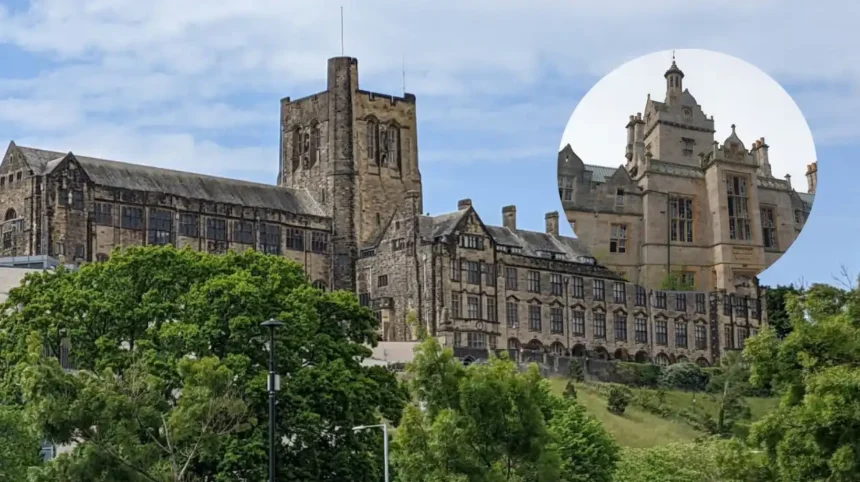
Key Points
- Arts and Humanities Research Council funding has been obtained by Bangor University for a three-year project about Denbigh Hospital heritage.
- This project aims to research the social history, architecture and role within the local community of the former hospital.
- A virtual recreation of the hospital is intended to be done in order to better comprehend the process of its development and functioning.
- It is expected that the results will be shared with local communities, former patients, employees, family members, historians and the general public.
- The research will consider the hospital both as a building and institution which is connected to generations of people from Denbighshire.
- This project might contribute to preserving memories and historical facts about a hospital whose buildings and documentation are exposed to dangers of time, change and destruction.
- The research is likely to link academic research and digital heritage together.
- This story was covered by the Bangor Aye. The provided article does not mention any specific journalist.
Bangor (Wales Times) September 19, 2026 — It has secured funding from the Arts and Humanities Research Council for a three-year project to research, digitally reconstruct and share the story of Denbigh Hospital heritage.
- Key Points
- How will the Bangor University project research the hospital?
- Why does Denbigh Hospital’s social history matter?
- What role will digital reconstruction play in preserving the site?
- Who could benefit from the research?
- How will the findings be shared?
- What has been reported about the announcement?
- What is the background to Denbigh Hospital heritage?
- How could the development affect local communities and heritage audiences?
The development places the former hospital’s buildings, communities and memories at the centre of a research programme designed to document its social and architectural importance. According to The uk/local/bangor/">Bangor Aye’s report, the project will investigate the hospital’s story and create digital resources through which the public can engage with the site’s history.
The funding is significant because Denbigh Hospital was more than a collection of buildings. Like many hospitals that served a local population over several generations, it was also a workplace, a place of care and a focal point for patients, families and surrounding communities. Its history therefore includes both architectural evidence and personal experiences.
The project is expected to bring those strands together. Researchers will study the hospital’s physical environment while also considering the people and communities connected with it. The planned digital reconstruction will offer a way to represent the hospital as it changed over time and to communicate that history beyond conventional academic publications.
How will the Bangor University project research the hospital?
The project will use historical research to examine the development and significance of Denbigh Hospital. Its scope includes the hospital’s architecture, its social history and the way it operated as part of the local community.
A central element will be the creation of a digital reconstruction. This approach can help researchers present buildings, layouts and historical changes in a form that is accessible to people who cannot visit the site or who may no longer be able to see the hospital as it once existed.
The reconstruction is also intended to support interpretation. Instead of presenting the hospital only through written descriptions or photographs, the project will use digital technology to provide a visual representation of its architecture and setting. That could help users understand how different parts of the hospital related to one another and how the site evolved.
The Bangor Aye reported that the team will research, digitally reconstruct and share the story of the hospital. The article’s supplied information does not provide a full list of the project researchers, the total grant value, the precise technical format of the reconstruction or a detailed publication timetable. Those details should therefore not be inferred.
Why does Denbigh Hospital’s social history matter?
The social history of a hospital records how an institution affected people’s lives. It can include the experiences of patients, the work of doctors and nurses, the contribution of other staff, the role of families and the hospital’s relationship with the town and wider region.
That history can be difficult to preserve because it is often distributed across official records, newspaper reports, photographs, architectural plans, private collections and personal memories. Individual recollections may not appear in formal institutional documents, while written records may not fully explain how people experienced the hospital.
A project that combines archival research with community participation can therefore widen the historical record. Memories from former patients and employees may provide information about wards, routines, services and everyday life. Family stories can also show how the hospital was understood by people who relied on it.
The project’s public-facing purpose is particularly relevant in this context. Sharing the research can allow people connected to Denbigh Hospital to recognise their own experiences in the historical account and to contribute information that may otherwise remain undocumented.
What role will digital reconstruction play in preserving the site?
Digital reconstruction can preserve information about a historic site even when the original buildings have changed, been repurposed or become difficult to access. It can bring together evidence from maps, plans, photographs, written records and oral testimony.
For Denbigh Hospital, the method may make it possible to show architectural features and spatial relationships that are not immediately visible today. A digital model can also support comparisons between different periods, illustrating how the hospital expanded or altered as medical needs and local services changed.
The reconstruction should not be treated as a substitute for original evidence. Its value will depend on the quality of the sources used and the clarity with which researchers distinguish documented features from interpretation. Properly presented, however, it can provide an effective way to explain complex historical information to schools, families, researchers and members of the public.
It may also help preserve a record for future generations. Digital heritage projects can be updated as new evidence emerges, although their long-term usefulness depends on maintaining the files, documentation and access systems after the funded research period ends.
Who could benefit from the research?
The project could benefit several groups connected with Denbigh Hospital and its history.
- Former patients may find an opportunity to contribute memories and understand how their experiences fit into the hospital’s wider story.
- Former staff may help document working practices, professional roles and changes in healthcare provision.
- Families may contribute photographs, letters and personal accounts that are not held in public archives.
- Local residents may gain a clearer account of the hospital’s importance to Denbigh and surrounding communities.
- Schools and community groups may use the digital material for local-history education.
- Historians and heritage researchers may gain a consolidated resource for studying healthcare, architecture and social change.
- The university may strengthen its links with communities by making academic research publicly accessible.
The project also reflects a broader interest in interpreting heritage through the experiences of ordinary people. Buildings can be preserved as architectural objects, but their significance is often better understood when connected to the people who used them.
How will the findings be shared?
The stated aim is not only to conduct research but also to share the story of Denbigh Hospital. The digital reconstruction is likely to be a major part of that public engagement, although the supplied report does not specify all planned activities.
Sharing could involve online material, exhibitions, public events, educational resources or opportunities for people to submit memories and evidence. The precise methods remain to be confirmed by the project team.
Public access will be important to the project’s success. Research about a local institution has greater value when communities can see the results, assess them against their own knowledge and continue the conversation after the initial academic work has been completed.
Clear attribution will also matter. Personal memories should be identified appropriately, archival sources should be acknowledged and any reconstructed elements should be explained so that audiences understand the difference between direct evidence and informed interpretation.
What has been reported about the announcement?
The Bangor Aye reported that Bangor University had secured Arts and Humanities Research Council funding for a three-year project involving research, digital reconstruction and public sharing of Denbigh Hospital’s story.
No separate media reports or named author statements were provided with the material supplied for this article. Consequently, claims about the project have been limited to the information available in the referenced report. The funding amount, project title, staff involved, partner organisations and delivery milestones have not been added because they were not confirmed in the available source material.
That limitation is important when reporting on a developing research project. The announcement establishes the funding and broad objectives, but further information will be needed to describe the project’s methodology, community engagement programme and final outputs in detail.
What is the background to Denbigh Hospital heritage?
Denbigh Hospital’s heritage includes the physical buildings associated with healthcare in the area and the social memories created by the people who worked in and used the institution. Its significance is therefore likely to extend beyond architectural design.
Hospitals often change as healthcare systems develop. Wards may be adapted, services may move, buildings may be extended and former clinical spaces may acquire new uses. Each change can leave evidence of how medical care, technology and community needs evolved.
The hospital’s history can also reflect wider developments in Welsh society. Employment patterns, public health, professional training, family life and local identity may all be connected to the institution. Researching those relationships can place Denbigh Hospital within a broader account of healthcare and social change.
Bangor University’s project will provide a structured opportunity to examine those themes. By combining historical research with digital reconstruction, it can preserve information about the site while making the history more accessible to people beyond the university.
How could the development affect local communities and heritage audiences?
The project could give local communities a stronger role in preserving Denbigh Hospital heritage by creating a recognised platform for memories, photographs and historical evidence. Former patients, staff and residents may be able to contribute to a record that reflects personal experiences as well as institutional history.
For heritage audiences, the digital reconstruction could make the hospital easier to understand and engage with, particularly if it shows changes to the site over time. It could also support education and local-history activities.
The likely effect will depend on how widely the university shares the findings and how effectively it maintains the digital material after the three-year project. If the work remains accessible and clearly documented, it may become a lasting resource. If access is limited or the digital outputs are not maintained, its public benefit could be reduced.
At this stage, the confirmed development is the funding and the project’s broad research purpose. The eventual effect on tourism, conservation decisions, education and community participation will depend on the findings and the project’s later partnerships.