
Key Points
- Findings from archaeological excavations at the site of the now defunct Hafod-Morfa Copperworks have left designers no choice but to re-plan their new structure.
- According to Herald Wales, the findings pose “a big challenge” to the designers of the building.
- The affected development is the proposed Link Building project involving the restoration of Musgrave and Vivian Engine Houses and Rolling Mills.
- In the words of Black Mountains Archaeology, the initial plans involved the destruction of some parts of some of the archaeologically important structures and filling up historic voids.
- The redesigned structure will employ piling methods, including diamond drilling, ODEX, and mini-pile technologies.
- Restoration work is being done with the assistance of Swansea City Council and funds provided through the UK Government’s Local Regeneration Fund.
- The archaeology process has unearthed furnaces, flues, machinery foundations, rolling mills’ lines, culverts, and various other archaeological features that are over 150 years old.
- These finds are considered by Black Mountains Archaeology to be proof of one of Britain’s most important industrial complexes.
Swansea (Wales Times) October 05, 2026 — Archaeological remains revealed at uk/local/swansea/">Swansea’s former copperworks have forced designers of a new building to change their plans, according to Herald Wales, which reported that the finds have given the project’s designers “a big challenge”.
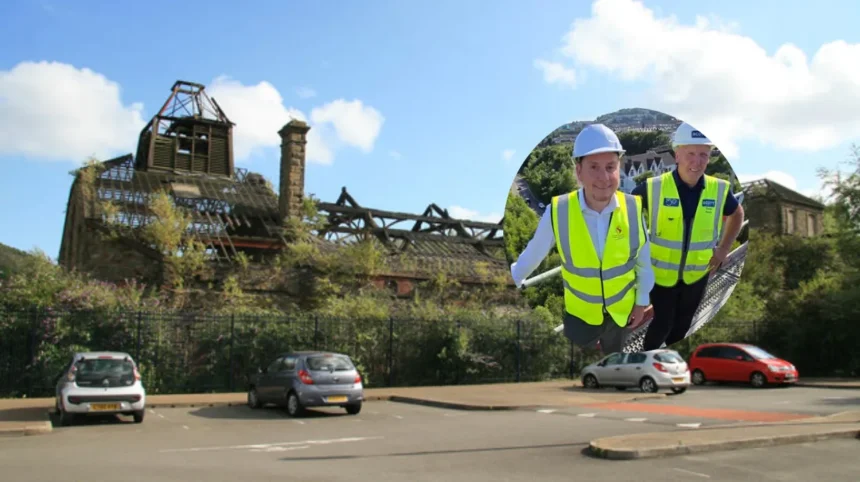
The development concerns the Hafod-Morfa Copperworks in Landore, where Swansea Council is carrying out a wider restoration of historic industrial buildings. The archaeological discoveries affect the design of a proposed Link Building associated with the Musgrave and Vivian Engine Houses and Rolling Mills.
Why have archaeological finds changed the design?
As reported by Herald Wales, archaeological remains at the former copperworks have presented designers with a major challenge in creating a new building. The report did not provide further details about the exact nature of the newly revealed remains or the revised building layout.
Black Mountains Archaeology, which has supported Swansea Council on the restoration, said in a July 2026 project update that the proposed Link Building required an unusually complex foundation design because of “exceptionally complex and deeply stratified archaeological remains”, voids, contaminated ground, water ingress and unstable made ground.
The company said the original engineering proposal involved engineered fill and a reinforced concrete raft foundation. It stated that this approach would have required the partial removal of significant archaeological structures and the infilling of historic voids, while also creating an unacceptable risk of settlement in surviving remains.
What solution has been adopted?
Black Mountains Archaeology said it worked with conservation engineers Mann Williams and GOWN, alongside Swansea Council, Cadw, Heneb and the wider project team, to develop a revised foundation approach.
The final solution is described as a highly targeted piled foundation system using diamond drilling together with ODEX and mini-pile techniques. Black Mountains Archaeology described this as a “keyhole surgery” approach, intended to thread foundations through archaeological remains with precision while reducing disturbance and vibration.
The company said ground investigations using rotary coring produced clean cores through selected archaeological structures with negligible disturbance. It added that the design process was informed by Historic England’s Piling and Archaeology: Guidance and Good Practice (2019).
What has been found at the copperworks?
Black Mountains Archaeology said its investigations across the wider copperworks site have uncovered well-preserved remains of buildings, furnaces, flues, machinery and industrial floor surfaces. It said these provide insight into almost two centuries of copper production.
The company said its work was carried out in three phases between January 2024 and October 2025. Finds included a drive shaft and belt wheel, masonry structures and a probable flywheel pit linked to the original 1819 beam engine house, the Vivian flywheel pit, two rolling-mill lines, machine bases, annealing furnaces and extensive hot-gas flues.
Later phases uncovered the Musgrave rolling machine pit with surviving in-situ machinery, two annealing furnaces, major hot-gas flues connecting to the Musgrave chimney, a steel water-supply pipe, a substantial stone platform, early nineteenth-century rolling-mill remains, curved stone foundations, culverts, pipework and a brick manhole chamber.
Black Mountains Archaeology said the remains represent one of the most significant surviving industrial landscapes in Wales and that preservation became a central objective of the wider restoration project.
What is being restored at Hafod-Morfa?
The wider project involves the stabilisation and restoration of the Scheduled Monument and Grade II Listed Musgrave and Vivian Engine Houses and Rolling Mills. Swansea Council says the project is expected to be completed this year, after which the building will be ready for fitting out by a future occupier.
As reported by Swansea Bay News, the nearby Grade II listed Laboratory Building is also being restored by John Weaver Contractors. The council says the building could open as a restaurant seating more than 100 people once complete.
Swansea Bay News reported that contractors have repaired stonework, stabilised archways and rebuilt a chimney stack using salvaged bricks. The publication said a Welsh slate roof was the next major task and that the council expected the building to be watertight and complete this year.
Swansea Council leader Rob Stewart said the copperworks had the potential to become a major leisure destination. As quoted by Swansea Bay News, he said:
“We’re pushing forward with the restoration of the Tawe River corridor, and Lower Swansea Valley Project.”
Who is involved in the project?
Black Mountains Archaeology said it worked as part of a wider design team with Swansea Council, Swansea’s Local Planning Authority, Cadw, Heneb, GWP Architecture, Mann Williams, principal contractor Andrew Scott Ltd and other specialists, including Ian Davies Plant, Pritchards Remediation, Coreus and SLR Consulting.
The company said every design decision was considered against archaeological significance, engineering practicality, construction methodology, programme requirements and project budget. It said pile positions were repeatedly challenged, relocated or removed where necessary during successive design reviews.
The archaeological archive, including excavation records, plans, reports, survey data, photographs and digital models, is due to be deposited with the National Monuments Record of Wales and the regional Historic Environment Record curated by Heneb.
Background of the development
The Hafod and Morfa Copperworks were among the largest copperworks in the world at their peak in the mid-nineteenth century, according to Black Mountains Archaeology. The company said the works employed more than 1,000 people and produced a substantial proportion of the world’s copper and yellow metal.
The two works were amalgamated in 1924 to form British Copper Manufacturers before being acquired by Imperial Chemical Industries in 1927, becoming known as ICI Landore. Black Mountains Archaeology said copper plate and sheet production continued until the works closed in 1980, ending the last operational copper plate mill in the United Kingdom.
Swansea Council says the Laboratory Building once played a key role in the copperworks that helped put Swansea on the global industrial map. The council’s wider Lower Swansea Valley regeneration programme includes restoration of the engine houses, river-side improvements and other heritage projects.
Prediction: What could this mean for Swansea?
For local residents, the redesign is likely to mean that more of the copperworks’ buried industrial history can remain protected while the site is brought back into use. If the targeted foundation approach performs as described, it may allow regeneration and heritage conservation to continue side by side at one of Wales’ most significant industrial locations.
For visitors and potential businesses, the project could strengthen the Hafod-Morfa area as a heritage and leisure destination. Swansea Council has already said the restored Laboratory Building could accommodate a restaurant, while the engine houses could eventually provide food, retail and exhibition space.
For heritage and construction professionals, the case may become a practical example of how archaeological constraints can shape foundation engineering. Black Mountains Archaeology said the adopted solution shows what can be achieved through collaboration between archaeologists, engineers, conservation bodies, planners and contractors.