
Key Points
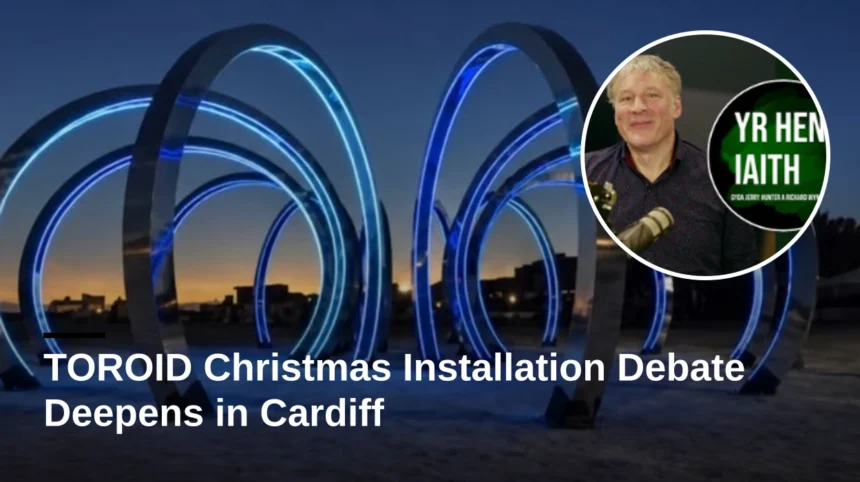
- TOROID, a light and sound installation, is being displayed in Cardiff’s Central Square.
- The artwork is the centrepiece of FOR Cardiff’s 2026 Christmas campaign and is funded through the business improvement district levy.
- Some residents have questioned whether public priorities should favour artwork while homelessness and the cost-of-living crisis remain concerns.
- FOR Cardiff says the installation is free, supports the city centre and was approved through member consultation and board oversight.
- The installation will remain in place until January 5, 2027.
uk/local/cardiff/">Cardiff (The Wales Times) November 25, 2026 — A large Christmas light installation in Cardiff’s Central Square has prompted debate about spending priorities, after some residents questioned the value of funding public art while homelessness and financial hardship remain visible concerns. TOROID, created by Somerset-based artists Harriet Lumby and Alan Hayes of This is Loop, was commissioned by city-centre business improvement district FOR Cardiff as the centrepiece of its 2026 Christmas campaign. The free installation combines mirrored structures, lighting and a soundscape created by Welsh musicians Cian Ciarán and Meilyr Tomos.
Why has TOROID attracted criticism in Cardiff?
As reported by Nation.Cymru, residents criticised the installation on social media and questioned whether money could instead support homelessness services, animal shelters or other community priorities. One commenter described the artwork as unnecessary, while another said displays offering a seasonal photo opportunity were difficult to justify while people slept rough in cold conditions.
Nation.Cymru also reported that some people asked how much the installation cost. No total expenditure was included in the report.
How has FOR Cardiff responded to the concerns?
Carolyn Brownell, Executive Director of FOR Cardiff, said the project was funded through the levy paid by eligible businesses and organisations, rather than council tax. She said member working groups set annual project budgets and that FOR Cardiff’s volunteer Board of Directors approves them. The organisation publishes spending details in its annual reports.
Brownell said Central Square provides the first impression of Cardiff for many rail passengers and that businesses and city partners had identified a more welcoming square as a priority. She said public art was suggested as one way to achieve that aim and argued that TOROID could encourage visitors to spend time in the city centre, shops, cafés and restaurants during the festive trading period.
“TOROID is free for everyone to enjoy and gives people another reason to spend time in the city centre,” Carolyn Brownell said, according to Nation.Cymru.
What does the Cardiff installation include?
According to It’s On Cardiff, TOROID will be available from 4pm on November 25, 2026, until January 5, 2027, each day between 4pm and 10.30pm. The work comprises 12 mirrored hoops measuring four metres high and 13 metres in diameter, forming a reflective canopy intended to encourage visitors to gather beneath it.
The Cardiff presentation marks the first Welsh exhibition by This is Loop. Its soundscape was specially created for the installation’s Cardiff debut and draws on the city’s industrial and cultural history, including experimental metallic recordings made with steel wires and magnets.
The artists said bringing TOROID to Cardiff was their first opportunity to show work in Wales and that they were pleased to present the installation in the city.
What could the debate mean for Cardiff’s Christmas programme?
TOROID is likely to remain part of a wider discussion about how Cardiff’s festive programme balances cultural activity, business support and social concerns. FOR Cardiff expects the free installation to increase footfall and support shops, cafés and restaurants, while critics are likely to continue seeking clearer information about the levy’s cost and benefits.
With the work scheduled to remain in Central Square through the Christmas trading period, public reaction may depend on visitor numbers, business feedback and whether the installation is seen as improving the area without diverting money from services that residents consider more urgent.