Wales officially contains seven recognized cities granted status through royal letters patent or historical charters. These urban centers vary significantly in geographic size, economic output, and total population density across the northern, western, and southern regions of the nation.
The seven official cities in Wales are uk/local/cardiff/">Cardiff, Swansea, Newport, Bangor, St Davids, St Asaph, and Wrexham. The legal designation of a city in the United Kingdom does not depend on population size, municipal footprint, or the presence of a cathedral. City status is an administrative honor conferred exclusively by the British monarch through formal letters patent.
Cardiff gained official city status in 1905 and became the capital of Wales in 1955. Swansea received its status in 1969 to mark the investiture of the Prince of Wales. Newport secured city status in 2002 as part of the Golden Jubilee celebrations of Queen Elizabeth II. Bangor holds ancient cathedral roots dating to the sixth century and had its city status formally confirmed by royal charter in 1974. St Davids was granted city status in 1994 in recognition of its historic Christian heritage. St Asaph was awarded status during the Diamond Jubilee in 2012. Wrexham is the newest addition, obtaining official city status in September 2022 during the Platinum Jubilee Civic Honours competition.
The legal framework governing civic status in Wales means large settlements like Barry, Rhyl, or Merthyr Tydfil remain classified as towns despite having larger populations than historic cities like St Davids or St Asaph. Official administrative records from the Welsh Government, the Office for National Statistics, and the Privy Council confirm these seven specific locations as the sole holders of official city status in Wales.
What is the history of city status allocation across Welsh settlements?
The history of city status allocation in Wales spans early ecclesiastical foundation charters, twentieth century economic expansion, and modern royal jubilee civic competitions. Historical criteria transitioned from cathedral presence to formal civic competitions managed by the Home Office and the Cabinet Office.
During the medieval era, European settlement hierarchy tied city status directly to the presence of a diocesan cathedral. Under this ecclesiastical model, settlements like Bangor and St Davids operated as urban religious centers. Bangor Cathedral was founded by Saint Deiniol in the sixth century, establishing an unbroken line of religious administration in North Wales. St Davids Cathedral developed around the burial site of Saint David, becoming a central pilgrimage destination throughout the Middle Ages.
The legal criteria changed fundamentally during the nineteenth and twentieth centuries. The British Crown detached cathedral ownership from city status, requiring formal administrative petitions instead. Industrial growth in South Wales shifted national focus toward commercial and maritime powerhouses. Cardiff leveraged its position as the primary coal exporting port in the world to secure city status from King Edward VII in 1905. Swansea followed an industrial growth trajectory through its copper smelting and tinplate operations, achieving city status in 1969.
In the modern era, the UK Government introduced competitive civic honors contests to mark significant monarchical milestones. Local councils submit technical bids evaluating economic regeneration, heritage assets, community identity, and royal connections. Newport successfully won its bid during the 2002 Golden Jubilee competition. St Asaph secured its designation during the 2012 Diamond Jubilee after previous unsuccessful attempts. Wrexham completed its transition from county town to city in 2022 through the Platinum Jubilee Civic Honours, illustrating the modern evolution of Welsh civic classification.
How do the populations of Welsh cities compare to one another?

The populations of Welsh cities show extreme variance ranging from regional capital metropolitan areas with over 300,000 residents to small cathedral settlements housing fewer than 2,000 citizens. Official census metrics reflect major demographic disparities across the seven designated urban centers.
Cardiff ranks as the most populous city in Wales, with a local authority administrative population exceeding 359,000 residents. The wider Cardiff urban built-up area forms the economic engine of South Wales, concentrating government administration, higher education, financial services, and media infrastructure. Swansea represents the second largest city in Wales, maintaining an administrative population of approximately 237,000 residents within its county borough boundaries. Newport occupies the third position in demographic scale, recording an administrative population of roughly 159,000 residents.
Wrexham stands as the largest city in North Wales, supporting an administrative county borough population of over 135,000 people. The urban core of Wrexham contains approximately 44,000 residents, surrounded by suburban industrial corridors and commercial districts. Bangor hosts an estimated population of 15,000 permanent residents, a figure that expands substantially during academic terms due to the student intake at Bangor University.
The smallest cities in Wales present unique demographic characteristics that contrast with typical global city models. St Asaph in Denbighshire records a population of approximately 3,400 inhabitants. St Davids in Pembrokeshire is the smallest city in the United Kingdom, maintaining a permanent resident population of around 1,300 people. These population figures demonstrate that statutory city status in Wales operates independently of demographic volume or geographic density.
What administrative and economic roles do Welsh cities fulfill?
Welsh cities fulfill distinct administrative, commercial, cultural, and educational functions within their respective regional economies. The geographic distribution of these cities creates economic hubs across the northern, western, and southern regions of the nation.
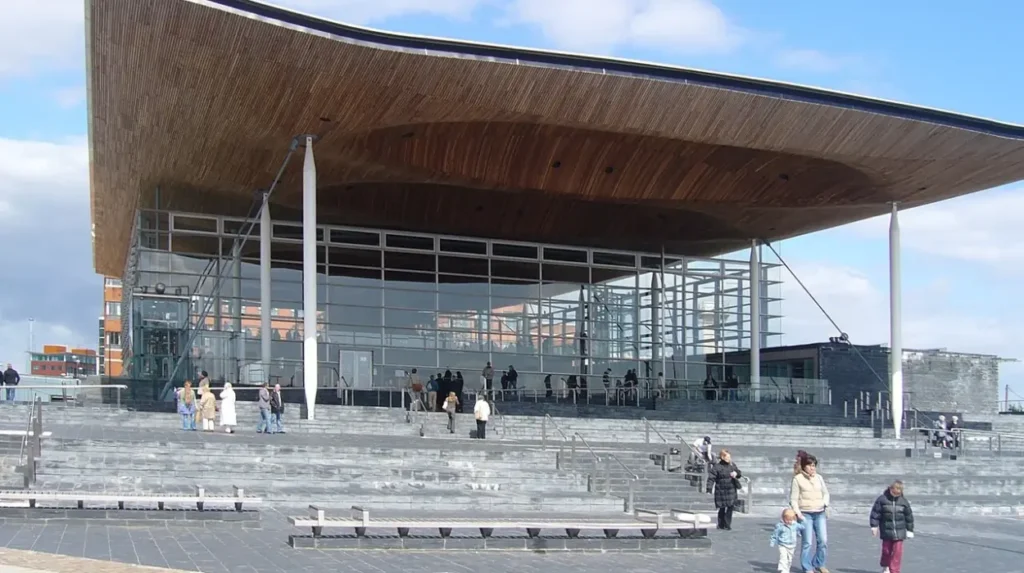
Cardiff functions as the political and administrative hub of Wales, hosting the Senedd, national government offices, corporate headquarters, and major cultural institutions. The capital city generates a significant share of national gross value added through professional services, creative industries, digital technology, and public administration. Swansea serves as the primary commercial hub for West Wales, specializing in healthcare research, marine engineering, retail trade, and public sector operations such as the Driver and Vehicle Licensing Agency.
Newport acts as a key industrial and logistics hub in South East Wales due to its proximity to the M4 motorway corridor and deepwater port facilities. The city has attracted foreign direct investment in compound semiconductor manufacturing, financial services technology, and administrative headquarters. Wrexham functions as the primary economic hub for North East Wales, driving regional manufacturing, automotive assembly, aerospace supply chains, and international sports tourism.
Bangor operates as a major educational and cultural center for North West Wales, anchored by Bangor University, research institutes, and regional healthcare services. St Davids and St Asaph contribute significantly to the national tourism economy through heritage preservation, religious history, and pilgrimage tourism. St Davids lies within the Pembrokeshire Coast National Park, supporting specialized hospitality, retail, and environmental conservation sectors. St Asaph supports rural professional services and cultural events across the Vale of Clwyd.
How are modern towns in Wales granted official city status?
Modern towns in Wales achieve official city status through competitive civic honor competitions established by the Cabinet Office and granted by the British monarch. Local authorities must submit formal proposals demonstrating municipal merit, historical heritage, and economic vitality.
The formal process begins when the UK Government announces a Civic Honours competition, usually linked to major royal milestones like jubilees or coronation anniversaries. Local councils, town partnerships, and civic organizations assemble technical application portfolios. These submissions detail local governance structures, civic amenities, historical identity, community cohesion, and forward-looking economic regeneration plans.
The Cabinet Office reviews all submitted entries against standardized evaluation criteria. Evaluation panels assess cultural facilities, educational institutions, infrastructure networks, population growth patterns, and distinct local character. The panel generates recommendations that pass to the Prime Minister and subsequently to the reigning monarch for formal approval.
Upon royal approval, the Crown Office prepares formal letters patent under the Great Seal of the Realm. The issuance of letters patent legally transforms the town into a city without altering its underlying local government boundary or council tax structure. Towns such as Aberystwyth, Machynlleth, and Llanelli have launched public campaigns or formal applications in previous competitions to secure this status. The award of city status delivers economic branding advantages, elevates international visibility, and assists local authorities in securing regional regeneration funding.
Related Article: Read more aboutCardiff city centre and Cardiff Bay connectivity prioritiesto explore how capital city infrastructure projects drive economic growth across South Wales.
More Coverage: Learn aboutBangor University governance updatesto see how educational leadership shapes the economy of North Wales.
Frequently Asked Questions
Is St Davids really considered a full city despite its small population?
Yes, St Davids is an official city despite having a population of around 1,300 people. Queen Elizabeth II officially restored its historic city status by royal charter in 1994 in recognition of its early Christian heritage and cathedral. In the UK legal system, city status is a royal mark of honor that does not depend on population size.
Why is Wrexham a city while larger Welsh towns are not?
Wrexham gained official city status in September 2022 after winning the Platinum Jubilee Civic Honours competition. Larger towns like Barry or Llanelli remain classified as towns because they have not been awarded royal letters patent. City status requires a successful formal application through government competitions rather than reaching a specific population threshold.
Does a town in Wales need a cathedral to become an official city?
No, holding a cathedral is no longer a requirement for achieving city status in Wales or the wider UK. While historic cities like Bangor and St Davids built their status around cathedral heritage, modern cities like Newport and Wrexham received city status through civic honor competitions. The monarch confers city status solely on the advice of government ministers via royal letters patent.
What is the newest city in Wales?
Wrexham is the newest city in Wales, having received its official city status in September 2022. The status was awarded as part of the UK Platinum Jubilee Civic Honours to recognize Wrexham’s growing industrial, economic, and cultural significance. It became the seventh official city in Wales and the main urban center for North East Wales.
Which city in Wales has the largest population?
Cardiff is the largest city in Wales by population, with over 350,000 residents living within its local authority area. It serves as the national capital, hosting the Welsh Parliament, major financial firms, universities, and commercial sectors. Swansea ranks second in population size, followed by Newport and Wrexham.