

Key Points
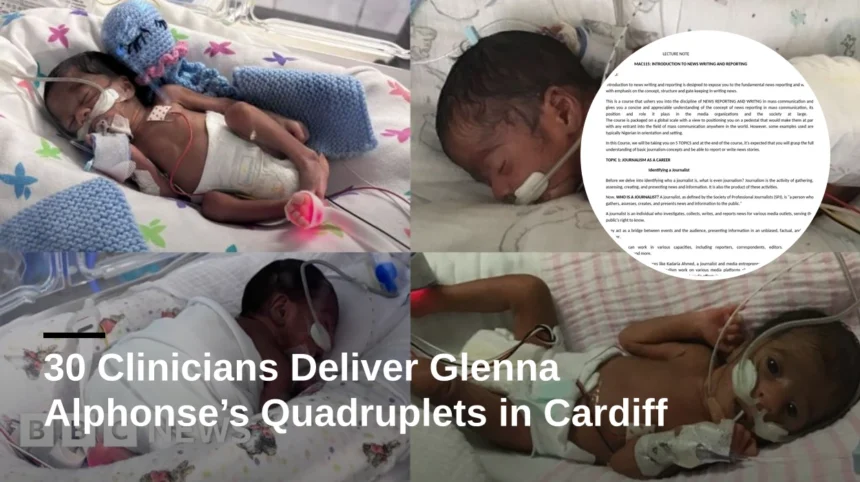
- Glenna Alphonse and John Poul Josh’s quadruplets were delivered at 27 weeks at University Hospital of Wales in Cardiff.
- A 30-strong specialist team, known as the Quad Squad, prepared for the complex delivery.
- The two boys and two girls weighed between 745 grams and 1.18 kilograms.
- The babies were later moved to Singleton Hospital in Swansea for specialist neonatal care nearer the family home.
- The parents said clinicians provided extensive medical and emotional support during the pregnancy and birth.
uk/local/cardiff/">Cardiff (The Wales Times) November 27, 2026 – Glenna Alphonse and John Poul Josh’s four babies have been delivered safely after a specialist 30-member medical team coordinated their care at the University Hospital of Wales in Cardiff. The quadruplets were born at 27 weeks after a complex pregnancy and are receiving specialist neonatal care to help them feed and grow. The two boys and two girls weighed between 745 grams and 1.18 kilograms at birth and were later transferred to Singleton Hospital in Swansea, nearer the family home.
How did the Quad Squad prepare for the quadruplets’ delivery?
As reported by the BBC, the specialist team called itself the “Quad Squad” and prepared for two possible outcomes: an urgent birth caused by complications or a planned caesarean section. Clinicians identified a theatre with room for each baby and created a medical and nursing rota to provide immediate support.
The BBC reported that five neonatal staff members were allocated to each baby, alongside the theatre team and staff continuing to care for the neonatal intensive care unit. Some clinicians worked beyond their shifts, while others returned from home to provide additional assistance.
What complications affected the pregnancy?
The couple first learned they were expecting quadruplets during a scan at Princess of Wales Hospital in Bridgend. Glenna Alphonse was referred to Bryan Beattie, lead consultant for fetal medicine in Wales, because of the pregnancy’s complexity.
At 22 weeks, a routine scan showed that Glenna’s cervix was close to opening. Her planned baby shower and gender-reveal party were cancelled, and she was admitted to the University Hospital of Wales. A cervical stitch, known as a cerclage, was inserted to help prolong the pregnancy, and she remained in hospital for five weeks under regular review.
The BBC reported that Glenna later went into spontaneous labour at 27 weeks. Consultant neonatologist Rachel Hayward described the delivery as resembling a military operation, reflecting the number of clinicians required to care for four premature babies simultaneously.
What has the family said about the birth?
Glenna Alphonse said she initially disputed the scan results and did not believe she was expecting quadruplets. She later said that seeing her babies’ faces ended the mental struggle she had experienced during the pregnancy.
John Poul Josh said the medical team had given “200%” for the family. The couple named all four babies with names beginning with the letter N, reflecting the shared initial in their names.
What is the background to rare quadruplet births?
The BBC reported that natural quadruplet pregnancies occur approximately once in 700,000 pregnancies. It also said that only a handful of couples in the United Kingdom have four babies each year. Quadruplet pregnancies carry heightened risks because the mother must sustain four developing babies and the infants may require premature neonatal care. In this case, specialist fetal-medicine, obstetric and neonatal teams coordinated care from pregnancy through delivery and transfer.
How could this affect families of rare quadruplets in Cardiff?
The case demonstrates how Cardiff’s specialist maternity and neonatal services can coordinate large multidisciplinary teams for rare quadruplet pregnancies. For families expecting quadruplets, the arrangements described by the BBC may highlight the importance of early referral, counselling, hospital monitoring and detailed birth planning. The transfer to Singleton Hospital also shows how neonatal care can continue closer to a family’s home when clinically appropriate. The outcome does not establish a broader medical result for all quadruplet pregnancies, but it provides a documented example of coordinated specialist care in Wales.