Ogmore Vale Wales is a former coal mining village situated in the Ogmore Valley within Bridgend County Borough in South Wales. Located approximately eight miles north of Bridgend town centre, the settlement sits along the River Ogwr Fawr at Ordnance Survey grid reference SS929904.
- How Did Ogmore Vale Wales Develop During the Industrial Revolution?
- What Role Did Coal Mining Play in the Economy of Ogmore Vale Wales?
- What Are the Current Demographics and Population Statistics of Ogmore Vale Wales?
- How Is Ogmore Vale Wales Governed and Represented Politically?
- What Landmarks, Cultural Heritage, and Notable People Come from Ogmore Vale Wales?
- What Are the Transport Links, Amenities, and Future Prospects for Ogmore Vale Wales?
- Frequently Asked Questions About Ogmore Vale Wales
The village occupies a narrow glacial valley carved through the Pennant Sandstone measures of the South Wales Coalfield. Its geographic coordinates sit at 51.603028 degrees north latitude and 3.546700 degrees west longitude. The settlement forms part of the wider Ogmore Valley community council area alongside neighbouring villages such as Nantymoel, Price Town, Wyndham, Lewistown, Pant-yr-awel, and Blackmill. The River Ogwr Fawr rises at Craig Ogwr to the north and flows southward through the village before joining the Ogwr Fach at Blackmill.
Steep valley sides rise sharply on both the eastern and western flanks, creating a linear urban footprint characterized by traditional terraced housing. Under the Welsh language name Cwm Ogwr, the settlement falls within the historic county boundaries of Glamorgan. Modern administrative governance places the village under Bridgend County Borough Council, which oversees municipal infrastructure, planning, and public services. The surrounding upland terrain connects directly to neighbouring valleys, including the Rhondda Valley to the northeast and the Garw Valley to the west. This geographic positioning historically dictated transport routes, industrial logistics, and residential expansion across the mid-Glamorgan region.
How Did Ogmore Vale Wales Develop During the Industrial Revolution?
Ogmore Vale Wales transformed from a rural farming district of fewer than ten farms into a densely populated industrial settlement after 1865. The sinking of deep coal shafts by John Brogden and Sons triggered rapid population growth, railway construction, and terraced housing development across the valley floor.
Prior to the mid-nineteenth century, the upper Ogmore Valley supported an isolated agricultural economy based on upland sheep grazing and small-scale subsistence farming. Industrial transformation began in late 1865 when ironmaster John Brogden and Sons commenced sinking the Nos. 1 and 2 pits of the Wyndham Colliery. By 1868, workers proved the Two Feet Nine seam at 161 yards and the Six Feet seam at 227 yards, extracting high-quality smokeless dry steam coal. Five years later, in 1873, David Davies and Company began sinking the nearby Western Colliery, also known as Ocean Colliery, raising its first coal in 1876. The opening of these two major collieries created immediate demand for skilled miners, hauliers, engineers, and surface labourers from across Wales and England.
To house this incoming workforce, developers constructed long rows of stone-built terraced cottages along the valley floor and lower hillsides. Commercial infrastructure expanded rapidly alongside residential streets, highlighted by the construction of Gwalia Stores in 1880 to supply groceries and household goods to mining families. Rail connections via the Ogmore Valley Railway linked the pits directly to coastal ports at Porthcawl and Barry for global coal export. By the early twentieth century, ownership consolidated under major conglomerates including North’s Navigation Collieries, Cory Brothers Limited, and Powell Duffryn Associated Collieries.
What Role Did Coal Mining Play in the Economy of Ogmore Vale Wales?
Coal mining served as the primary economic engine of Ogmore Vale Wales for over a century until pit closures in 1984. At peak production, local collieries such as Wyndham and Western employed over two thousand workers and produced hundreds of thousands of tons of steam coal annually.
The geology of the Ogmore Valley yielded valuable seams from the Lower Coal Measures, including the Gellideg, Bute, Lower Nine Feet, uk/local/cardiff/caerau/">Caerau, and Two Feet Nine seams. In 1913, Cory Brothers Limited employed 1,395 men at Wyndham Colliery alone, while Western Colliery maintained a workforce exceeding 850 men during the same period. Following the nationalisation of the British coal industry in 1947, the National Coal Board assumed operational control of all valley mining assets. Between 1957 and 1965, the National Coal Board invested three million pounds to merge Wyndham Colliery and Western Colliery underground into a single combined complex.
By 1971, the unified Wyndham/Western Colliery employed 1,188 men and produced 475,000 tons of coal, achieving the highest output of any single unit in the South Wales Coalfield. Underground operations utilized mechanized face conveyors and double-shift coaling systems to extract coal across 160-yard faces. However, geological faulting, rising extraction costs, and national energy policy shifts led to the permanent closure of the Wyndham/Western combine in January 1984. The cessation of deep mining ended a 119-year industrial era and forced an economic transition toward commuting, light manufacturing, and service sector employment. Subsequent land reclamation projects removed colliery spoil tips and landscaped former pithead sites into green recreational corridors.
What Are the Current Demographics and Population Statistics of Ogmore Vale Wales?
Ogmore Vale Wales has an estimated population of 3,085 residents across a built-up urban area of 0.70 square kilometres. Data from the UK Office for National Statistics indicates a population density of 4,407 people per square kilometre and a stable demographic profile.
Statistical records from the UK Office for National Statistics demonstrate that the wider Ogmore Valley community civil parish encompasses 8,012 residents across 38.49 square kilometres. Within the core built-up boundary of Ogmore Vale itself, the gender distribution comprises 1,475 males and 1,610 females. Age distribution figures show 630 residents aged 0 to 17 years, 1,816 working-age adults between 18 and 64 years, and 639 seniors aged 65 years and older. Between 2021 and 2024, the built-up settlement recorded a slight annual population change of minus 0.10 percent, reflecting gradual demographic stabilization.
Census data confirms that 97.9 percent of residents were born within the United Kingdom, with small minority populations originating from European Union nations and other countries. Religious affiliation statistics from the 2021 Census identify 1,121 residents as Christian, while the remaining population reports no religion or belongs to smaller faith groups. Housing stock in the ward consists predominantly of nineteenth-century stone terraced properties supplemented by twentieth-century municipal estates and modern infill developments. Household tenure data shows high rates of owner-occupancy alongside social housing managed by regional housing associations within Bridgend County Borough.
How Is Ogmore Vale Wales Governed and Represented Politically?
Ogmore Vale Wales operates under a three-tier governance structure consisting of Ogmore Valley Community Council, Bridgend County Borough Council, and the UK Parliament. Since 1995, the village has functioned as an electoral ward returning one county councillor to Bridgend County Borough Council.
Local parish-level administration is handled by Ogmore Valley Community Council, which manages community amenities, local grants, and grassroots civic initiatives across the valley villages. In 2022, the community council attracted regional media attention when only one candidate initially stood for fifteen available council seats, highlighting recruitment challenges in hyper-local governance. At the unitary authority level, Bridgend County Borough Council holds statutory responsibility for education, social care, waste collection, highway maintenance, and strategic land planning.
Historically, the Ogmore Vale electoral ward has elected representatives from the Labour Party, Plaid Cymru, and independent political platforms. For Senedd Cymru, the Welsh Parliament, residents reside within the Ogmore constituency, which elects a member to legislate on devolved matters including health and transport. At the Westminster level, parliamentary boundary revisions placed the village inside the Rhondda and Ogmore constituency in July 2024. Policing and community safety fall under the jurisdiction of South Wales Police, which coordinates neighbourhood policing teams across the Bridgend valleys. These overlapping institutional frameworks ensure that both local environmental maintenance and regional infrastructure funding remain aligned with Welsh Government policy standards.
What Landmarks, Cultural Heritage, and Notable People Come from Ogmore Vale Wales?
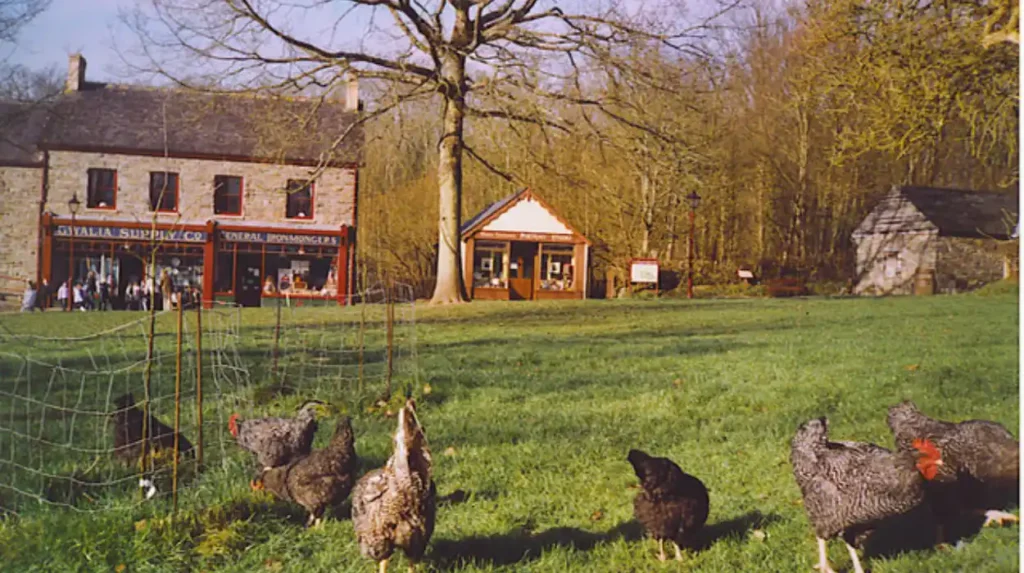
Ogmore Vale Wales preserves its industrial heritage through historic architecture, local history archives, and museum reconstructions such as Gwalia Stores at St Fagans National Museum of History. The village has produced prominent figures in literature, Olympic athletics, international rugby union, and modern rock music.
One of the most famous architectural exports from the village is Gwalia Stores, an 1880 cooperative grocery shop that was dismantled stone by stone and rebuilt at St Fagans National Museum of History near Cardiff. Within the village, the Ogmore Valley Local History and Heritage Society maintains extensive archival records, photographs, and mining fatality memorials documenting the Wyndham and Western collieries. In 2016, local authorities demolished the historic Aber Infants School built in 1909 and Aber Girls School built in 1912, constructing a dedicated bat dwelling on the former schoolyard to protect local wildlife.
Cultural achievements linked to the settlement include modernist novelist Dorothy Edwards, who was born in Ogmore Vale in 1903 and authored Rhapsody in 1927 and Winter Sonata in 1928. Writer William Ingram, creator of the television drama The District Nurse, resided on Gorwyl Road until his death in 2013, and several episodes were filmed directly in the village. Sporting icons include 1964 Tokyo Olympic long jump gold medallist Lynn Davies, alongside Wales rugby union internationals Grahame Hodgson and Melbourne Thomas. Contemporary music figures raised in the village include members of heavy metal band Bullet for My Valentine and post-hardcore group Funeral for a Friend.
What Are the Transport Links, Amenities, and Future Prospects for Ogmore Vale Wales?
Ogmore Vale Wales relies primarily on the A4061 road corridor and regional bus networks to connect residents with Bridgend, Cardiff, and the M4 motorway. Current regeneration initiatives focus on active travel routes, green tourism, and residential redevelopment of former industrial and educational sites.
Passenger rail services to Ogmore Vale ceased during the twentieth century, leaving road transport via the A4061 highway as the primary artery linking the valley to Junction 36 of the M4 motorway at Sarn. Public bus routes operated by regional carriers provide regular daily connections between Nantymoel, Ogmore Vale, and Bridgend bus station, where passengers access mainline rail services to Cardiff Central and Swansea. Cycling and pedestrian infrastructure has expanded significantly through the development of the Ogmore Valley Community Route, a traffic-free shared-use path following the former railway trackbed along the River Ogwr Fawr. Local amenities include primary schools, convenience stores, community centres, and rugby union facilities that serve as focal points for civic life.
Several brownfield parcels, including the former nursery site on Park Avenue, remain earmarked for future residential or community-led regeneration projects. Environmental restoration of surrounding uplands and forestry trails positions the valley to benefit from sustainable outdoor recreation and eco-tourism across Bridgend County Borough. Continued investment in broadband connectivity and regional transport integration remains essential to supporting remote workers and commuting households in the post-industrial valley economy.
Frequently Asked Questions About Ogmore Vale Wales
Is Ogmore Vale Wales a safe and affordable place to live?
Ogmore Vale Wales offers significantly lower property prices compared to Cardiff and coastal Bridgend, making it attractive for first-time buyers and commuters. Crime rates remain relatively low and consist primarily of minor anti-social behaviour typical of quiet rural valley communities. Residents benefit from strong neighbourly cohesion, scenic hill walks, and convenient road access to the M4 corridor.
Why did the coal mines in Ogmore Vale close down?
The combined Wyndham and Western Colliery closed permanently in January 1984 due to geological faulting, exhausting accessible coal seams, and restructuring by the National Coal Board. Although the mine produced 475,000 tons of coal in 1971, rising extraction costs made continued deep mining financially unviable. The closure ended over a century of commercial coal production in the valley.
What is the history of Gwalia Stores from Ogmore Vale?
Gwalia Stores was a traditional general grocery and hardware shop built in Ogmore Vale in 1880 to serve local coal mining families. After closing in the late twentieth century, curators carefully dismantled the building and reconstructed it at St Fagans National Museum of History. Today, visitors can walk inside the restored shop to experience authentic Victorian and Edwardian Welsh retail history.
Are there train stations in Ogmore Vale Wales today?
Ogmore Vale no longer has an active passenger railway station following the closure of local valley branch lines during the mid-twentieth century. The nearest mainline railway station is located eight miles south in Bridgend town centre. Commuters travel to Bridgend via regular local bus services or by driving along the A4061 road to connect with Great Western Railway and Transport for Wales trains.
What famous people were born or raised in Ogmore Vale?
Ogmore Vale has produced several notable figures across sport, literature, and entertainment, including 1964 Olympic long jump gold medallist Lynn Davies. Acclaimed modernist author Dorothy Edwards was born in the village in 1903, and actor Windsor Davies also had strong local ties. Additionally, founding members of the internationally successful Welsh rock bands Bullet for My Valentine and Funeral for a Friend grew up in the area.