

The best places to visit in Wales comprise a diverse range of national parks, historic fortresses, coastal preserves, and vibrant urban centers across North, Mid, and South Wales. Key destinations include Eryri National Park, Pembrokeshire Coast National Park, Bannau Brycheiniog National Park, Conwy uk/local/swansea/castle/">Castle, and the capital city of Cardiff.
- Why Is Eryri National Park a Top Destination in North Wales?
- How Does Pembrokeshire Coast National Park Offer Unique Coastal Views?
- Why Should Travelers Visit the Capital City of Cardiff?
- What Makes Conwy Castle and the North Coast Historically Significant?
- Why Is Bannau Brycheiniog National Park Ideal for Outdoor Enthusiasts?
- How Does the Isle of Anglesey Combine Island Scenery and Ancient Heritage?
- What Makes the Village of Portmeirion an Architectural Wonder?
- Frequently Asked Questions
Wales is a constituent country of the United Kingdom covering an area of 20,779 square kilometers on the island of Great Britain. The country features 1,400 kilometers of coastline, three designated national parks, and five Areas of Outstanding Natural Beauty. Geographic geography ranges from alpine mountain ranges in the north to dramatic sea cliffs in the west and rolling sandstone peaks in the south. Travel destinations across Wales cater to outdoor recreation, historical exploration, cultural heritage tourism, and eco-tourism.
Historically, the spatial layout of settlements and travel corridors in Wales followed trade routes, mining infrastructure, and coastal harbors. Medieval fortification systems built during the 13th-century conquest by Edward I created urban centers around coastal fortresses like Caernarfon, Conwy, and Beaumaris. During the Industrial Revolution, transport networks expanded to support slate quarrying in northwestern Wales and coal mining in southern valleys. Modern Welsh tourism infrastructure utilizes these historical routes, transforming legacy industrial rail lines and ancient pilgrimage trails into scenic transport corridors and public footpaths.
The structural layout of destination appeal relies on preserved ecological zones and historic building preservation. Environmental governance protects large swaths of terrain through national park status, preserving biodiversity while maintaining public access rights. Historic sites fall under the management of Cadw, the historic environment service for the Welsh Government, or the National Trust. These institutions maintain physical access, safety standards, and structural integrity for centuries-old assets. Modern visitor management balances ecological conservation with sustainable visitor volume across all premier regions.
Mechanisms for exploring these destinations include integrated public transport networks and dedicated footpaths. The Wales Coast Path spans 1,400 continuous kilometers along the maritime border, offering connected access to coastal preserves. Regional heritage railways, such as the Ffestiniog and Welsh Highland Railways, provide interior mountain transit. Highway systems like the A470 run vertically from Cardiff in the south to Llandudno in the north, allowing systematic vehicular navigation across all major geographic zones.
According to official tourism statistics published by the Welsh Government, tourism contributes over 3 billion pounds annually to the Welsh economy. Visitors spend tens of millions of days exploring outdoor spaces, heritage sites, and cultural attractions each year. Dark Sky Reserves in Eryri and Bannau Brycheiniog attract astronomical tourists due to low light pollution metrics. Examples of high-density visitor regions include the Gwynedd county mountain ranges, the Pembrokeshire coastal trail system, and the Cardiff Bay waterfront development.
Understanding destination distribution allows travelers to plan efficient travel routes across regional hubs. Sustainable management of tourist distribution reduces environmental impact on fragile ecosystems while supporting rural community economies. As global travel shifts toward sustainable and nature-focused itineraries, Wales remains a primary European destination due to its protected natural habitats and well-preserved historic infrastructure.
Why Is Eryri National Park a Top Destination in North Wales?
Eryri National Park is a premier destination because it houses Yr Wyddfa, the highest peak in Wales at 1,085 meters, along with 2,130 square kilometers of protected glacial valleys, alpine lakes, and heritage mountain railways.
Eryri National Park, historically known in English as Snowdonia, covers a vast region in northwestern Wales. The landscape was shaped by prehistoric glaciation, resulting in steep U-shaped valleys, deep glacial tarns, and sharp arêtes. The area features nine mountain ranges containing fourteen peaks over 3,000 feet, known collectively as the Welsh 3000s. The park encompasses extensive slate landscapes that carry UNESCO World Heritage designation, testifying to the region’s 19th-century slate extraction industry.
The park operates under strict conservation protocols managed by the Eryri National Park Authority. Visitor management centers around key trailheads such as Pen-y-Pass, Llanberis, and Ogwen Valley. The Snowdon Mountain Railway, operating since 1896, provides rack-and-pinion rail transport from Llanberis directly to the summit station at Hafod Eryri. Hikers utilize six main routes to ascend Yr Wyddfa, including the Llanberis Path, Pyg Track, Miners’ Track, and Watkin Path.
Outdoor adventure tourism forms a major part of the regional economy. Zip World Penrhyn Quarry features the fastest zipline in the world, reaching speeds over 100 miles per hour over an ancient quarry site. Examples of mountain villages within the park include Betws-y-Coed, Beddgelert, and Llanberis. Annual visitor statistics indicate that Yr Wyddfa attracts over 600,000 walkers each year, making it one of the most visited peaks in Europe.
The park plays an essential role in preserving rare arctic-alpine flora, such as the Snowdon lily, and unique fauna, including pine martens and feral goats. Balanced land management ensures agriculture, forestry, and adventure tourism coexist without degrading sensitive habitats. The ongoing transition to sustainable visitor transit, including the Sherpa’r Wyddfa bus network, sets a framework for low-carbon travel in national parks worldwide.
How Does Pembrokeshire Coast National Park Offer Unique Coastal Views?
Pembrokeshire Coast National Park offers unique coastal views because it is the only national park in the United Kingdom designated primarily for its maritime landscape, featuring 420 kilometers of sea cliffs, sandy coves, and offshore islands.
Located in southwestern Wales, Pembrokeshire Coast National Park covers 620 square kilometers of coastal terrain. The park consists of diverse geological formations, including Old Red Sandstone cliffs, Carboniferous limestone headlands, and volcanic rock outcrops. Marine erosion over millions of years created dramatic features such as sea arches, stacks, and blowholes. Key island habitats include Ramsey Island, Skomer Island, Skokholm Island, and Caldey Island.
The central feature of the park is the Pembrokeshire Coast Path, a 299-kilometer national trail running from St Dogmaels in the north to Amroth in the south. The path climbs 11,000 meters of total ascent along rugged cliff edges, estuaries, and coastal plateaus. Transport links include coastal bus services, such as the Puffin Checker and Poppit Rocket, designed specifically to drop walkers at key trailheads along the route.
The area is an international site for marine fauna observation. Skomer Island hosts the largest Atlantic puffin colony in southern Britain, with populations exceeding 40,000 birds during springtime nesting seasons. Examples of famous coastal locations within the park include Barafundle Bay, the Blue Lagoon at Abereiddi, Tenby harbor town, and St Davids. The waters of the Pembrokeshire Marine Special Area of Conservation support grey seals, harbour porpoises, and common dolphins.
The park supports eco-tourism, marine research, and coastal conservation efforts. Sustainable management strategies address issues like coastal erosion caused by rising sea levels and storm events. Protecting these maritime habitats ensures long-term viability for local fishing traditions, coastal hiking, and marine wildlife observation.
Why Should Travelers Visit the Capital City of Cardiff?
Travelers should visit Cardiff because the capital city blends ancient history with modern urban design, featuring Cardiff Castle, the Wales Millennium Centre, national museums, and expansive waterfront developments at Cardiff Bay.
Cardiff was officially designated the capital city of Wales in 1955 and stands as the commercial and cultural center of the nation. Located in southeastern Wales along the Severn Estuary, the city developed rapidly during the 19th century as one of the world’s largest coal-exporting ports. Modern Cardiff covers 140 square kilometers and holds a population exceeding 360,000 residents, combining historical architecture with modern waterfront infrastructure.
Cardiff Castle sits at the heart of the city, displaying a layered construction history that includes a 1st-century Roman fort, a 11th-century Norman keep, and a 19th-century Victorian Gothic palace constructed by the Marquess of Bute. The Cardiff Bay Barrage, completed in 1999, transformed former industrial mudflats into a 500-acre freshwater lake surrounded by modern cultural venues. The Wales Millennium Centre serves as the national arts center for performing arts, opera, and theater.
The city operates as a major hub for international sports, arts, and educational tourism. Principality Stadium, located in the central core, features a fully retractable roof and seats over 74,000 spectators for international rugby matches and stadium concerts. Examples of key cultural institutions include the National Museum Cardiff, St Fagans National Museum of History, and the Senedd building. St Fagans is an open-air museum detailing Welsh cultural life through more than 40 relocated historical buildings.
Cardiff drives national economic growth through media production, financial services, and higher education. The ongoing development of sustainable public transit, including the South Wales Metro system, improves regional connectivity. The city serves as a global model for urban regeneration, converting historic coal infrastructure into sustainable commercial and cultural assets.
What Makes Conwy Castle and the North Coast Historically Significant?
Conwy Castle and the North Coast are historically significant because they form part of King Edward I’s 13th-century military conquest architecture, representing one of the finest preserved examples of medieval European fortification design.
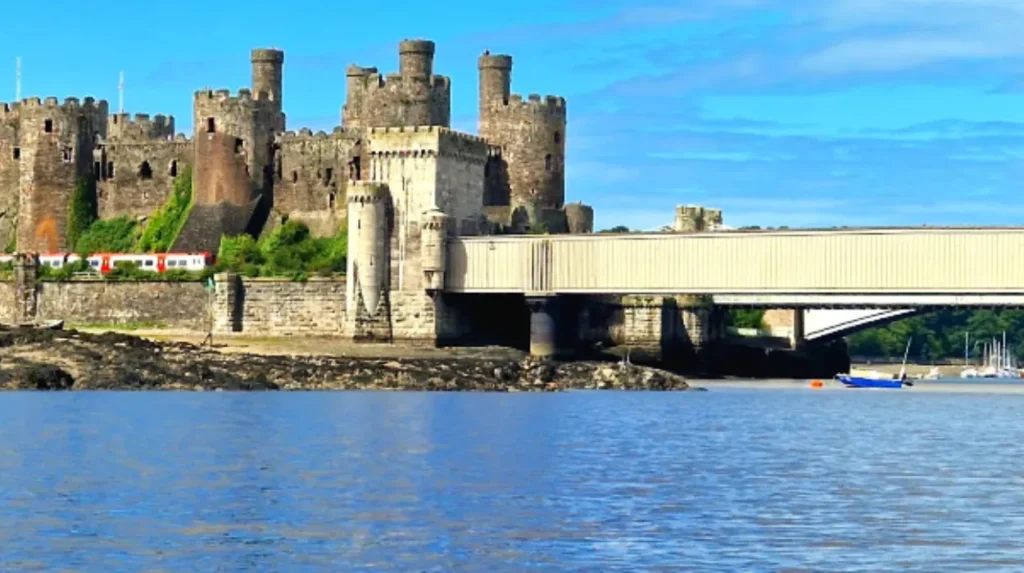
Conwy Castle stands on a coastal rock promontory overlooking the Conwy Estuary in North Wales. Constructed between 1283 and 1287 under the direction of master architect James of St. George, the fortress was built as part of the “Iron Ring” of castles designed to solidify English control over Gwynedd. Together with Harlech, Caernarfon, and Beaumaris, Conwy Castle forms part of the Castles and Town Walls of King Edward in Gwynedd UNESCO World Heritage Site.
The castle features an imposing rectangular layout defended by eight massive round towers, two fortified barbicans, and an inner ward containing royal apartments. The adjacent town of Conwy remains enclosed by its original 1.3-kilometer medieval stone wall circuit, which includes 21 curtain towers and three original gateway arches. Cadw maintains the structural integrity of the masonry, providing public access to the wall walks and tower battlements.
The surrounding North Coast region combines medieval heritage with Victorian coastal tourism infrastructure. The Great Orme, a massive limestone headland in nearby Llandudno, features the Great Orme Tramway, operating since 1902 as Britain’s only cable-operated street tramway. Examples of notable historic attractions along this coastal corridor include the Smallest House in Great Britain located on Conwy quay, Bodnant Garden, and the suspension bridges built by Thomas Telford.
Conwy Castle provides concrete architectural evidence of medieval military engineering, siege strategy, and urban planning. Studying these preservation methods offers insights into ancient masonry conservation techniques. The fortress remains an enduring educational resource, drawing hundreds of thousands of international historians and visitors annually.
Why Is Bannau Brycheiniog National Park Ideal for Outdoor Enthusiasts?
Bannau Brycheiniog National Park is ideal for outdoor enthusiasts because it features 1,344 square kilometers of sandstone peaks, deep glacial valleys, extensive cave networks, and an officially certified International Dark Sky Reserve.
Bannau Brycheiniog, formerly known as Brecon Beacons National Park, stretches across South and Mid Wales. The park’s geology consists primarily of Old Red Sandstone, which forms high, flat-topped mountain ridges separated by steep glacial valleys. The central Brecon Beacons range includes Pen y Fan, the highest summit in South Wales at 886 meters above sea level.
The park provides extensive infrastructure for low-impact recreation, including over 2,000 kilometers of public rights of way. Activities include hillwalking, mountain biking, horseback riding, and limestone cave exploration. The Dan-yr-Ogof cave system forms part of the National Showcase Centre for Caves, offering entry to one of Europe’s most extensive subterranean networks. The Monmouthshire and Brecon Canal runs through the park, providing 56 miles of navigable inland waterway for canal boating and towpath walking.
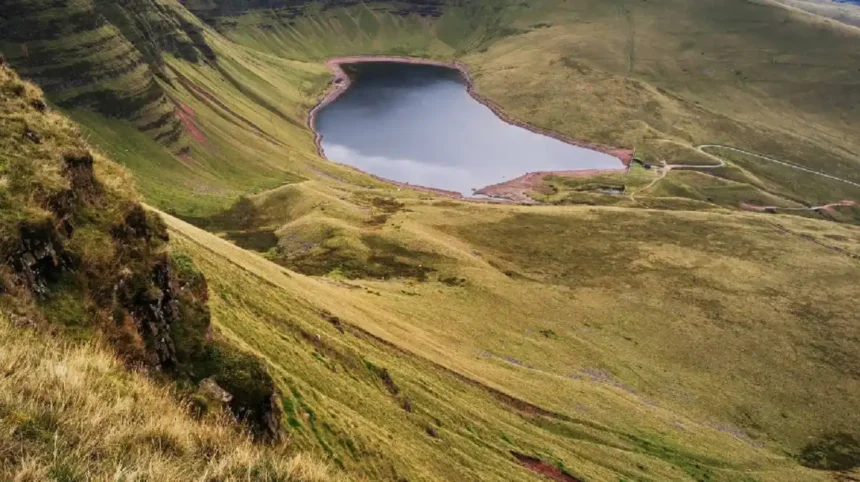
Waterfall Country, located in the southern section near Ystradfellte, features deep gorges where rivers cascade over resistant sandstone ledges. Examples of notable natural landmarks include Sgwd yr Eira waterfall, Llyn y Fan Fach glacial lake, the Black Mountain range, and Sugar Loaf Mountain. In 2013, the park became the fifth location in the world to receive International Dark Sky Reserve status, recognizing its exceptionally clear night skies free from ambient light pollution.
Bannau Brycheiniog serves as an essential ecological filter and watershed, providing drinking water to major urban populations across South Wales. Sustainable farming initiatives within the park preserve traditional upland agriculture while supporting biodiversity restoration. The park demonstrates how active outdoor recreation can integrate with ecological protection and agricultural land use.
How Does the Isle of Anglesey Combine Island Scenery and Ancient Heritage?
The Isle of Anglesey combines island scenery and ancient heritage by providing over 200 kilometers of protected coastline alongside prehistoric megaliths, medieval fortresses, and unique Celtic archaeological sites.
The Isle of Anglesey, known in Welsh as Ynys Môn, is the largest island in Wales, covering 714 square kilometers off the northwest coast. It is separated from the mainland by the Menai Strait, a narrow tidal waterway spanned by two historic bridges: Thomas Telford’s Menai Suspension Bridge, opened in 1826, and Robert Stephenson’s Britannia Bridge. The island’s geography features low rolling hills, rich agricultural land, and rocky coastal headlands.
Anglesey holds significant archaeological importance due to its dense concentration of prehistoric monuments. During the Neolithic and Bronze Ages, the island served as a major ritual center, earning it historical recognition as the stronghold of the Celtic Druids prior to the Roman conquest under Suetonius Paulinus in 60 AD. Historic management bodies preserve sites such as Bryn Celli Ddu, a Neolithic passage tomb aligned with the summer solstice sunrise.
The coastal perimeter forms an Area of Outstanding Natural Beauty containing diverse wildlife preserves. South Stack Cliffs Nature Reserve, managed by the RSPB, provides critical nesting sites for razorbills, guillemots, and puffins around an isolated 19th-century lighthouse. Examples of prominent island landmarks include Beaumaris Castle, the village of Llanfairpwllgwyngyllgogerychwyrndrobwyllllantysiliogogogoch, Newborough Warren beach, and Llanddwyn Island.
Anglesey remains a vital region for Welsh language preservation, with over half the population speaking fluent Welsh. The island supports renewable energy development, including tidal power generation initiatives in the Menai Strait and offshore wind projects. This combination of historical depth, ecological preservation, and clean energy innovation establishes Anglesey as a model island community.
What Makes the Village of Portmeirion an Architectural Wonder?
Portmeirion is an architectural wonder because it is an Italianate-style coastal resort village designed by Sir Clough Williams-Ellis between 1925 and 1975, blending Mediterranean building aesthetics with subtropical gardens in North Wales.
Portmeirion sits on a private peninsula in the Dwyryd Estuary near Porthmadog in Gwynedd. Architect Sir Clough Williams-Ellis acquired the site, formerly known as Aber Iâ, in 1925 with the explicit goal of proving that a naturally beautiful location could be developed without spoiling its ecological character. Over a 50-year construction period, he constructed a whimsical village inspired by the vibrant architecture of Portofino, Italy.
The village’s structural framework integrates salvaged architectural fragments from demolished historic mansions across Britain and Europe. Structures feature bright pastel facades, terracotta roofs, elaborate bell towers, classical colonnades, and decorative plasterwork. The central piazza includes a sunken garden, a gilded statue of Neptune, and a re-erected 17th-century ceiling rescued from Emral Hall in Flintshire.
Portmeirion is surrounded by the Gwyllt, a 70-acre subtropical woodland garden containing over 20 kilometers of walking paths. The area’s microclimate, warmed by the Gulf Stream, allows exotic plant species to thrive, including giant redwoods, Himalayan rhododendrons, camellias, and tree ferns. Examples of notable features include the Hotel Portmeirion, Castell Deudraeth, the Pantheon dome, and the Hercules Hall.
Portmeirion demonstrates architectural recycling and early eco-tourism design principles. The site gained international fame as the filming location for the 1960s cult television series The Prisoner, attracting media studies enthusiasts globally. Today, the village operates as an architectural open-air preserve, demonstrating how creative structural design can harmonize with sensitive coastal environments.
Frequently Asked Questions
What is the best time of year to visit Wales?
The ideal time to visit Wales is between May and September, when weather conditions are mildest and daylight hours are longest. Summer months offer optimal conditions for coastal hiking, outdoor adventure sports, and attending cultural festivals. Spring and early autumn provide fewer crowds at major historic sites and national parks.
Do I need a car to travel around Wales?
While major cities like Cardiff and Swansea are well-connected by rail, renting a car is recommended for exploring rural national parks and coastal regions. Main highways like the A470 connect north and south regions efficiently. Scenic heritage train lines and local bus networks provide public transit alternatives for popular tourist corridors.
What language is spoken in Wales?
English and Welsh are both official languages spoken throughout Wales. English is spoken by nearly all residents, while Welsh is spoken fluently by roughly 20 percent of the population, particularly in northern and western counties. Road signs, public services, and historic site documentation are presented in both languages.
How many days should I spend on a Wales holiday?
A seven to ten-day itinerary is recommended to experience the primary regions of North, Mid, and South Wales. A shorter three to four-day trip allows sufficient time to focus on a single region, such as Cardiff and Bannau Brycheiniog in the south, or Eryri and Anglesey in the north.
Is Wales an expensive destination for tourists?
Wales offers travel options for varying budgets, generally costing less than neighboring regions in southern England. Entrance fees for national parks and public coastal footpaths are free, while Cadw and National Trust passes offer affordable access to historic castles and heritage estates.