
Key Points:
- Leon Gillespie, a 26-year-old male who hails from Deganwy, Wales, scaled the roof of Ysbyty Glan Clwyd Hospital, which is located in St Asaph.
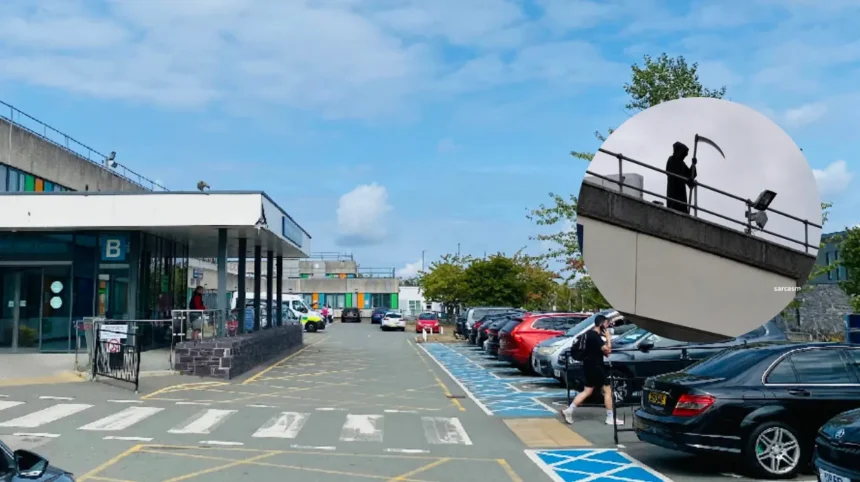
- Gillespie wore a black hooded costume which was said by witnesses to resemble the Grim Reaper.
- According to reports, Gillespie allegedly stayed atop the hospital entrance looking down upon patients, visitors and staff.
- It was alleged that Gillespie stayed on the hospital roof for about 50 minutes, armed with what seemed like a long blade or scythe.
- Officers of the law and firefighters visited the hospital prior to Gillespie being brought down and arrested.
- Gillespie pleaded guilty to causing a nuisance or disturbance at National Health Service premises without a reasonable excuse.
- Llandudno magistrates fined Gillespie £200 for the aforementioned hospital incident and also directed him to pay additional compensation and court costs.
- Gillespie did not give an explanation for his behavior at the hospital in court.
- Gillespie also pleaded guilty to two other unconnected offences of shoplifting cat food, cat litter, food and drinks.
- This happened on 6th June 2026, with court hearings being reported in July and news reportage coming in August.
Wales Crime (Wales Times) August 7, 2026 — Welsh man Leon Gillespie was arrested and fined after climbing on to the roof of Ysbyty Glan Clwyd hospital in a black hooded costume resembling the Grim Reaper and staring down at patients, visitors and staff.
- Key Points:
- What happened on the hospital roof?
- How did police respond to the incident?
- What did the court decide?
- Why did the costume cause concern at a hospital?
- What did Gillespie say about the stunt?
- What is known about Ysbyty Glan Clwyd?
- What are the confirmed facts and unresolved details?
- Background: What led to the court case?
- Prediction: How could this affect hospital patients and staff?
According to VICE’s report, which cited USA Today and other coverage, Gillespie remained above the hospital entrance for approximately 50 minutes. Witnesses described him as wearing a black robe or hooded outfit and carrying an object that appeared to be a long blade. Police and firefighters attended the scene before he was eventually brought down and arrested.
Gillespie later pleaded guilty to causing a nuisance or disturbance on National Health Service property without a reasonable excuse. The offence also involved refusing to leave when instructed to do so by a police officer, according to the reports. Llandudno magistrates fined him £200 for the hospital incident and imposed additional compensation and court costs.
What happened on the hospital roof?
The incident occurred on 6 June 2026 at Ysbyty Glan Clwyd in uk/local/st-asaph/">St Asaph, Denbighshire. Reports identified Gillespie as a resident of Deganwy, a town in North Wales.
The black hooded clothing led people at the hospital to believe that he was dressed as the Grim Reaper, the fictional figure traditionally associated with death. The Independent reported that he climbed on to the hospital roof and looked towards staff and visitors from above. USA Today likewise reported that the scene took place above the entrance to the hospital.
VICE described the incident as an apparent performance or stunt, but there was no confirmed explanation from Gillespie about his intentions. The outlet reported that he did not explain the performance when he appeared in court.
The reports state that he silently stared down at people entering the building. Other coverage described him as making gestures or noises, although those details were not included in every account. The central point consistently reported by the available sources is that he was positioned on the roof, dressed in dark clothing and visible to people inside or around the hospital.
A hospital roof also created a practical safety and security concern. The presence of a person above the entrance required a response from emergency services, including police and firefighters. The reports do not state that anyone was physically injured during the incident.
How did police respond to the incident?
Police and firefighters attended after Gillespie was seen on the roof. VICE reported that emergency responders arrived before Gillespie was eventually arrested. Other reports said officers instructed him to leave, but he refused to do so.
The charge was not reported as an allegation of assault or a specific threat against an individual. Instead, prosecutors relied on an offence concerning nuisance or disturbance on NHS premises without a reasonable excuse.
The North Wales Police statement quoted in coverage said Gillespie had been charged after allegedly causing a nuisance or disturbance to an NHS staff member working at the hospital or otherwise present in connection with work. The statement also referred to his refusal to leave when asked by a police officer.
The available reports do not provide a detailed account of the police operation used to bring Gillespie down from the roof. They do establish that emergency services attended and that he was later taken into custody.
What did the court decide?
Gillespie pleaded guilty to the hospital-related charge. The Independent reported that he was fined £200 by Llandudno magistrates. VICE also reported the £200 fine and said that additional compensation and court costs were imposed.
The court proceedings took place after the June incident, with reports stating that Gillespie appeared before magistrates on 15 July 2026. The available coverage does not indicate that he received a custodial sentence for the hospital offence.
The reports also state that Gillespie admitted two separate shoplifting offences during the same court appearance. VICE reported that one offence involved stealing between £30 and £40 worth of cat food and cat litter from a Pets at Home shop. The other involved taking food and drinks from Sainsbury’s.
Those shoplifting offences were unrelated to the hospital rooftop incident. The hospital charge concerned the alleged nuisance or disturbance on NHS premises and the refusal to leave when directed by police.
Coverage differs in the way it describes the overall financial penalty, because some reports focus on the £200 hospital fine while others refer to additional compensation and court costs. The consistent figure directly linked to the hospital incident is the £200 fine.
Why did the costume cause concern at a hospital?
The reports connect the public reaction to the location, the costume and the way Gillespie behaved on the roof. Patients and visitors could see a figure dressed in black above the hospital entrance, while the object he carried appeared to resemble a scythe or long blade.
The Independent reported that the sight caused concern among people at the hospital. NDTV described the image of a figure symbolising death being visible through hospital windows as distressing for vulnerable patients and visitors.
The coverage does not establish that Gillespie made a direct threat or intended to harm anyone. It does show that his presence caused a disturbance significant enough to bring police and firefighters to the hospital and resulted in criminal proceedings.
Hospitals receive people who may already be distressed because of illness, injury or concern for relatives. The reports do not provide individual accounts from patients or staff, so the precise emotional impact on those who saw Gillespie cannot be independently assessed from the available information.
What did Gillespie say about the stunt?
The available reports do not contain a public explanation from Gillespie about why he climbed on to the roof or wore the costume. VICE reported that he did not explain the performance in court.
Some online accounts described the incident as a prank or performance, but those descriptions are characterisations rather than a confirmed statement of intent from Gillespie. The known court facts are that he pleaded guilty to the nuisance or disturbance charge and was fined.
The reports also do not establish whether the costume was intended specifically to frighten patients, visitors or hospital staff. Witnesses interpreted the clothing as resembling the Grim Reaper, while the court case focused on the disturbance caused on NHS premises and his refusal to leave.
What is known about Ysbyty Glan Clwyd?
Ysbyty Glan Clwyd is the hospital named in the reports about the incident. It is located in St Asaph in Denbighshire, North Wales.
The hospital became the focus of the incident because Gillespie positioned himself above its entrance. The reports do not state that hospital services were permanently closed or that medical treatment was stopped. They do indicate that the presence of a person on the roof prompted an emergency response.
The available coverage also does not provide a detailed statement from the hospital about the length of any disruption. As a result, it would be inaccurate to claim that the incident caused a specific number of delays, cancellations or affected appointments.
What are the confirmed facts and unresolved details?
The confirmed facts reported across the available coverage are Gillespie’s age, his connection to Deganwy, the hospital’s location, the black hooded clothing, the rooftop appearance, the emergency response, the guilty plea and the £200 fine. These details appear in reporting by VICE, USA Today and The Independent.
Several details remain less clear. The exact design of the costume, whether the object was a genuine weapon or a prop, and Gillespie’s reason for the stunt are not fully established by the available reports.
Some reports describe the object as a scythe, while others use more cautious wording such as a long blade or an object that appeared to be a blade. For that reason, it is more accurate to say that witnesses believed he was carrying an object resembling a blade or scythe.
The reports also vary in their descriptions of the total amount he was ordered to pay because the £200 hospital fine was separate from additional compensation and court costs. The £200 figure is the clearest penalty specifically attributed to the hospital incident.
Background: What led to the court case?
The case followed the 6 June 2026 incident at Ysbyty Glan Clwyd hospital. Gillespie was reported to have climbed on to the roof, remained there for about 50 minutes and refused to leave after being instructed by police.
North Wales Police described the alleged conduct as causing a nuisance or disturbance to an NHS staff member on NHS premises without a reasonable excuse. The charge was therefore connected to the disruption and refusal to leave rather than a reported physical attack.
Gillespie pleaded guilty when the matter reached Llandudno magistrates. The court fined him £200 and ordered additional payments for compensation and costs. During the same proceedings, he admitted two unrelated shoplifting offences involving retail goods from Pets at Home and Sainsbury’s.
The incident attracted wider attention because the image of a Grim Reaper-like figure on a hospital roof was unusual and easily recorded or described in viral news coverage. However, the available reports do not confirm that Gillespie intended to create a specific public message, protest or threat.
Prediction: How could this affect hospital patients and staff?
For hospital patients, visitors and staff, the most likely effect will be heightened attention to security around roofs, entrances and other areas visible from treatment spaces. The incident demonstrates how an unusual presence on hospital property can create alarm even when reports do not identify a physical injury.
Hospitals may also continue to emphasise that disruptive behaviour on NHS premises can lead to police involvement and criminal proceedings. That prediction is based on the reported charge, the emergency response and the court’s decision, rather than on any announced new policy.
For the wider public, the case may reinforce the importance of distinguishing between a costume or performance and behaviour that creates a disturbance in a healthcare setting. The available evidence does not support predicting broader hospital closures or changes to medical services, but it does support the expectation that similar incidents could receive rapid emergency and media attention.