
Wales contains hundreds of spectacular waterfalls formed by glacial erosion and river dynamics over millions of years, with the most famous being Pistyll Rhaeadr, Henrhyd Falls, Swallow Falls, Aber Falls, and Sgwd yr Eira in Waterfall Country.
Waterfalls in Wales represent some of the most ecologically significant landforms in the United Kingdom. These hydrological features attract millions of visitors annually to national parks including Bannau Brycheiniog and Eryri. The geographical distribution spans across North Wales, Mid Wales, and South Wales. Each region offers distinct river systems flowing over ancient geological formations.Pistyll Rhaeadr stands near Llanrhaeadr-ym-Mochnant in Powys. It drops 80 metres in three distinct stages over Silurian cliff faces.
Henrhyd Falls is located near Coelbren in the Brecon Beacons. It measures 27 metres in height, making it the highest drop in South Wales. Swallow Falls, known natively as Rhaeadr Eynnws, flows along the River Llugwy near Betws-y-Coed. It features continuous cascades framed by ancient boreal woodland. Aber Falls, or Rhaeadr Fawr, drops 36 metres near Abergwyngregyn. It discharges water originating from the Carneddau mountain range into a deep plunge pool. Sgwd yr Eira, located on the River Hepste, provides a natural recess behind its falling water veil. Hikers navigate a designated hard rock path directly beneath its cascade ledge.
How did geological processes create Welsh waterfalls?
Welsh waterfalls originated through Paleozoic tectonic activity followed by Quaternary glaciation, where moving ice sheets carved deep U-shaped valleys and exposed alternating layers of resistant hard rock and softer sedimentary strata beneath flowing rivers. The physical foundation of Welsh waterfalls began over 400 million years ago during the Ordovician and Silurian periods. Volcanic eruptions and marine sedimentation deposited layers of basalt, slate, mudstone, and sandstone across the landscape.
Subsequent tectonic movements uplifted these rock formations across the modern Welsh terrain. The resulting differential rock hardness laid the structural framework for differential erosion. During the last glacial period, known as the Devensian glaciation, massive ice sheets covered Wales. Glaciers moved through existing river channels, scouring out deep U-shaped valleys while cutting away valley floors.
Tributary streams were left suspended high above main valley floors, creating classic hanging valleys. As glaciers melted 12,000 years ago, rivers refilled these elevated channels and cascaded over sheer rock lips. Hydraulic action and abrasion continually shape these riverbed drop-offs over time. Fast-flowing water carries grit and gravel that erodes softer rock beneath hard top layers.
This process undercuts hard caprock until it collapses under its own weight. The backward migration of the waterfall face leaves a steep gorge trailing downstream from the modern cascade site.
Where is Waterfall Country located in Wales?
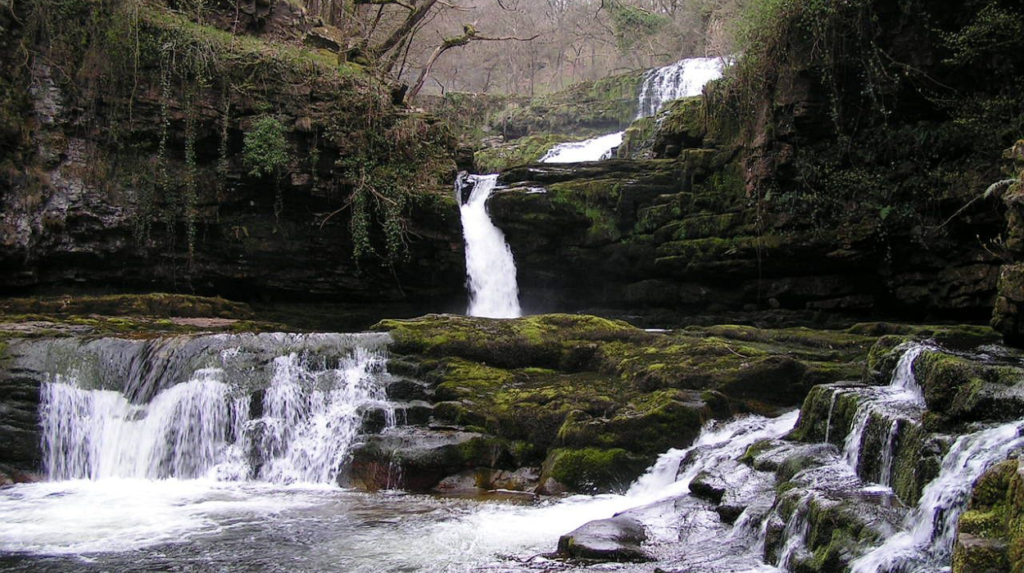
Waterfall Country is situated within the southern section of Bannau Brycheiniog National Park near Pontneddfechan, encompassing a network of deeply incised river gorges formed by the Mellte, Hepste, Neath, and Pyrddin rivers.
Waterfall Country represents one of the most concentrated hydrological reserves in western Europe. The region lies primarily within the county borough of Neath Port Talbot and Powys.
The geography features steep limestone gorges and dense oak woodlands designated as a Special Area of Conservation. Four primary rivers intersect across the local topography to produce more than twelve major waterfalls.
The village of Pontneddfechan serves as the main southern access gateway for walking trails. Ystradfellte provides the northern entry point to access the upper falls along the River Mellte.
The area forms part of the Fforest Fawr UNESCO Global Geopark. Visitors navigate well-maintained paths managed by Natural Resources Wales and the National Park Authority.
Annual visitor numbers exceed 160,000 people according to park authority management records. The microclimate remains exceptionally humid, supporting rare bryophyte and moss species along the gorge walls.
Safety infrastructure includes timber walkways, handrails, and stone steps installed to manage terrain challenges. Conservation policies enforce strict Leave No Trace principles to protect vulnerable riparian habitats.
What are the key walking trails for exploring waterfalls?
The primary waterfall trails in Wales are the Four Falls Trail and Elidir Trail in Bannau Brycheiniog, alongside the Aber Falls Trail and Pistyll Rhaeadr circular route in Eryri National Park.
Exploring waterfalls requires navigating specific waymarked routes that vary in distance and physical difficulty. The Four Falls Trail covers a circular distance of 8.8 kilometres through the heart of Waterfall Country.
This trail connects Sgwd Clun-Gwyn, Sgwd Isaf Clun-Gwyn, Sgwd y Pannwr, and Sgwd yr Eira. The path features rough woodland terrain and a descent of over 170 steep stone steps.
The Elidir Trail measures 4 kilometres along the River Nedd Fechan and River Pyrddin. It leads past Sgwd Gwladus, Sgwd-y-Bedol, and Sgwd Ddwli Uchaf over relatively gentle gradients.
In North Wales, the Aber Falls Trail covers 4.5 kilometres from the Abergwyngregyn car park. It provides a wide gravel path suitable for families and assisted mobility access.
The Henrhyd Falls circular route extends 5.6 kilometres through the Nant Llech valley. Hikers encounter steep wooden stairs and muddy paths along the river corridor.
Proper footwear with rubber outsoles is essential across all routes due to wet rock surfaces. Seasonal rainfall dramatically alters trail conditions and water flow volumes throughout the year.
Frequently Asked Questions
How do I get to Waterfall Country in Wales using public transport?
You can take a train to Neath or Aberdare railway station and board local bus services heading toward Pontneddfechan or Glynneath. Local buses run regularly on weekdays, dropping passengers within walking distance of the main Elidir and Four Falls trailheads.
Is it safe to swim in the waterfall pools across Wales?
Wild swimming is permitted in certain pools like Sgwd yr Eira, but it carries significant risks including cold water shock, strong undercurrents, and submerged rocks. Natural Resources Wales advises against swimming during periods of heavy rainfall due to rapid water level rises.
Which waterfall in Wales is the tallest?
The tallest single-drop waterfall in Wales is the Devil’s Appendix in Snowdonia (Eryri) at 93 metres, while Pistyll Rhaeadr is the tallest multi-stage waterfall dropping 80 metres overall. Henrhyd Falls holds the title for the tallest drop in South Wales at 27 metres.
Do I need to pay an entrance fee to visit Welsh waterfalls?
Access to the waterfalls themselves is free under public right of way access across Welsh national parks. However, visitor car parks managed by the National Trust or local authorities usually charge a daily parking fee to support conservation maintenance.
What is the best time of year to see waterfalls in Wales?
Autumn and early spring offer the highest water flow volumes due to seasonal rainfall, along with vibrant surrounding foliage. Summer provides easier trail conditions and drier footpaths, though water flows can diminish during extended dry spells.