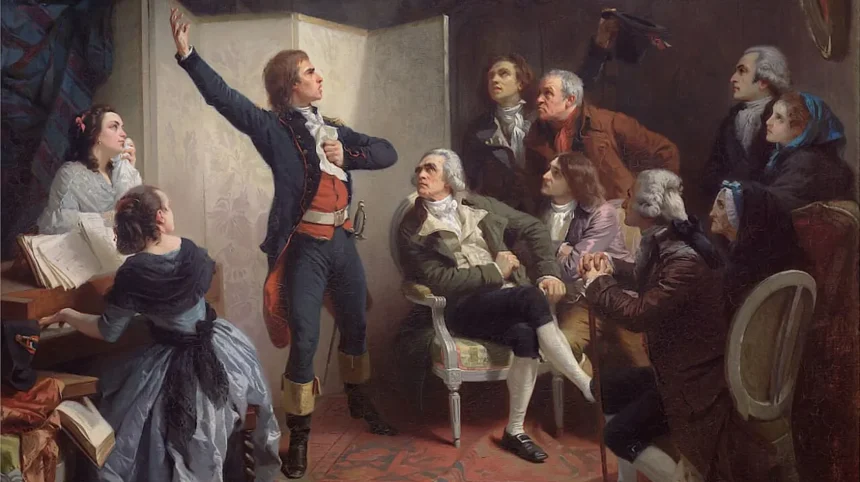
Hen Wlad Fy Nhadau serves as the official national anthem of Wales, composed in 1856 by Evan James and James James in Pontypridd. The Welsh title translates to Land of My Fathers in the English language.
- What Is the Origin of the Welsh National Anthem Hen Wlad Fy Nhadau?
- What Are the Official Welsh Lyrics of Hen Wlad Fy Nhadau?
- What Is the Literal English Translation of the Welsh National Anthem?
- How Is Hen Wlad Fy Nhadau Structured Musically and Poetically?
- What Is the Legal and Official Status of Wales National Anthem?
- How Did the Anthem Become Associated With Welsh Rugby and Sport?
- How Does Hen Wlad Fy Nhadau Compare to God Save the King and Yma o Hyd?
- What Cultural Impact Has Hen Wlad Fy Nhadau Made Globally?
- Frequently Asked Questions
The composition represents a vital piece of Celtic heritage, expressing themes of patriotism, poetic tradition, and linguistic preservation. The anthem consists of three main verses along with a unifying refrain. In public events, international sporting competitions, and formal gatherings, performers traditionally sing the first verse followed by the chorus. The original manuscript of the song, initially titled Glan Rhondda, remains archived at the National Library of Wales in Aberystwyth.
What Is the Origin of the Welsh National Anthem Hen Wlad Fy Nhadau?
Hen Wlad Fy Nhadau emerged in January 1856 in Pontypridd, Wales, created by father Evan James and son James James. James James composed the tune Glan Rhondda, while Evan James authored the three-stanza poetic text expressing deep national devotion.
The creation of the anthem occurred during a period of industrialization in the Rhondda Valley. James James, a harpist, composed the melody while walking along the banks of the River Rhondda. His father, Evan James, a weaver and poet, wrote the accompanying lyrics within days. The anthem was originally titled Glan Rhondda, named after the local river, before adopting its permanent title.
Public performance established the song rapidly across regional communities. The premiere performance occurred in January 1856 at the Tabor Chapel in Maesteg, sung by Elizabeth John. The anthem gained national prominence after its inclusion in the 1858 Llangollen Eisteddfod competition. Musician John Owen published the score in his 1860 anthology, Gems of Welsh Melody, standardizing its distribution.
Historical recording milestones further solidified its institutional status. On March 11, 1899, vocalist Madge Breese recorded the song for the Gramophone Company in London, producing the first known audio recording in the Welsh language. In 1905, before a rugby international against New Zealand at uk/local/cardiff/">Cardiff Arms Park, the Welsh team sang the anthem in response to the Haka, establishing a global tradition of singing national anthems prior to sporting events.
What Are the Official Welsh Lyrics of Hen Wlad Fy Nhadau?
The official Welsh text of Hen Wlad Fy Nhadau comprises three full stanzas alongside a recurring refrain. Public ceremonies, sporting events, and cultural gatherings typically feature the first verse and chorus exclusively during formal renditions.
The first stanza establishes the central themes of geographic reverence, poetic heritage, and historical sacrifice. The opening line, Mae hen wlad fy nhadau yn annwyl i mi, identifies the homeland as an ancestral inheritance. Subsequent lines honor renowned bards, singers, and patriotic warriors who shed blood for freedom.
The second stanza shifts focus toward natural landscapes and geographical endurance. The lyrics reference majestic mountains and wild valleys, asserting that traditional songs endure despite environmental shifts. The verse emphasizes that natural beauty reinforces national identity across successive generations.
The third stanza addresses the preservation of national culture and linguistic survival. The text invokes the protection of the Welsh language, expressed as yr hen iaith, asserting that political adversity cannot silence the native harp or poetic tradition. The chorus repeats the core invocation, Gwlad, Gwlad, pan fo meulion yn erlyn, o mor llawen yw’r fawl.
What Is the Literal English Translation of the Welsh National Anthem?
The literal English translation converts the poetic Welsh phrasing into precise English meanings, defining Hen Wlad Fy Nhadau directly as Land of My Fathers. The text celebrates ancestral warriors, natural beauty, and linguistic endurance across three distinct verses.
Verse one translates directly as: The old land of my fathers is dear to me, a land of bards and singers, famous men of renown. Its brave warriors, finest patriots, lost their blood for freedom. The refrain translates to: Country, Country, I am true to my country! While the sea guards its wall so pure, oh long may the old language endure.
Verse two translates as: Old mountainous land, paradise of the bard, every cliff and valley is delightful to me. Through patriotic feeling, how charming is the voice of her rivers and streams! The text emphasizes that natural topography mirrors the emotional resonance of native song.
Verse three translates as: Though the enemy treads my land under foot, the old language of Wales is as alive as ever. The muse is not hindered by the hand of treason, nor is the melodious harp of my country. This verse directly addresses cultural resilience against external domination.
How Is Hen Wlad Fy Nhadau Structured Musically and Poetically?
Hen Wlad Fy Nhadau features a standard AABA melodic structure written in common 3/4 time, composed by James James in the key of E-flat major. Poetically, Evan James employed classic Welsh meters featuring strict end-rhyme schemes.

The vocal range spans an octave and a third, allowing accessible congregational and stadium singing. The opening phrases establish a ascending melodic line, building harmonic tension toward the chorus. The refrain introduces a powerful dynamic shift, repeating the word Gwlad three times with increasing vocal intensity.
Poetic construction relies on internal rhyme and traditional Welsh assonance. Evan James used an AABB and ABAB rhyming structure across the stanzas to ensure rhythmic cadence. The imagery combines romantic nationalism with references to historical resistance, aligning with nineteenth-century European cultural movements.
Phonetic flow supports vocal projection across large gatherings. Broad open vowels in words like gwlad, nhadau, and iaith facilitate sustained choral harmony. The formal arrangement remains unchanged from the 1860 publication by John Owen.
What Is the Legal and Official Status of Wales National Anthem?
Hen Wlad Fy Nhadau holds the status of de facto national anthem of Wales, accepted through global convention rather than formal parliamentary legislation. It shares official ceremonial space with God Save the King during United Kingdom state occasions.
The anthem lacks statutory establishment by an Act of Parliament or the Senedd Welsh Parliament. Despite the absence of formal legislation, international sporting bodies including FIFA, UEFA, and World Rugby recognize Hen Wlad Fy Nhadau as the exclusive national anthem of Wales during international competitions.
State events observe specific protocol protocols regarding anthem selection. During events where Wales competes independently, such as the Commonwealth Games or international rugby matches, Hen Wlad Fy Nhadau is performed exclusively. At joint UK royal state occasions, both God Save the King and Hen Wlad Fy Nhadau are rendered in succession.
Linguistic preservation laws in Wales support the anthem’s public use. The Welsh Language Measure 2011 established equal legal status for Welsh and English, reinforcing the institutional mandate for performing the anthem in its original native tongue across public bodies.
How Did the Anthem Become Associated With Welsh Rugby and Sport?
The anthem became linked to international sports on December 16, 1905, when the Wales national rugby union team played the visiting New Zealand All Blacks at Cardiff Arms Park. Player Teddy Morgan led the crowd in singing the anthem to counter the Haka.
This 1905 match marked the first instance of a national anthem being sung before an international sporting contest. The crowd of 40,000 spectators joined the team in singing Hen Wlad Fy Nhadau, creating a home atmosphere that contributed to Wales defeating New Zealand 3-0. The event set a precedent adopted across global sports.
The tradition expanded into football and other international disciplines over the twentieth century. At Cardiff City Stadium and the Principality Stadium, stadium sound systems pause before the final chorus lines, allowing tens of thousands of supporters to complete the anthem acapella.
Sports administration bodies maintain strict protocols for anthem performances. The Welsh Rugby Union and Football Association of Wales mandate the inclusion of the anthem prior to all senior international matches hosted in Wales, ensuring continuous cultural transmission.
How Does Hen Wlad Fy Nhadau Compare to God Save the King and Yma o Hyd?
Hen Wlad Fy Nhadau serves as the primary national anthem, whereas God Save the King functions as the British royal anthem and Yma o Hyd operates as an official secondary anthem for Welsh football fans. God Save the King is used officially for sovereign functions across the entire United Kingdom. Hen Wlad Fy Nhadau represents Welsh national identity specifically, emphasizing geography, language, and culture rather than allegiance to the crown.

Yma o Hyd, composed by Dafydd Iwan in 1983, was formally adopted by the Football Association of Wales in 2022. While Hen Wlad Fy Nhadau remains the sole anthem played during official match ceremonies, Yma o Hyd plays immediately prior to kickoff at football international fixtures.
The three compositions serve distinct civic roles. God Save the King represents the state apparatus, Hen Wlad Fy Nhadau serves as the unifying patriotic symbol, and Yma o Hyd provides modern political expression focused on linguistic survival since the late twentieth century.
What Cultural Impact Has Hen Wlad Fy Nhadau Made Globally?
Hen Wlad Fy Nhadau influenced patriotic musical compositions globally, inspiring the national anthems of Brittany and Cornwall due to shared Celtic linguistic heritage.
The Breton national anthem, Bro Gozh ma Zadoù, adopted the music of James James in 1897, using lyrics adapted by François Jaffrennou. Similarly, the Cornish anthem, Bro Goth A’gan Tasow, utilizes the same melody with lyrics translated into the Cornish language.
The anthem features prominently in international cinema, television broadcasts, and classical music arrangements. Orchestral variations have been performed by major international ensembles, including performances at the BBC Proms and the Royal Albert Hall.
Monumental memorials preserve the authors’ legacy in Wales. In 1930, a grand memorial designed by sculptor Sir William Goscombe John was erected in Ynysangharad War Memorial Park in Pontypridd, featuring life-sized bronze figures representing Poetry and Music in honor of Evan and James James.
Related Article: Learn about the historic preservation efforts supportinghistorical engineering restoration workacross traditional Welsh landmarks.
Module 2: Community & Cultural Milestones
Read More: Discover how young people represent national heritage at major events in our report onWelsh youth ceremonial gatherings.
Module 3: Exploring Historic Sites
Explore Further: Read about regional history celebrations detailinghistorical monuments in North Wales.
Frequently Asked Questions
Who wrote the Welsh national anthem Hen Wlad Fy Nhadau?
Hen Wlad Fy Nhadau was written in January 1856 by father and son Evan James and James James in Pontypridd. Evan James wrote the lyrics, while James James composed the tune originally called Glan Rhondda.
What does Hen Wlad Fy Nhadau mean in English?
Hen Wlad Fy Nhadau translates literally to Old Land of My Fathers in English. The lyrics celebrate the heritage, poets, scenery, and language of Wales.
Why is Hen Wlad Fy Nhadau sung before rugby matches?
The tradition started on December 16, 1905, when Wales played New Zealand at Cardiff Arms Park. The Welsh team and crowd sang the anthem to respond to the Haka, marking the first time a national anthem was sung before a sporting match.
Is Hen Wlad Fy Nhadau the officially declared national anthem by law?
Hen Wlad Fy Nhadau is the de facto national anthem of Wales through tradition and cultural use rather than official legislation. It is recognized globally by major international bodies.
What other national anthems use the tune of Hen Wlad Fy Nhadau?
The melody of Hen Wlad Fy Nhadau is used by Brittany for its anthem Bro Gozh ma Zadoù and by Cornwall for Bro Goth A’gan Tasow. Both regions share Celtic cultural roots with Wales.