Hindu mandirs established an institutional presence in Wales during the late twentieth century, driven by South Asian migration patterns. Early community worship began in private residences before formal temple structures were acquired in uk/local/cardiff/">Cardiff, Newport, and Carmarthenshire.
Post-war economic migration brought South Asian families to urban Welsh centers, particularly Cardiff, Swansea, and Newport. In the 1970s, the expulsion of Asian populations from Uganda further increased the Hindu resident population across South Wales. These demographic changes created a necessity for permanent places of worship, leading community members to form religious trusts and registered charities.
The physical development of mandirs involved converting existing urban buildings and purchasing rural land. In 1979, the Hindu community acquired a former synagogue in Grangetown, Cardiff, establishing the Shree Swaminarayan Temple, which formally opened in 1982. Concurrently, rural initiatives emerged, such as the founding of Skanda Vale in Carmarthenshire in 1973 by Guru Sri Subramanium.
According to official United Kingdom census records, the Hindu population in Wales grew from 5,439 residents in 2001 to 10,434 in 2011, reaching 12,242 by 2021. This numerical expansion coincided with institutional investments in temple infrastructure, expanding prayer halls, community dining spaces, and cultural centers across urban and rural counties.
Where Are the Main Hindu Mandirs Located in Wales?
The primary Hindu mandirs in Wales operate within the capital city of Cardiff, the city of Newport, and rural Carmarthenshire. These places of worship include urban community centers alongside extensive pilgrimage ashrams set within the Welsh landscape.
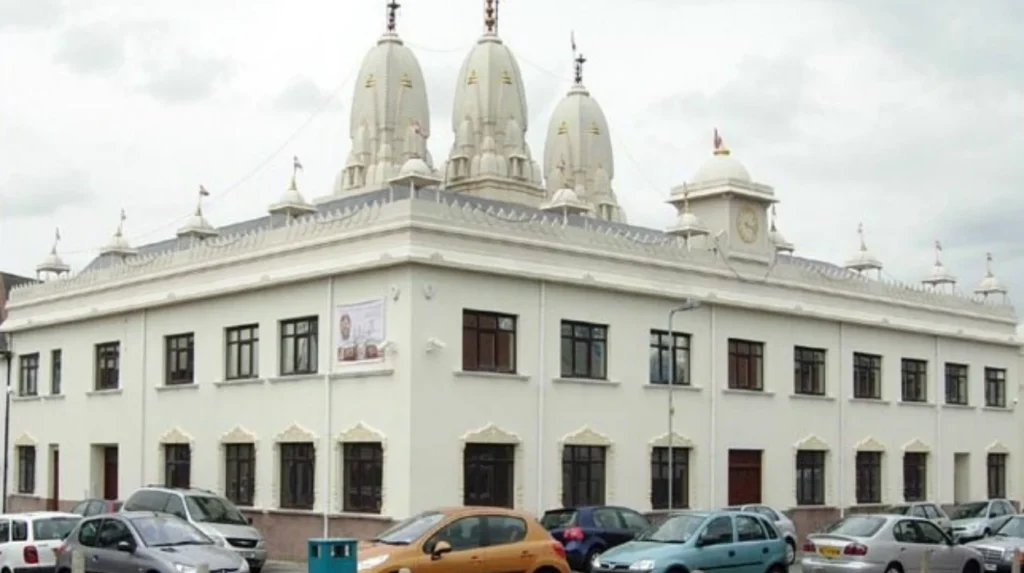
The Shree Swaminarayan Temple in Grangetown, Cardiff, functions as the first purpose-adapted mandir in Wales. Located on Merches Place, this temple relocated to its current expanded site in 1993, serving as an architectural focal point for the Swaminarayan Sampraday tradition.
In the Splott area of Cardiff, the Sanatan Dharma Mandal and Hindu Community Centre operates on Lewis Road. This facility provides a dedicated space for Sanatan Dharma traditions, serving pan-Indian community gatherings, educational workshops, and major calendar festivals across South Wales.
In rural West Wales, Skanda Vale occupies an extensive multi-faith monastery near Llanpumsaint in Carmarthenshire. Established in 1973, this sanctuary houses four main temples: the Lord Murugan Temple, the Maha Shakti Temple, the Sri Ranganatha Temple, and the Shirdi Sai Baba Temple.
What Architectural Features Define Welsh Mandir Designs?
Welsh mandirs integrate traditional Indian temple design principles, including sacred garbhagrihas and intricate murti consecrations, within adapted British building frameworks. These structures combine authentic stone carvings with local modern building requirements.
Urban mandirs in Wales frequently occupy repurposed civic buildings that undergo structural adaptations. Exterior facades retain traditional brickwork, while interior layouts feature sanctums designed according to Vastu Shastra principles. Renovations incorporate specialized ventilation, heating, and accessible ramps funded by local community contributions and civic grants.
The interior sanctum, or garbhagriha, houses sacred consecrated deities known as murtis. Craftsmen carve these sacred figures from white marble or black granite in traditional artisan centers across India before ceremonial installation in Wales. The mandirs feature carved wooden sinhasans, brass bells, and decorative altars tailored to daily ritual worship.
Rural sites like Skanda Vale incorporate natural elements into their spatial arrangement. The Carmarthenshire sanctuary places shrines within surrounding forests and hillsides, creating open-air ritual spaces that align traditional forest ashram concepts with the geography of West Wales.
How Do Mandirs Function as Civic and Cultural Hubs in Wales?
Mandirs in Wales operate as multi-functional community centers that facilitate religious education, humanitarian relief, interfaith dialogue, and cultural preservation. They host educational visits for local schools and support regional charitable initiatives.
Educational programs form a key component of temple operations throughout Wales. Mandirs host school visits, welcoming thousands of Welsh primary and secondary students annually to learn about Hindu traditions, sacred music, yoga practices, and ethical philosophy.
Humanitarian outreach represents another core function of these institutions. Following natural disasters, such as the 2001 Gujarat earthquake, the Cardiff mandir community raised £30,000 within days for emergency international relief. Rural centers like Skanda Vale operate food distribution programs alongside the Skanda Vale Hospice, providing free palliative care.
Cultural celebration days draw thousands of visitors to Welsh mandirs each year. Major annual observances include Diwali, Janmashtami, Navratri, and Mahashivratri. During these festivals, temples organize traditional music recitals, community feasts known as mahaprasad, and civic processions attended by local political representatives.
Module 1: Educational & Community Milestones
Read More: Explore recent achievements in Welsh learning by reading our report onprimary education standards in Wales.
Module 2: Structural Preservation & Heritage
Related Article: Learn how traditional structures are preserved in our coverage ofheritage restoration projects in Wales.
Module 3: Regional Charitable Support
Explore Further: Discover how local organizations raise vital care funds in our coverage ofhospice fundraising campaigns in Wales.
Frequently Asked Questions
Which is the largest Hindu temple in Wales?
The largest Hindu temple in Wales is the Shree Swaminarayan Temple located in Grangetown, Cardiff. Established originally in 1979 and expanded in 1993, it serves as a central place of worship for the Swaminarayan tradition in South Wales.
Where is Skanda Vale located, and can anyone visit?
Skanda Vale is located near Llanpumsaint in Carmarthenshire, West Wales. It is an inter-faith ashram with four distinct temples that welcomes visitors and pilgrims of all backgrounds for daily prayer services and darshan free of charge.
Are there Hindu mandirs in Newport and Swansea?
Yes, Newport is home to the Dharma Mandir in Duffryn, serving local Hindu families. While Swansea has a sizeable Hindu population, residents access local community centers and travel to established mandirs in Cardiff and Newport for major festival celebrations.
What festivals are celebrated at Hindu temples in Wales?
Welsh mandirs celebrate major Hindu festivals annually, including Diwali, Krishna Janmashtami, Navratri, and Mahashivratri. These public celebrations feature devotional music, traditional vegetarian feasts, cultural performances, and civic processions.
Do Welsh Hindu temples offer educational school tours?
Yes, temples like the Shree Swaminarayan Temple in Cardiff offer organized educational visits for primary and secondary schools. Students learn about Hindu customs, religious symbols, traditional musical instruments, and basic yoga principles.