

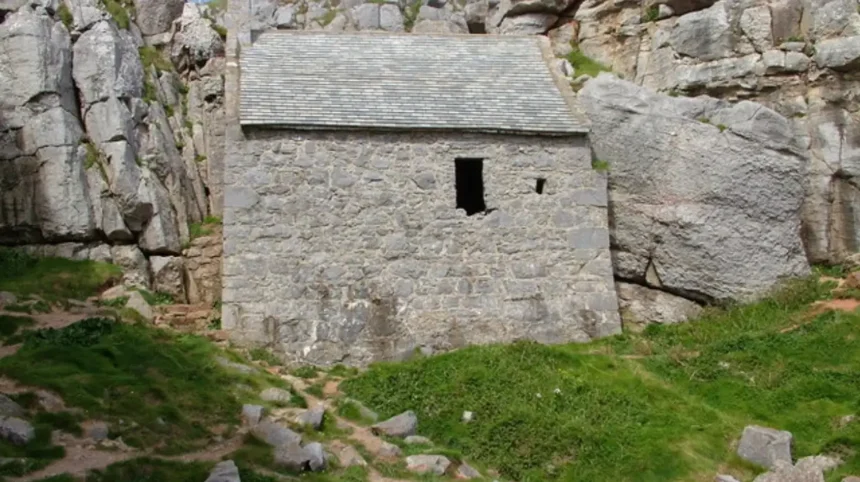
St Govan’s Chapel is a Grade I listed 13th-century religious sanctuary built into a limestone cliff face in Pembrokeshire, Wales. Measuring 20 by 12 feet, it sits above the Atlantic Ocean near Bosherston within the Castlemartin Military Training Area.
The structure stands inside a narrow rock fissure along the southern coast of South Wales. Historical records indicate the stone building was constructed in the 13th century to replace a 6th-century monastic hermitage. The early hermitage was established by Saint Govan, a Christian monk who sought shelter inside a natural cave within the limestone cliff face. Modern visitors reach the stone building by descending fifty-two limestone steps carved into the cliff edge. The location remains protected under Cadw regulations as an ancient monument.
The physical design of the building features simple medieval architecture built from locally quarried limestone blocks. The roof consists of a stone vault supported by thick masonry walls designed to withstand coastal weather conditions. Inside the single-room chamber, a slate stone altar sits against the eastern wall alongside low stone seating benches built into the sides. A small arched doorway in the western wall provides access directly to the rocky beach below.
The site holds significant historical value within Welsh heritage and early Christian archaeology. Folk traditions link Saint Govan to Gawain, a knight from Arthurian legend, or to an Irish abbot fleeing pirates. Legend states that the cliff face opened to conceal the saint from attackers before closing around him. Outside the chapel sits a historic holy well that attracted medieval pilgrims seeking cures for physical ailments. Local folklore claims that counting the stone steps leading down to the chapel yields a different number when walking back up.
What Is the History of St Govan’s Chapel Wales?
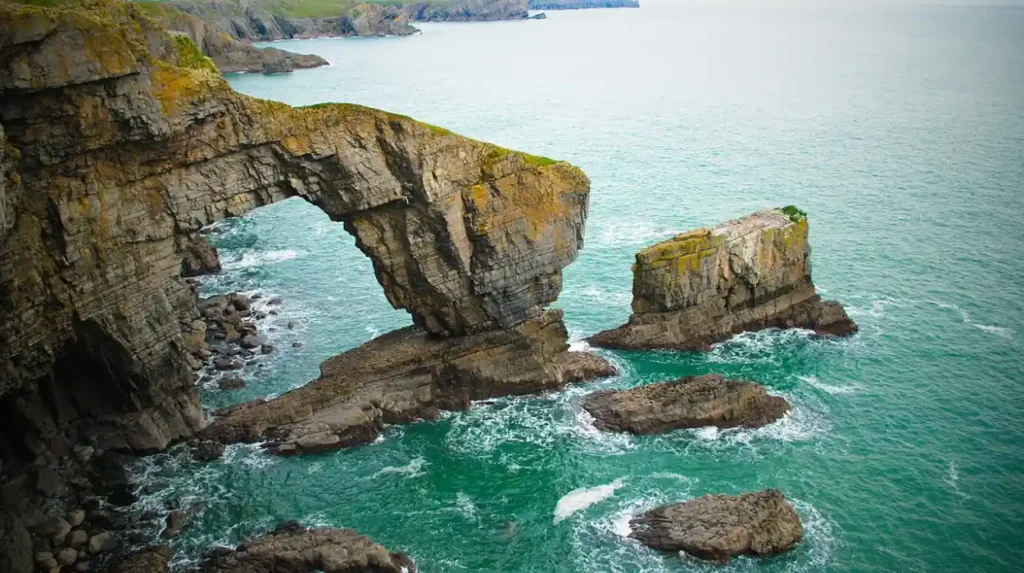
St Govan’s Chapel in Wales originated in the 6th century as a secluded monastic cell founded by Saint Govan before expanding into a 13th-century stone pilgrimage chapel built directly into the limestone cliffs of Pembrokeshire, South Wales.
Saint Govan established a religious retreat inside a natural cliff fissure around the year 580 AD. Historical documentation suggests Govan was an Irish monk who sailed across the Celtic Sea to establish a Christian hermitage along the Welsh coast. Alternative historical theories identify Govan as Sir Gawain, a legendary figure from King Arthur court who spent his final years in religious devotion. Govan lived as an anchorite, surviving on freshwater from a nearby spring and local seafood gathered from the coast.
During the 13th century, local religious authorities constructed the permanent limestone chapel over the original cave site. The construction project enclosed the natural fissure, transforming the hermitage into a formal pilgrimage destination. Throughout the Middle Ages, sick and injured pilgrims traveled to the cliff site to pray at the altar and drink from the holy well. Modern conservation efforts led by Cadw ensure the structural preservation of the chapel while maintaining public access within the Castlemartin Military Training Area.
How Do You Access St Govan’s Chapel Wales?
Accessing St Govan’s Chapel requires driving to the clifftop car park near Bosherston village and descending fifty-two steep, hand-carved stone steps down the cliff face directly into the medieval limestone building.
Visitors reach the destination by following the B4319 road from Pembroke toward the village of Bosherston. From Bosherston, a single-track road leads south across the Castlemartin peninsula directly to the designated clifftop parking lot. The car park provides vehicle space near the start of the coastal path leading to the access point. Visitors must check Ministry of Defence firing schedules prior to travel, as live military training operations can close access roads.
The physical descent involves navigating fifty-two stone steps that have been worn smooth by centuries of foot traffic. A safety handrail runs along the cliff wall to assist visitors during the steep walk. The path narrows as it approaches the upper door of the chapel building. Due to the historic steep steps, the site cannot accommodate wheelchairs or mobility scooters. Visitors are advised to wear sturdy footwear due to uneven stone surfaces and wet weather conditions along the coast.
1.Check Ministry of Defence Access:Castlemartin Range operations may restrict access.
Verify firing schedules via the Pembroke Visitor Centre or online Ministry of Defence notices before traveling.
2.Drive to Bosherston Clifftop Car Park:Follow the B4319 road south from Pembroke.
Park at the designated clifftop facility located 100 meters from the coastal path access point.
3.Descend the 52 Stone Steps:Use caution on smooth, hand-carved limestone steps.
Hold the safety handrail while navigating the steep path down the cliff face to the chapel entrance.
What Architectural Features Define St Govan’s Chapel Wales?
St Govan’s Chapel features a simple rectangular footprint measuring 20 by 12 feet, constructed from thick limestone blocks with a pointed stone vault roof, internal slate altar, and cliffside doorways.
The building structure incorporates local limestone masonry joined with traditional lime mortar. The exterior walls measure over two feet thick, providing structural support against severe Atlantic storms. The roof features a solid stone barrel vault topped with slate tiles to prevent water penetration into the chapel interior. The small overall dimensions reflect medieval monastic architecture designed for solitude rather than large congregations.
Inside the single chamber, visitors observe key religious components preserved from the medieval period. The eastern wall houses a solid stone altar where mass was historically celebrated. Stone benches run along the northern and southern walls, providing seating for pilgrims. A small arched doorway in the northern wall serves as the primary entrance, while a western passageway leads toward the beach. Vertical window slits allow natural light to illuminate the interior space.
Related Articles Section
- Discover Coastal Destinations: Learn more about historic seaside spots by reading What Is Saundersfoot Wales and Why Is It Famous?
- Plan Your Welsh Stay: Explore top regional accommodations in our guide on What Is The Quay Hotel Deganwy Wales and Where Is It Located?
- Relax and Unwind: Check out our breakdown of What Is Quay Spa North Wales and What Services Does It Offer?
Frequently Asked Questions
What is the origin of St Govan’s Chapel in Wales?
St Govan’s Chapel was built in the 13th century on the site of a 6th-century monastic hermitage. Saint Govan settled in a natural cliff cave to live as an anchorite, leading to the later construction of the stone chapel to honor his legacy.
How many steps lead down to St Govan’s Chapel?
There are fifty-two stone steps carved into the cliff face leading down to the chapel entrance. Local folklore famously claims that the number of steps differs depending on whether you count them while descending or ascending.
Is St Govan’s Chapel always open to visitors?
Access depends on the operations of the Castlemartin Military Training Area managed by the Ministry of Defence. The site is temporarily closed during live military firing exercises, so visitors should check range schedules before traveling.
Can you go inside St Govan’s Chapel?
Yes, visitors can walk inside the single-room stone building free of charge when the military range is open. Inside, you can see the original stone altar, low seating benches, and the doorway leading toward the hermitage cave.
Where is St Govan’s Chapel located?
St Govan’s Chapel is located at St Govan’s Head near the village of Bosherston in Pembrokeshire, South Wales. It sits directly on the limestone cliffs overlooking the Celtic Sea within the Pembrokeshire Coast National Park.