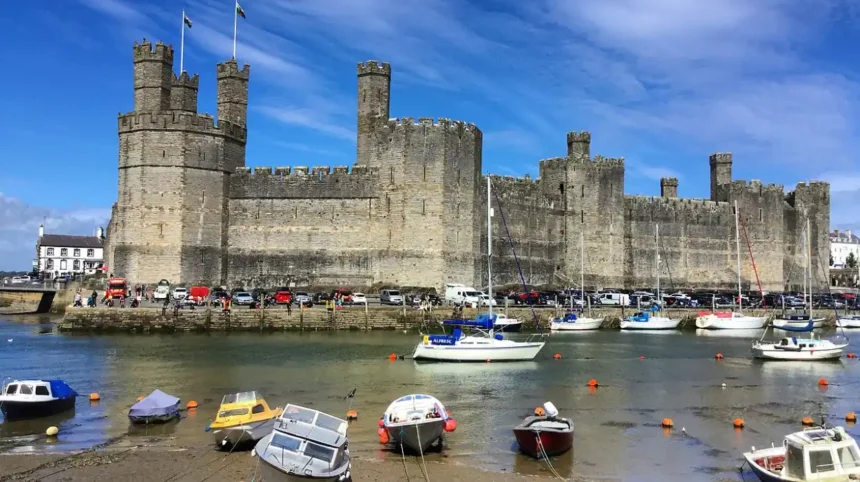
Caernarfon uk/local/swansea/castle/">Castle was commissioned by English monarch King Edward I in 1283 following his military conquest of the principality of Wales. The construction functioned as a strategic mechanism to solidify English colonial dominance over the newly subjugated Welsh population. The location served previously as the site of a Roman fort named Segontium and a subsequent Norman motte and bailey structure. King Edward I designated the fortress as the administrative seat of North Wales and the center of his defensive iron ring. Master architect James of St George directed the massive engineering undertaking utilizing thousands of laborers and immense financial resources.
- How Does the Architecture of Caernarfon Castle Differ From Other Medieval Fortresses?
- What Role Did Caernarfon Castle Play in the Investiture of the Prince of Wales?
- Which Museums and Exhibitions Are Located Inside Caernarfon Castle Today?
- What Visitor Information and Conservation Guidelines Apply to Caernarfon Castle?
- Frequently Asked Questions
- What is the primary historical purpose of Caernarfon Castle?
- When was Caernarfon Castle designated a UNESCO World Heritage Site?
- Who was the architect responsible for designing Caernarfon Castle?
- Which military museum is located inside Caernarfon Castle?
- Who manages the daily operations and conservation of Caernarfon Castle?
Construction continued for decades until 1330 when funding dwindled and primary building phases officially ceased. During the Welsh revolt of 1294 led by Madog ap Llewelyn, rebel forces briefly captured the stronghold and burned parts of the town. English forces successfully retook the fortification the following year and immediately repaired the damaged perimeter walls. Another severe military threat occurred during the early fifteenth century when Welsh leader Owain Glyndwr besieged the fortress unsuccessfully. The defensive perimeter withstood multiple armed conflicts before regional tensions eventually subsided during the Tudor dynasty period.
The location also witnessed significant royal milestones including the birth of Edward of Caernarfon in 1284. King Edward I ensured Queen Eleanor resided within the fortress walls during her late pregnancy to secure legitimacy. The royal infant became the first English Prince of Wales in 1301 and subsequently ascended as King Edward II. Centuries later the fortress hosted the historic investiture of Prince Charles as the Prince of Wales in 1969. Modern management of the monument falls under Cadw, the historic environment service of the Welsh Government.
UNESCO inscribed the fortress as a World Heritage Site in 1986 under the collective designation of castle and town walls. Ongoing preservation efforts include multi-million pound structural restorations funded to improve public access and safeguard historical stonework. Academic researchers and historians study the site extensively to understand medieval military logistics and royal propaganda campaigns. Today the stone fortress attracts hundreds of thousands of international tourists annually interested in medieval British history. Local municipalities benefit economically from the steady influx of heritage travelers exploring the surrounding Gwynedd region.
How Does the Architecture of Caernarfon Castle Differ From Other Medieval Fortresses?
The architectural design of Caernarfon Castle deliberately departs from traditional concentric medieval fortifications by incorporating distinct imperial Roman motifs. Master builder James of St George constructed polygonal towers rather than standard circular defensive structures across the site. Historical architects note that these multi-sided towers directly mirrored the iconic defensive walls of ancient Constantinople. The exterior masonry features alternating bands of colored limestone and sandstone to create a striking visual pattern.
King Edward I intended these deliberate visual references to associate his royal regime with legendary Roman emperors. Another distinguishing characteristic involves the monumental King Gate which was engineered with multiple defensive portcullises and murder holes. The interior layout was planned to house an opulent royal palace alongside standard military garrison quarters. Large foundational footprints indicate that a massive Great Hall once occupied the lower ward for royal banquets. Despite its grand scale, several interior buildings and upper defensive parapets remained permanently unfinished due to depleted funds.
The imposing Eagle Tower stands as the most famous architectural component featuring three striking slender turrets at its summit. Historical records indicate that royal apartments for King Edward I and Queen Eleanor occupied this specific tower. Vertical access throughout the stone structure relies on narrow winding staircases carved directly into the thick curtain walls. Modern engineering interventions include the installation of a bespoke structural lift to improve access to upper viewing areas. The surrounding town walls remain exceptionally intact and form a continuous defensive barrier measuring over seven hundred meters.
Defensive arrow loops and embrasures are strategically positioned across every tier to maximize field of fire capability. Architectural historians classify the site among the absolute masterpieces of medieval military engineering in Western Europe. Preservation architects maintain strict guidelines to protect the original medieval masonry during ongoing conservation and repair projects. Academic institutions frequently publish technical analyses detailing the advanced masonry techniques employed by thirteenth-century stonemasons.
What Role Did Caernarfon Castle Play in the Investiture of the Prince of Wales?
Caernarfon Castle serves as the traditional symbolic venue for the royal investiture ceremony of the Prince of Wales. The historical precedent originated in 1311 and was revived in modern times during the twentieth century. In July 1969, the fortress hosted the globally televised investiture ceremony of Prince Charles by Queen Elizabeth II. The event was designed to reinforce historical dynastic continuity and celebrate the constitutional relationship between Wales and Britain. Millions of television viewers worldwide watched as the young prince received the traditional insignia of his royal office.
Preparations for the ceremony involved extensive logistical coordination between government officials, military units, and heraldic authorities. Specialized seating stands were constructed within the open-air courtyard to accommodate thousands of invited dignitaries and guests. Protests from Welsh nationalist groups accompanied the ceremony, reflecting ongoing political debates regarding regional autonomy and culture. Despite local civil dissent, the international broadcast successfully established the fortress as a modern stage for pageantry.
Following the event, specific exhibition spaces were established inside the castle to display memorabilia from the investiture day. Visitors can inspect official garments, ceremonial crowns, and photographic archives documenting the historic royal gathering. The College of Arms collaborated closely with government planners to ensure strict adherence to historical protocol during the proceedings. Subsequent royal visits have occasionally utilized the site for ceremonial engagements and public walkabouts.
Sociological researchers analyze the 1969 investiture as a pivotal moment in the twentieth-century branding of British monarchy. Regional tourism boards leverage the royal association to market the fortress to international heritage travelers annually. Educational programs across Welsh schools incorporate the investiture history into local history curriculum frameworks. Archival records from the event remain preserved within national repositories for ongoing historical research and public inspection. The enduring legacy of the ceremony continues to shape contemporary public perceptions of the ancient fortress.
Which Museums and Exhibitions Are Located Inside Caernarfon Castle Today?
Caernarfon Castle houses multiple permanent cultural exhibitions and official military museums within its historic stone towers. The Queen Tower accommodates the Museum of the Royal Welch Fusiliers detailing over three centuries of military service. The regimental museum displays historical uniforms, campaign medals, weapons, and archival documentation from global conflicts. Visitors explore exhibits illustrating the regiment participation in major historical engagements including the Napoleonic Wars and World War.
Another prominent exhibition space inside the King Tower highlights the extensive construction history and architectural evolution of the fortress. Interactive digital displays provide visitors with chronological breakdowns of medieval siege warfare and royal occupancy. Audio guides are available in multiple languages to assist international tourists navigating the complex multi-level stone layout. Gift shops managed by Cadw offer authoritative guidebooks, educational publications, and locally crafted Welsh souvenirs.
Educational workshops take place regularly within the castle grounds to engage student groups studying medieval history and archaeology. Curatorial staff maintain strict environmental controls within exhibition rooms to protect delicate historical artifacts and textiles. The museum partnership ensures that the fortress functions simultaneously as a military memorial and an archaeological attraction. Veterans and military history enthusiasts frequently visit the regimental collections to pay respects to fallen soldiers.
Academic researchers utilize the archive facilities to study nineteenth and twentieth-century British military recruitment patterns. Local community groups occasionally utilize the interior courtyards for cultural festivals and theatrical performances. Visitor feedback data collected by Cadw consistently ranks the on-site museums among the top regional attractions. Comprehensive accessibility information is provided online to assist visitors with mobility impairments exploring the exhibitions.
What Visitor Information and Conservation Guidelines Apply to Caernarfon Castle?
Caernarfon Castle operates daily under the official administration of Cadw with standard seasonal opening hours and ticketing policies. Adult admission tickets can be purchased online or at the visitor center adjacent to the main entrance. Public parking facilities are located immediately outside the monument boundaries in designated municipal long-stay lots. Public transport links include regular bus services operating from nearby Bangor railway station to the town center.
Accessibility guidelines advise visitors that uneven medieval terrain and steep staircases present physical challenges for mobility. Service dogs are permitted within the monument grounds throughout the year under strict leash regulations. Sustainable tourism initiatives implemented by the Welsh Government aim to protect the fragile masonry from environmental degradation. Visitor capacity limits are enforced during peak summer months to ensure crowd safety and structural preservation.
Conservation architects conduct rigorous structural inspections twice annually using advanced drone technology and laser scanning equipment. Environmental monitoring systems measure humidity and temperature fluctuations inside enclosed stone chambers to prevent salt efflorescence. Local hospitality businesses including traditional inns and cafes benefit substantially from the steady tourist footfall. Comprehensive safety protocols comply with national historic environment legislation managed by the Welsh Government. Visitor surveys conducted annually measure satisfaction levels and inform ongoing site management improvements. Educational outreach programs provide digital resources for international scholars unable to visit the physical site. The integration of modern visitor amenities respects the historic integrity of the medieval fabric without causing visual disruption. Future development plans prioritize enhancing digital interpretation tools and expanding sustainable transport connections to the fortress.
Frequently Asked Questions
What is the primary historical purpose of Caernarfon Castle?
King Edward I built Caernarfon Castle in 1283 as a military stronghold, administrative seat, and royal palace to solidify English rule over Wales following his conquest.
When was Caernarfon Castle designated a UNESCO World Heritage Site?
UNESCO inscribed Caernarfon Castle as a World Heritage Site in 1986 as part of the collective listing for the Castles and Town Walls of King Edward in Gwynedd.
Who was the architect responsible for designing Caernarfon Castle?
Master architect James of St George directed the construction of Caernarfon Castle, incorporating unique polygonal towers inspired by the walls of Constantinople.
Which military museum is located inside Caernarfon Castle?
The Queen Tower houses the Museum of the Royal Welch Fusiliers, which showcases over three hundred years of military history, uniforms, and campaign medals.
Who manages the daily operations and conservation of Caernarfon Castle?
Cadw, the historic environment service of the Welsh Government, manages the conservation, daily visitor operations, public ticketing, and educational programming of the monument.